MTD Under Review: Landlords Face £350 Bill as Net Widens
The Treasury has confirmed that HMRC will evaluate the impact of Making Tax Digital for Income Tax as it is rolled out, after a Liberal Democrat MP pressed ministers on the extra software and accountancy bills facing landlords and sole traders.
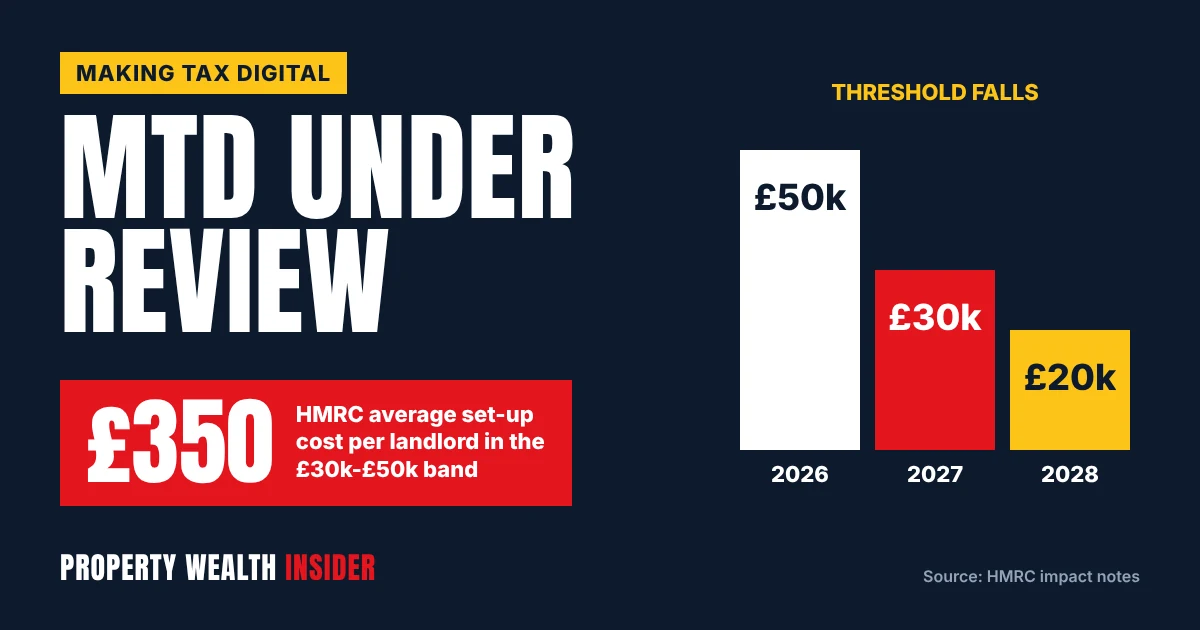
The promise lands just as the net is about to widen sharply. Landlords with more than £50,000 of gross income have been in since April 2026. Those over £30,000 join in April 2027, and those over £20,000 in April 2028. HMRC’s own figures put the first-year cost of switching at hundreds of pounds per person, plus an ongoing annual bill.
If you let property, here is exactly what the government said, what it says MTD will cost you, which April you must start, and what to do before your first deadline.
Key facts
- Treasury minister James Murray said on 14 October 2026 that HMRC will evaluate the impacts of MTD for Income Tax as it is rolled out.
- The threshold falls from £50,000 (April 2026) to £30,000 (April 2027) and £20,000 (April 2028), measured on gross income, not profit.
- HMRC estimates an average one-off cost of £350 and £110 a year for people in the £30,000 to £50,000 band, and £285 plus £115 a year above £50,000.
- Around 970,000 people are expected to join in April 2027, and a further 970,000 when the £20,000 threshold arrives in April 2028.
- The next quarterly update deadline for those already in is 7 November 2026. There are no penalty points for late quarterly updates in 2026 to 2027.
What the government actually said
Monica Harding, Liberal Democrat MP for Esher and Walton, tabled a written question on 14 September 2026. She asked what assessment HMRC had made of the extra software and accountancy costs for sole traders and landlords who have to run separate systems for MTD for Income Tax and for VAT.
Treasury minister James Murray replied on 14 October 2026. He pointed to HMRC’s published tax information and impact note, which sets out estimated costs for businesses with income above £30,000, and confirmed that “HMRC will evaluate the impacts of MTD for Income Tax as it is rolled out”. He restated the April 2027 and April 2028 start dates.
Note what the answer did not do. It gave no new cost figures, no date for the evaluation, and nothing on the specific VAT double-software problem the MP raised. There is no change to the rules. Everything below is the law as it stands today.
What “evaluate” means here: HMRC’s impact note for the £20,000 threshold says it will monitor the policy through independent social research before and after introduction, plus Self Assessment data on take-up, extra tax collected and error reduction. That is a review of how MTD is working, not a pause or a rethink of the timetable.
Who is in scope, and when
MTD for Income Tax applies to individuals registered for Self Assessment who have self-employment or property income. It is an HMRC income tax rule, so it covers landlords across the UK, not just England. Limited companies and partnerships are not in it. HMRC says partnerships do not need to use it yet.
The test is your qualifying income: gross rents plus gross self-employment turnover, before expenses. Wages, pensions, dividends and your share of partnership profits do not count. If you own a property jointly, only your share of the rent counts.
Crucially, each start date looks back at an earlier tax year:
| You must start | If qualifying income is over | Measured on tax year | Est. people joining |
|---|---|---|---|
| 6 April 2026 | £50,000 | 2024 to 2025 | 780,000 |
| 6 April 2027 | £30,000 | 2025 to 2026 | 970,000 |
| 6 April 2028 | £20,000 | 2026 to 2027 | 970,000 |
The look-back is what catches people out. Your 2025 to 2026 return, due by 31 January 2027, decides whether you are in from April 2027. And the tax year you are living through right now, 2026 to 2027, decides April 2028.
Worked example, joint owners: a couple own a portfolio 50/50 that brings in £56,000 a year in rent. Each has £28,000 of qualifying income. Neither is in for 2026 or 2027, but both are above £20,000, so both must start in April 2028 if 2026 to 2027 rents stay at that level. That is two sign-ups and two sets of costs.
Worked example, mixed income: a landlord with £18,000 of rent and a £15,000 side business has £33,000 of qualifying income. Neither source alone would trigger MTD, but together they clear £30,000, so the start date is April 2027 and both businesses need quarterly updates.
What HMRC says MTD will cost you
These are the government’s own estimates from its impact notes. They cover things like buying software, learning it and any extra accountancy help. Many landlords will find their real bills are higher, especially if an accountant handles quarterly filing for them.
| Income band | Start | Avg one-off cost | Avg extra cost a year | Total one-off cost (all) |
|---|---|---|---|---|
| Over £50,000 | April 2026 | £285 | £115 | £223m |
| £30,000 to £50,000 | April 2027 | £350 | £110 | £338m |
| £20,000 to £30,000 | April 2028 | about £390* | about £104* | £380m |
*HMRC does not publish a per-person average for the £20,000 band. PWI has divided its totals (£380m one-off, £101m a year net) by the 970,000 people it expects to be affected.
Worked example: a sole landlord with £38,000 of gross rent in 2025 to 2026 starts in April 2027. On HMRC’s averages that is £350 to get set up plus £110 a year. Over the first three years, that adds up to £350 + (3 × £110) = £680.
For context, HMRC’s impact note says the Self Assessment tax gap for these businesses is around 18.5%, and it expects the original MTD rollout to bring in an extra £780m in 2028 to 2029. That is the trade-off the evaluation will be testing.
Checker: are you in MTD, and when?
Enter your gross figures for a typical year. The checker works out your qualifying income, your start date, your next deadline and HMRC’s estimated cost for your band.
Are you in MTD, and when?
Guide only, not tax advice. Assumes your income is similar in each tax year. HMRC decides your start date from the Self Assessment return for the relevant year (2024 to 2025 for April 2026, 2025 to 2026 for April 2027, 2026 to 2027 for April 2028) and will write to confirm. Costs are HMRC’s averages; the £20,000 band figure is PWI’s division of HMRC totals.
Deadlines and penalties
Once you are in, you keep digital records and send a quarterly update every three months for each self-employment and property business. Each update is cumulative from 6 April, and errors can be corrected in the next one. The tax return and any tax owed are still due by 31 January after the tax year ends.
| Update covers | Deadline | For 2026 to 2027 |
|---|---|---|
| 6 April to 5 July | 7 August | 7 August 2026 (passed) |
| 6 April to 5 October | 7 November | 7 November 2026 |
| 6 April to 5 January | 7 February | 7 February 2027 |
| 6 April to 5 April | 7 May | 7 May 2027 |
| Tax return and payment | 31 January | 31 January 2028 |
You can choose calendar quarters instead (1 April to 30 June and so on), with the same deadlines, but only if you select that in your software before your first update.
Late submission: each missed deadline earns one point. At four points you get a £200 penalty, then another £200 for every further miss. HMRC has confirmed there are no penalties for missed quarterly updates in 2026 to 2027, but the points system bites from 2027 to 2028.
Late payment: for 2027 to 2028 there is no penalty within 15 days, then 4% of the tax unpaid at day 15, another 4% of the tax unpaid at day 30, and 10% a year on the balance from day 31. In your first year under the new rules, nothing is charged for the first 30 days. On a £6,000 bill paid 31 days late after your first year, that is £240 + £240 = £480, before the 10% yearly rate and late payment interest.
Who is exempt
Some people are exempt automatically, including anyone with qualifying income of £20,000 or less, people without a National Insurance number, trusts, and personal representatives of someone who has died. Others must apply.
The main one landlords ask about is digital exclusion: where age, health, disability, religious beliefs or lack of internet access at your location make software impractical. HMRC says it will refuse applications based only on preferring paper, being unfamiliar with software, or the extra time or cost. A temporary exemption to at least April 2027 also covers people claiming qualifying care relief or filing the trusts/estates (SA107) or residence (SA109) pages.
What to do now
- Add up your gross income from rent (your share only) and any self-employment for 2025 to 2026. Over £30,000 means April 2027.
- Project 2026 to 2027. If you are between £20,000 and £30,000, you are on course for April 2028.
- If you are already in, get your update to 5 October in by 7 November 2026. No points this year, but build the habit now.
- Price it up. Ask your accountant for a fixed quarterly fee and compare with doing it yourself; HMRC’s estimates are only averages.
- Check for an exemption before you spend money, especially if age, health or connectivity are an issue.
- Tell HMRC about the burden. Ministers have committed to evaluating the impact, so evidence of real costs from landlords, via your MP or professional bodies, matters.
- Gross rent (my share) plus self-employment turnover worked out for 2025 to 2026
- Estimate for 2026 to 2027 done
- Start date noted: April 2026 / 2027 / 2028 / not yet
- Exemption checked
- Software or accountant chosen and priced
- Calendar or standard quarters decided before the first update
- Deadlines in diary: 7 Aug, 7 Nov, 7 Feb, 7 May, 31 Jan
- Joint owners: each owner’s share and sign-up confirmed
FAQs
Is Making Tax Digital being scrapped or delayed?
No. The Treasury’s 14 October 2026 answer confirmed an evaluation of its impact, but restated the April 2027 and April 2028 start dates. Nothing has changed in the rules.
Is the MTD threshold based on rental profit or gross rent?
Gross. It is your rent and self-employment turnover before expenses. A landlord with £35,000 of rent and £20,000 of costs still has £35,000 of qualifying income.
How does MTD work for jointly owned property?
Only your share of the rent counts towards your threshold. Each owner who is over the threshold must use MTD separately. For jointly let property you can send income only in quarterly updates and add expenses at the end of the year.
How much will Making Tax Digital cost a landlord?
HMRC estimates an average one-off cost of £350 and £110 a year for the £30,000 to £50,000 band, and £285 plus £115 a year above £50,000. Your own costs depend on your software and how much your accountant charges.
When is the next MTD quarterly deadline?
7 November 2026, for the period 6 April to 5 October 2026. The next ones are 7 February 2027 and 7 May 2027.
- UK Parliament: written question 29778 and answer, 14 October 2026
- HMRC: MTD for Income Tax for sole traders and landlords, tax information and impact note
- HMRC: reducing the threshold from £30,000 to £20,000, tax information and impact note
- GOV.UK: Find out if and when you need to use MTD for Income Tax
- GOV.UK: Work out your qualifying income
- GOV.UK: Send quarterly updates
- GOV.UK: Penalties for MTD for Income Tax
- GOV.UK: Find out if you can get an exemption
This article is news and general guidance, not financial, legal or tax advice.