Landlords face £30,000 EPC fines as new energy Bill hits Commons
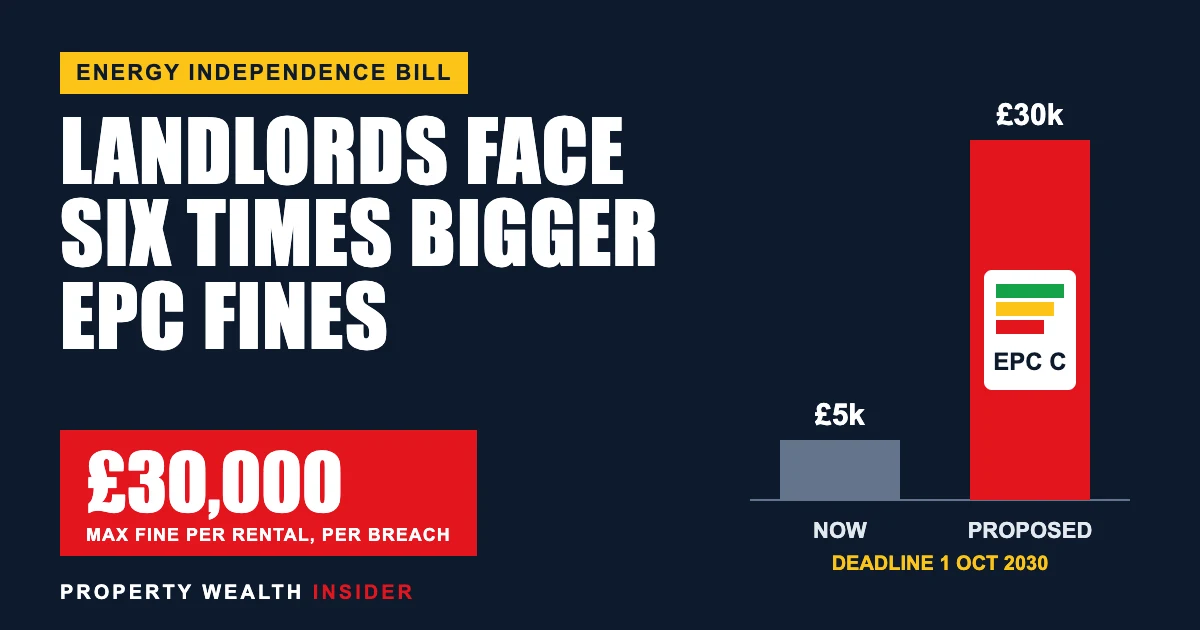
Landlords who let cold, leaky homes are about to face fines six times bigger than today. The government’s Energy Independence Bill, introduced to Parliament on Wednesday 4 November 2026, would raise the maximum civil penalty for breaking the domestic private rented energy efficiency rules from £5,000 to £30,000 per property, per breach.
The new fine sits alongside a deadline already set in January: from 1 October 2030, every privately rented home in England and Wales must meet EPC band C, on new-style EPCs, or have a valid exemption registered. That covers all tenancies, not just new ones. The government is deliberately pitching the penalty well above the new £10,000 spending cap, so ignoring the rules costs more than complying with them.
Here is what is law today and what is only proposed. You will also find the cost cap, the new exemptions, worked £ examples and a calculator to estimate your own spend and fine exposure.
Key facts
- The Energy Independence Bill would raise the maximum MEES fine to £30,000 per property, per breach. Today’s cap is £5,000.
- From 1 October 2030, all private rented homes in England and Wales must reach EPC C on new EPC metrics or have an exemption registered.
- Landlords will have to spend up to £10,000 per property (today: £3,500). Qualifying spend from 1 October 2025 counts towards it.
- Homes rated C or above on the current EPC rating before 1 October 2029 stay compliant until that EPC expires or is replaced.
- The minimum is still EPC E until 2030. The Bill is at an early stage and its fine is not yet law.
What’s in force now vs what’s proposed
The rules live in the Energy Efficiency (Private Rented Property) (England and Wales) Regulations 2015, known as MEES. Since 1 April 2020 you cannot let, or keep letting, a covered home rated F or G unless it has a registered exemption.
Today the fines come in layers. It is up to £2,000 if the breach has lasted under three months and £4,000 if three months or more. There is up to £1,000 for false information on the Exemptions Register and £2,000 for ignoring a compliance notice. The combined total is capped at £5,000 per property. Councils can also publish your details.
| Rule | In force now | Proposed | Status of proposal |
|---|---|---|---|
| Minimum EPC to let | E (F and G banned) | C on new EPC metrics | Confirmed 21 Jan 2026; needs new regulations |
| Compliance date | All tenancies since 1 Apr 2020 | All tenancies by 1 Oct 2030 | Regulations aimed to come into force in 2027 |
| Maximum spend required | £3,500 inc VAT | £10,000 per property over 10 years | Government response |
| Spend that counts | Since 1 Oct 2017 | From 1 Oct 2025 | Government response |
| Maximum fine | £5,000 per property | £30,000 per property, per breach | Energy Independence Bill, Commons, awaiting second reading |
| HMOs | Not always covered | Can be required to comply | Bill power |
| Short-term lets | Not in scope | Power to add them; no plans to use it yet | Bill power |
Where it applies: MEES covers England and Wales only, and the January 2026 decisions and the Bill’s factsheet are framed the same way. Scotland and Northern Ireland have their own regimes and are not covered by any of this.
The EPC C 2030 rules in detail
The Department for Energy Security and Net Zero (DESNZ) confirmed the policy in its government response of 21 January 2026. The headline points:
- One date for everyone. All private tenancies must comply by 1 October 2030. The earlier date for new tenancies proposed in the consultation was dropped.
- New EPC metrics. Homes must reach C on a new “fabric performance” metric first. They then need C on either a “heating system” metric or a “smart readiness” metric, and the landlord chooses which. You will not be forced to rip out a working boiler for a heat pump.
- Early action counts. A home rated C or above on today’s Energy Efficiency Rating before 1 October 2029 is treated as compliant until that EPC expires or is replaced.
- Two new EPCs for the rest. Homes below C will need a new-style EPC before the works and another one after.
- EPC E still applies until then. F and G homes remain unlettable without an exemption.
The new EPC methodology is still being finalised under the Home Energy Model, so the exact score that counts as C on the new metrics has not been confirmed yet. That will be set in secondary legislation.
The £10,000 cap and the new exemptions
You must spend up to £10,000 per property on relevant improvements. If the home is still below C after that, you can register a cost cap exemption that lasts 10 years and keep letting. The £10,000 is the most you can be required to spend in any 10-year period. The government’s impact assessment puts the average spend at £5,400.
Three details matter for your budget:
- Spend on recommended measures from 1 October 2025 counts towards the cap.
- Grants and other third-party funding count towards the cap. Boiler Upgrade Scheme money does not. With a £7,500 heat pump voucher, an £11,000 heat pump uses only £3,500 of your cap.
- The zero rate of VAT on energy saving materials such as insulation and heat pumps runs until March 2027.
| Exemption (proposed for 2030) | When it applies | Valid for |
|---|---|---|
| Cost cap | You have spent £10,000, or the next cheapest measure would take you over it | 10 years |
| Property value adjustment (affordability) | The cap falls to 10% of the home’s value if that is lower than £10,000 | 10 years |
| Negative impacts | Merges the devaluation and wall insulation exemptions; covers measures that would harm the property | 10 years |
| Solid wall insulation | You choose not to fit SWI and the home stays below the fabric standard | 5 years |
| High cost | Even the cheapest recommended measure would exceed the cap (inc VAT) | Typically 5 years |
| All relevant improvements made | Nothing more can be done and the home is still below standard | Typically 5 years |
| Third-party consent | A tenant, superior landlord or planning authority refuses consent | Typically 5 years |
| New landlord | You have recently become landlord of a tenanted property | 6 months |
Exemptions apply measure by measure. An exemption for one measure does not excuse you from fitting others within the cap. Every exemption has to be logged on the PRS Exemptions Register, which councils check alongside the EPC register.
Calculator: your upgrade bill and fine exposure
Enter your current EPC band and an estimate of the upgrade cost. The calculator applies the proposed 2030 cap, including the 10%-of-value affordability cap, and compares the worst-case fine today with the proposed £30,000.
EPC C upgrade cost and compliance calculator
Guide only, not advice. Based on today’s regulations and the government’s January 2026 policy. The £30,000 fine is in a Bill that is not yet law, and the 2030 rules still need regulations. Bands use today’s EPC ratings; new EPC metrics may score your home differently. Fines shown are maximums per property for one breach. Councils set the actual amount.
Worked examples in £
1. EPC D terrace, £950 a month. Loft insulation, cavity wall insulation and heating controls are quoted at £7,200 in total. That is under the £10,000 cap, so the full £7,200 is required. That works out at about 7.6 months’ rent. If £1,500 of it was spent in spring 2026, it already counts and £5,700 is left.
2. EPC E solid-wall house worth £180,000. Reaching C is estimated at £16,000. The cap is £10,000 (10% of value is £18,000, which is higher). You spend £10,000 on the most effective measures and register a cost cap exemption for 10 years. You could also choose not to fit solid wall insulation and record a five-year SWI exemption instead.
3. Low-value EPC F flat worth £70,000. The affordability exemption cuts the cap to £7,000, which is 10% of its value. But as an F, this flat is already unlettable today without works or an exemption. Today’s £3,500 cap and £5,000 maximum fine apply right now.
4. Five EPC D flats, landlord does nothing. The most they can be made to spend is £50,000 (5 x £10,000). If the Bill passes as drafted, the worst case is £150,000 in fines (5 x £30,000), and that is for a single breach on each flat.
Warm Homes Agency, standing charges and the rest of the Bill
The MEES changes are one part of a much wider Bill. According to the government’s announcement, the parts most relevant to landlords are:
- Warm Homes Agency. The Bill puts the Warm Homes Agency in law. It will run national energy efficiency schemes, take over Salix’s functions and act as a single source of advice on upgrades. It will be an executive agency of government, not an independent body.
- Gas standing charges. The government says it will later table amendments to support scrapping standing charges on household gas bills. It says about 60% of gas account holders would save an average of £45 a year. This is not in the Bill as introduced.
- Commercial lets. The Bill also gives councils stronger enforcement powers over the non-domestic private rented sector. The £30,000 figure applies to domestic lets.
- Enforcement data. Councils will have to report the enforcement action they take. Combined with the private rented sector database coming under the Renters’ Rights Act, non-compliant homes will be much easier to spot.
According to Parliament’s Bill page, the Bill started in the House of Commons and is awaiting second reading. It can still be amended.
What to do now: step by step
- Step 1: Check every EPC. Note each property’s band and expiry date. Any F or G let without an exemption is a breach today.
- Step 2: Think about timing for borderline Ds. If cheap measures would lift a home to C on today’s rating, getting a new EPC before 1 October 2029 could keep it compliant until that EPC expires.
- Step 3: Keep every invoice from 1 October 2025. Qualifying spend from that date counts towards the £10,000 cap.
- Step 4: Get quotes and check grants. Ask about the Boiler Upgrade Scheme and Warm Homes: Local Grants. The zero VAT rate on insulation and heat pumps runs until March 2027.
- Step 5: Plan tenant access. You will need a new-style EPC before works and another after. Book contractors early, because thousands of landlords will be chasing the same installers before 2030.
- Step 6: Register exemptions properly. Use the Exemptions Register and keep quotes and evidence. False information carries its own fine.
- EPC band and expiry date logged for every property
- No F or G homes let without a registered exemption
- Invoices for energy works since 1 October 2025 filed
- Upgrade quotes obtained, inc VAT
- Grant eligibility checked (Boiler Upgrade Scheme, Warm Homes: Local Grants)
- Property value checked against the 10% affordability cap
- Works pencilled in well before 1 October 2030
- Any exemptions registered, with evidence kept
FAQ
Is the £30,000 EPC fine for landlords law yet?
No. It is in the Energy Independence Bill, introduced on 4 November 2026 and still going through Parliament. Until it passes and takes effect, the maximum MEES fine is £5,000 per property.
Do landlords need EPC C by 2028 or 2030?
2030. The government chose a single deadline of 1 October 2030 for all tenancies. The earlier date for new tenancies proposed in the consultation was dropped.
How much will I have to spend to get my rental to EPC C?
Up to £10,000 per property, or 10% of its value if that is lower. Qualifying spend from 1 October 2025 counts towards it. If the home is still below C after you spend the cap, you can register a 10-year exemption.
My rental is already EPC C. Do I need to do anything?
If it is rated C or above on the current rating before 1 October 2029, it counts as compliant until that EPC expires or is replaced. After that you will need to meet the standard on the new metrics.
Does the EPC C rule apply in Scotland or Northern Ireland?
No. MEES and the 2030 EPC C policy cover England and Wales. Scotland and Northern Ireland set their own rules.
Will HMOs have to meet EPC C?
The Bill gives the government a power to require HMOs to comply with the MEES regulations. Details will follow in regulations.
- GOV.UK: Energy reforms to cut bills and put power back in people’s hands (4 November 2026)
- DESNZ: Energy Independence Bill factsheet, domestic PRS MEES enforcement
- DESNZ: Energy Independence Bill factsheet, Warm Homes Agency
- UK Parliament: Energy Independence Bill
- DESNZ: Improving the energy performance of privately rented homes, government response (21 January 2026)
- legislation.gov.uk: Energy Efficiency (Private Rented Property) (England and Wales) Regulations 2015, regulation 40
- GOV.UK: Domestic private rented property minimum energy efficiency standard, landlord guidance
- GOV.UK: Register a PRS energy standard exemption
This article is news and general guidance only. It is not financial, legal or tax advice.