73% of Landlords to Hike Rents: How to Do It Lawfully
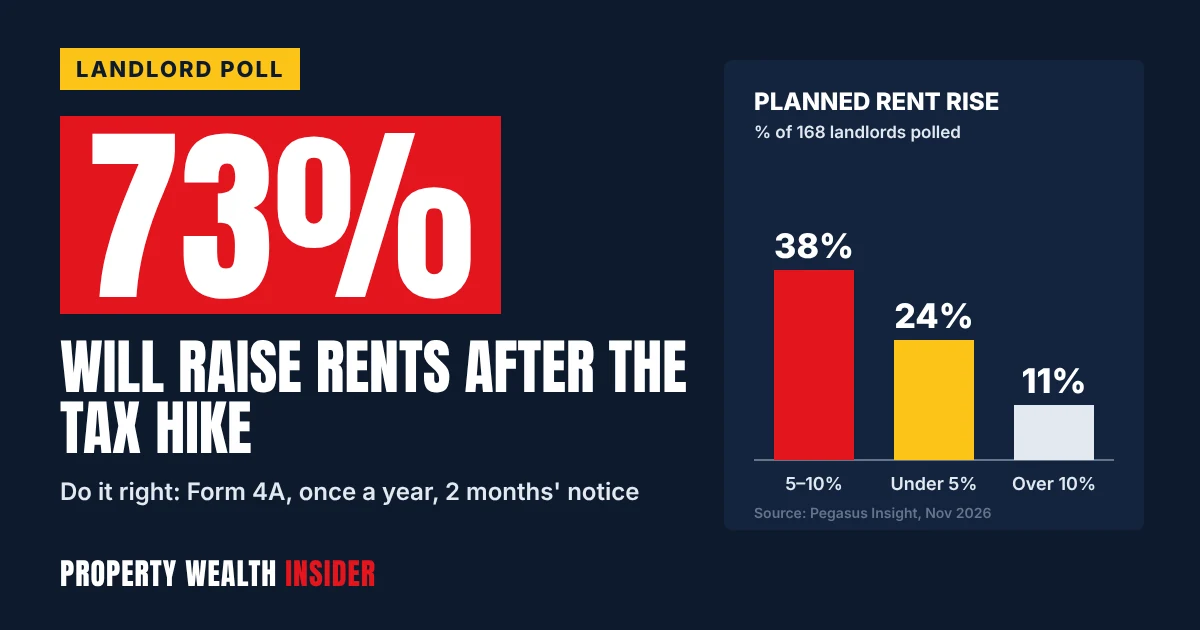
Almost three in four landlords say they will put the rent up at the first chance they get, after the Budget on 28 October 2026 added another two percentage points to the tax on rental income from April 2027. That is the headline from a snap poll of 168 National Residential Landlords Association (NRLA) members carried out by research firm Pegasus Insight and published this week.
For landlords in England there is a catch. Since 1 May 2026, the Renters’ Rights Act regime means there is only one lawful way to raise the rent on a private tenancy: a section 13 notice on Form 4A, no more than once a year, with at least two months’ notice. Get the dates wrong and the increase is invalid.
This guide covers what the poll found, how the tax change fits in, and exactly how to serve a rent increase that will stand up. Use our planner to work out the earliest date your new rent can start.
Key facts
- 73% of 168 NRLA landlords polled by Pegasus Insight expect to raise rents when they are next allowed to
- 38% picked a rise of 5% to 10% (or to market rent if higher); 11% more than 10%; 24% under 5%
- 52% plan to sell rental property within 12 months: 38% some, 14% their whole portfolio
- Property income tax rates for landlords who own in their own name will be 24%, 44% and 49% from 6 April 2027 (England, Wales and Northern Ireland)
- In England, rent can only go up once a year, using Form 4A, with at least 2 months’ notice
- A tribunal can set a rent lower than you proposed, but never higher
What the landlord poll found
Pegasus Insight asked NRLA members how they would react to rental income tax rates of 24%, 44% and 49% from April 2027, the combined effect of last year’s Budget and this one. The poll was taken just after the Budget.
Most respondents (73%) said they expect to raise rents when they are next permitted to. The single biggest group, 38% of all respondents, chose a rise of 5% to 10% or to market rent, whichever is higher.
The poll also asked about selling and spending. These are the full verified results:
| Question | Answer | Share |
|---|---|---|
| Rent plans when next permitted | Rise of 5% to 10% (or to market rent) | 38% |
| Rise of under 5% (or to market rent) | 24% | |
| Rise of more than 10% (or to market rent) | 11% | |
| Portfolio plans, next 12 months | Sell some properties | 38% |
| Sell entire portfolio | 14% | |
| Buy more | 2% | |
| No change | 26% | |
| Too early to say | 20% | |
| Maintenance and improvement spending | Expect to cut (13% significantly) | 29% |
| No change | 55% |
Treat these numbers with care. It is a small snap poll of one landlord body’s members, recording gut reactions rather than decisions. Pegasus Insight director Mark Long said himself: “These are immediate reactions, and intentions to raise rents or sell will not all become reality.”
The tax change behind it
The November 2025 Budget had already set separate property income tax rates of 22%, 42% and 47% from 6 April 2027. The Treasury’s Budget 2026 announcement says rates on savings and property income “will rise by a further two percentage points across all bands” from April 2027.
HMRC’s policy paper, published on 29 October 2026, confirms property income rates of 24% basic, 44% higher and 49% additional from 6 April 2027. It affects individuals and partnerships letting property, plus trustees and personal representatives. Companies are not among those listed as affected.
The new property rates apply to individuals in England, Wales and Northern Ireland. Scotland and Wales can set their own property income rates under their fiscal frameworks, so landlords there should watch for decisions from Holyrood and the Senedd. This is announced policy, not yet in force: it starts with the 2027-28 tax year. We covered how much rent it takes to cover the extra tax in our 5 November piece, so here we focus on the mechanics of putting the rent up.
The rent increase rules in England now
The Renters’ Rights Act changes came into effect on 1 May 2026 and apply in England. Private tenancies are now periodic, and rent rises run through section 13 of the Housing Act 1988, as amended. Here is what the law and government guidance say.
| Rule | What it means for you |
|---|---|
| Form 4A only | Use Form 4A, “Landlord’s notice proposing a new rent”. You must use it every time, even if your tenant has already agreed the rise. Do not change its wording. |
| At least 2 months’ notice | The new rent can start no earlier than two months after the notice is served. |
| Once a year | No rise in the first year of the tenancy (the Act says 52 weeks from the first period), and none until a year after the last increase took effect. |
| Start of a rental period | The new rent must begin at the start of a new period of the tenancy, which for most monthly lets is the rent due date. |
| Rent review clauses void | Any clause allowing rent to rise other than by section 13 notice or tribunal decision has no effect. A clause-based rise agreed before 1 May 2026 that starts after that date will not apply. |
| Tenant can challenge | The tenant can ask the First-tier Tribunal to decide the rent, if they apply before the new rent starts. |
| Serving the notice | In person, by post, or by email if the tenancy agreement allows email. |
Old-style Form 4 notices served before 1 May 2026 still take effect on the date and at the rent they stated. Either way, the clock for your next rise runs from when that increase took effect. Government guidance gives the example of an increase from 1 February 2026: the next one cannot start before 1 February 2027.
When can your new rent start? Planner and examples
Your new rent can start on the latest of three dates: two months after you serve the notice, one year after the last increase (or tenancy start), and the next rent due date after those. Enter your figures below.
Section 13 rent rise planner (England)
Guide only, not legal advice. Assumes a monthly tenancy where rent falls due on the same day of the month as the date you enter (last day of the month if that day does not exist). The Act says 52 weeks; we use the full one-year anniversary, matching government guidance, which is the safer reading. In rare cases involving several earlier increases the law can require 53 weeks. “Served” means the date the tenant receives the notice, so allow extra days for post. Weekly or other tenancies follow different period dates.
Example 1: you are ready now. Your tenant pays £1,200 on the 1st of each month and the last rise took effect on 1 February 2026. You serve Form 4A on 12 November 2026 proposing £1,272, a 6% rise. Two months’ notice takes you to 12 January 2027, but the one-year rule means the earliest start is 1 February 2027. That brings in an extra £72 a month, or £864 a year.
Example 2: you left it late. Same tenancy, but you serve on 15 December 2026. Two months takes you to 15 February 2027, so the rise cannot start until the next rent day, 1 March 2027. Missing February costs you that month’s £72 uplift. To start on the anniversary you needed to serve by 1 December 2026.
Example 3: the poll’s most common answer. On a £1,200 rent, a 5% to 10% rise means a new rent of £1,260 to £1,320, or £720 to £1,440 more a year. If comparable homes nearby let for £1,280, the top of that range is above market and open to challenge.
If your tenant challenges the rise
A tenant who thinks your proposed rent is above the open market rent can apply to the First-tier Tribunal. Under section 13(4) they must apply before the new rent is due to start. Open market rent means what you would expect to get by reletting the property on the open market.
Under new section 14ZB of the Housing Act 1988, in force since 1 May 2026, the tribunal’s figure becomes the rent only if it is lower than you proposed. Otherwise your proposed rent stands. It cannot award you more than you asked for.
Timing matters too. If the tribunal decides after your proposed start date, the new rent runs from the first rental period on or after the decision, not backdated. If paying from that date would cause the tenant undue hardship, the tribunal can delay it, but by no more than two months from the decision.
Why this matters: an over-ambitious rise can backfire. If your tenant challenges, you may wait months for a decision with no backdating, and end up with a lower rent than a sensible figure would have got you on time. Price close to the real market and keep the evidence.
New tenants also have a separate right to challenge the starting rent within the first six months of the tenancy, under section 14(A1).
What to do now: step by step
- Find your anchor date. Check when the last rise took effect, or when the tenancy started if there has been none.
- Check the market. Collect three to five comparable lets nearby (same size, condition, area) and save screenshots with dates.
- Talk to your tenant. Government guidance tells you to discuss the rise first. A tenant who understands it is less likely to challenge.
- Complete Form 4A. Download the current version from GOV.UK, fill in every part and do not alter the wording.
- Pick the start date. It must be a rent due date, at least two months after service and at least a year after the last increase.
- Serve it properly. By hand, post or email (only if the tenancy agreement allows email). Keep proof of service.
- Diarise the next one. Note the anniversary and the date two months before it.
- Anchor date confirmed (last rise or tenancy start)
- Comparable rents saved as evidence
- Proposed rent at or below market
- Current Form 4A used, wording unchanged
- Start date is a rent due date
- At least 2 months between service and start date
- At least a year since the last increase took effect
- Email service allowed by the tenancy agreement (if used)
- Proof of service kept
- No reliance on a rent review clause
Wales and Scotland are different
The section 13 process above applies to England. In Wales, under the Renting Homes (Wales) Act 2016, the Welsh Government says landlords must give two months’ notice of a rent variation, which may be issued annually.
In Scotland, private residential tenancy rents can rise once in a 12-month period with at least three months’ written notice on the correct form. Tenants have 21 days to refer the increase to a rent officer, who can set a figure higher or lower than proposed.
On tax, Scotland is outside the new property income rates for now, and both Holyrood and the Senedd have powers to set their own property rates.
FAQs
How much notice do I need to give to increase rent in England?
At least two months, using Form 4A. The new rent must also start at the beginning of a rental period and at least a year after the last increase.
Can I put the rent up if my tenant agrees?
Yes, but you still have to serve Form 4A. Government guidance says the section 13 process must be followed every time, even when the tenant has already agreed.
Is my rent review clause still valid?
No. Since 1 May 2026, any term that lets rent rise other than by a section 13 notice or tribunal decision has no effect in England.
Can the tribunal increase the rent above what I asked for?
No. The tribunal decides the open market rent. Your tenant pays that figure only if it is lower than your proposal; otherwise your proposed rent applies.
What are the landlord income tax rates from April 2027?
For property income of individuals in England, Wales and Northern Ireland: 24% basic, 44% higher and 49% additional rate, from 6 April 2027.
- HMRC: Income Tax changes to tax rates for property and savings income (29 October 2026)
- HM Treasury: Budget 2026 press release
- HMRC: changes to tax rates for property, savings and dividend income (27 November 2025)
- GOV.UK: Renting out your property, rent increases
- GOV.UK: Assured periodic tenancies, a guide for landlords: rent increases
- GOV.UK: Renters’ Rights Act, an overview for landlords
- GOV.UK: Assured tenancy forms from 1 May 2026 (Form 4A)
- Housing Act 1988, section 13
- Housing Act 1988, section 14ZB
- Housing Act 1988, section 14
- Welsh Government: Renting homes FAQs for landlords
- mygov.scot: Increasing the rent for a private residential tenancy
- The Negotiator: Pegasus Insight poll report (11 November 2026)
- The Intermediary: Pegasus Insight poll report (10 November 2026)
This article is news and general guidance only. It is not financial, legal or tax advice.