Holiday lets face up to 5% tourist tax as levy bill advances
Holiday let and serviced accommodation hosts in England are a step closer to charging a tourist tax on every booking. The Visitor Levy (England) Bill, introduced in the House of Commons on 4 November 2026, would let mayors and other strategic authorities add a percentage levy to the cost of overnight stays in their area.
The tax is not law yet and no English area can charge it today. But the design is now largely settled: a percentage of the room price, collected and paid by the accommodation provider, with Airbnb-style short-term lets firmly in scope. Ten mayors have pledged that any levy in their areas will be no higher than 5%.
If you run serviced accommodation in a mayoral area, this will land on your pricing, your booking software and your bookkeeping. Here is what is confirmed, what is still open and what it could cost you.
Key facts
- The Visitor Levy (England) Bill was introduced on 4 November 2026. It is a Bill, not law: no levy can be charged in England yet.
- The levy must be a percentage of the accommodation cost, not a flat fee. Meals and other extras are excluded.
- The Bill sets no national cap, but ten mayors have committed that any levy in their area will be no higher than 5%.
- It applies only to the first 28 consecutive days of a stay, and accommodation providers are liable to collect and pay it.
- Scotland is already charging: Edinburgh’s 5% levy (first 5 nights) has applied to stays since 24 July 2026. Wales charges £1.30 per person per night, with Cardiff first from 1 April 2027.
What the England visitor levy Bill does
The Bill gives strategic authorities in England the power to bring in a new local tax on stays in visitor accommodation. It follows a consultation run by the Ministry of Housing, Communities and Local Government (MHCLG) and HM Treasury from 26 November 2025 to 18 February 2026, with the government’s response published on 10 September 2026.
Housing Secretary Angela Rayner said on introduction: “Every pound raised through these levies will stay in the local area.” Parliament’s records list the Bill’s Commons second reading on 16 November 2026.
- Who can charge it: mayoral strategic authorities and foundation strategic authorities. In a foundation strategic authority, a levy needs unanimous support.
- How it is set: a single percentage of the accommodation cost across the whole authority area. Authorities will not be able to vary it by season, accommodation type or council area, or charge only part of their area.
- What is caught: all short-term, commercially let visitor accommodation, including hotels, B&Bs, self-catering and short-term lets.
- Length of stay: only the first 28 consecutive days are chargeable, because longer stays count as long-term accommodation.
- Who pays the council: the accommodation provider, through self-assessment. You can choose to pass the cost on to guests or absorb it.
- Exemptions: national exemptions for student accommodation, care homes, children’s homes and school boarding houses. Temporary accommodation, shelters and refuges are not charged. Authorities can add limited local exemptions, such as camping pitches.
- Occasional hosts: people who only let a spare room now and then will pay only if they earn above a set threshold, which local leaders can adjust. The amount has not been published.
Before charging, an authority must publish a draft plan and impact assessment setting out the rate, threshold, exemptions and spending plans, then consult local people and businesses. Authorities with a levy must publish an annual report on what they raise and spend.
Is there a 5% cap? Not in law. The government’s September 2026 response said it “does not intend to set a cap on the visitor levy rate”, though it would keep the case under review. The 5% figure is a commitment from ten mayors, not a legal maximum, and could change.
In force or proposed? England vs Scotland vs Wales
| Nation | Law | Status | How it is charged | Stay limit |
|---|---|---|---|---|
| England | Visitor Levy (England) Bill | Proposed: Bill before Parliament since 4 November 2026 | % of accommodation cost, set locally (10 mayors pledge max 5%) | First 28 consecutive days |
| Scotland | Visitor Levy (Scotland) Act 2024 (Royal Assent 5 July 2024) | In force: Edinburgh charging since 24 July 2026; four more councils have set start dates | % of accommodation cost, set by each council | Set locally (Edinburgh: first 5 nights) |
| Wales | Visitor Accommodation (Register and Levy) Etc. (Wales) Act 2025 (Act on 18 September 2025) | Law, not yet charging: Cardiff from 1 April 2027 | Flat £1.30 per person per night (75p in hostels and on tent pitches) | Long stays excluded |
In Scotland, a council must give at least 18 months’ notice between deciding to go ahead and the levy starting. That is why Edinburgh’s scheme, agreed in January 2025, applied to bookings made from 1 October 2025 for stays from 24 July 2026.
In Wales, under-18s are exempt when staying in hostels or on campsites, and VAT-registered providers charge VAT on the levy where they pass it on. Other Welsh councils, such as Gwynedd, are still consulting and need to give 12 months’ notice.
How the rates compare on a real booking
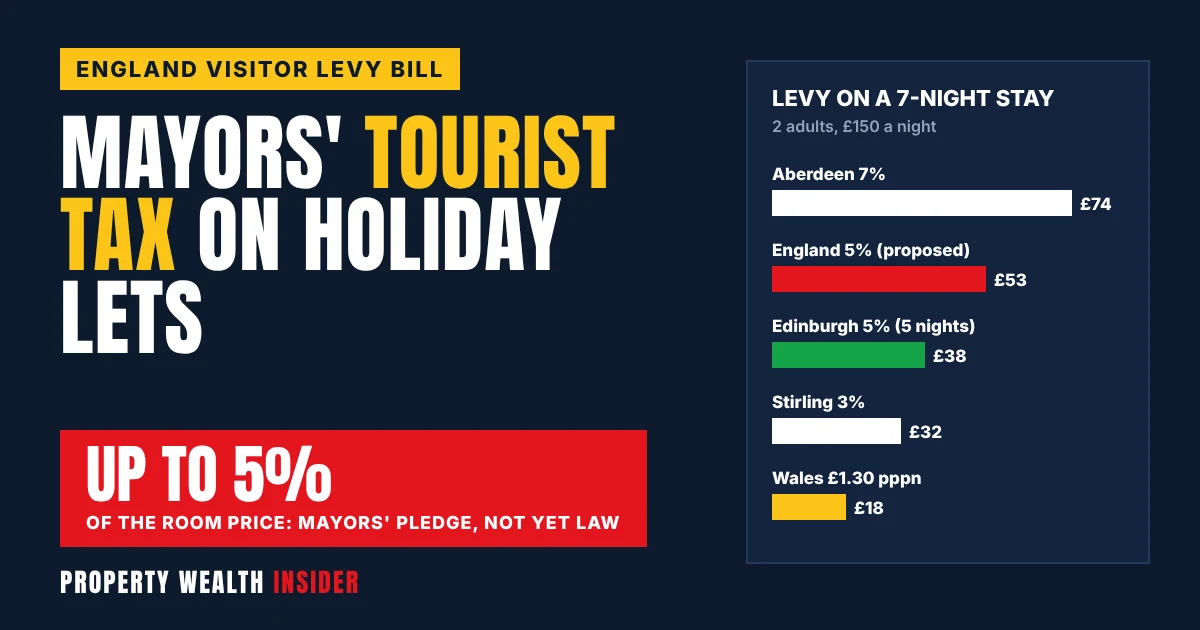
Headline percentages can mislead because of night caps. The chart applies each published rate to the same booking: two adults, seven nights, £150 a night (£1,050 of accommodation).
Two things stand out. Edinburgh’s five-night cap makes it cheaper than Glasgow for a week-long stay despite the same 5% rate. And England’s 28-day limit means a week-long stay would be taxed on every night.
The Welsh flat rate hurts cheaper, busier lets more than expensive ones. A £60-a-night room for two adults pays £2.60 a night in Wales (4.3%), against £3 a night at 5%.
What it could cost a holiday let host
Example 1: city-centre apartment, levy passed on. £150 a night, 200 occupied nights a year, average stay of four nights. That is 50 stays and £30,000 of accommodation income. At 5%, each guest pays £30 more per stay (£630 instead of £600), and you collect and pay over £1,500 a year.
Example 2: same flat, levy absorbed. If competition on Airbnb or Booking.com means you hold your £600 total price, your income falls by about £1,500 a year (a little less if you treat the £600 as levy-inclusive). On a 25% net margin, that is around a fifth of your profit gone.
Example 3: long contractor stay. A contractor books 35 nights at £90. Only the first 28 consecutive days would be chargeable under the England proposal: 28 x £90 x 5% = £126. In Edinburgh, the five-night cap would mean just £22.50.
Example 4: Cardiff family let from April 2027. Four guests for three nights at £1.30 is £15.60, whatever the room rate. Under-18s are only exempt in hostels and on campsites, so a family in a self-catering house pays for every person.
Still undecided in England: the point at which a stay becomes liable, how packages and third-party sales are apportioned, the occasional-host threshold, and whether booking platforms will collect the levy for you. The government says it is still working these out with the sector.
Visitor levy cost calculator
Enter your own figures. Use percentage mode for England or Scotland, or flat mode for Wales. Set the night cap to 28 for the England proposal, 5 for Edinburgh, or 0 for no cap.
Visitor levy cost calculator
Guide only, not tax advice. England’s levy is not yet law and rates will be set by each authority. Ignores VAT, exemptions and the occasional-host threshold.
What to do now: step by step
Nothing is payable in England yet, and any authority will have to consult before charging. Use that time.
- Check whether you are in a mayoral or foundation strategic authority area. Only these authorities get the power. Mayors in Greater Manchester, Liverpool City Region, London, York and North Yorkshire, West Yorkshire, the West Midlands, the East Midlands, the West of England, the North East and South Yorkshire all welcomed the Bill.
- Watch for your authority’s draft plan. Each must publish a draft plan and impact assessment with the proposed rate, threshold and exemptions before consulting. Respond to it, especially on the occasional-host threshold.
- Run your numbers. Use the calculator above at 5% and a higher rate, in case the mayors’ pledge does not hold.
- Split your pricing. The levy is on the accommodation element only. If you bundle cleaning, breakfast, parking or experiences, start showing them separately in your records now.
- Check your channel manager and booking platforms. Ask whether they can add a percentage levy line and report it per stay, as they already must for Edinburgh.
- Review forward bookings. In Scotland, Edinburgh’s levy caught advance bookings made from 1 October 2025. Make sure your booking terms for future stays let you add a tax introduced by law.
- Talk to your accountant about the VAT treatment and how levy receipts and payments will appear in your accounts.
- Confirmed whether my property is in a mayoral or foundation strategic authority area
- Signed up for my authority’s consultation updates
- Modelled the levy at 5% and a higher rate
- Separated room price from cleaning, meals and extras in my pricing
- Checked my channel manager can add and report a levy
- Updated booking terms to cover new taxes on future stays
- Checked Scotland or Wales rules if I have properties there
- Booked a VAT and bookkeeping check with my accountant
Visitor levy FAQ
Is there a tourist tax in England now?
No. The Visitor Levy (England) Bill was introduced on 4 November 2026 and must pass Parliament first. Authorities then have to consult before charging. The government has said it expects local leaders to be able to set out plans for spending the money by March 2028.
Will the England visitor levy be capped at 5%?
Not by law. The government chose not to set a national cap, though it said it would keep the case under review. Ten mayors have committed that any levy in their areas will be no higher than 5%.
Do Airbnb and holiday lets have to pay the visitor levy?
Yes, if the property is commercially let to visitors. All types of short-term visitor accommodation are in scope. The provider is liable, not the platform, although the government is looking at whether platforms could help collect it. Occasional hosts below a threshold will not pay.
How much is the Edinburgh tourist tax?
5% of the accommodation cost, before VAT, on the first five consecutive nights. It has applied to stays from 24 July 2026, except stays booked and paid for (in part or full) before 1 October 2025.
How much is the Wales visitor levy and when does it start?
£1.30 per person per night for most accommodation, or 75p in hostel dorms and on tent pitches. April 2027 is the earliest start anywhere in Wales, and Cardiff has introduced it for stays from 1 April 2027.
Can I absorb the visitor levy instead of charging guests?
Yes. In England, the provider is liable and can choose to pass on some, all or none of the cost. Either way you must account for and pay it, so absorbing it simply comes out of your income.
- MHCLG: New visitor levy powers to put money back into local communities (4 November 2026)
- UK Parliament: Visitor Levy (England) Bill
- MHCLG and HM Treasury: Visitor levy in England consultation and government response
- Visitor Levy in England: government response (PDF, September 2026)
- Visitor Levy (Scotland) Act 2024
- City of Edinburgh Council: About the Edinburgh Visitor Levy
- City of Edinburgh Council: Edinburgh Visitor Levy comes into effect (23 July 2026)
- VisitScotland: Visitor Levy in Scotland
- Welsh Government: A visitor levy for Wales
- Welsh Government: Visitor levy to support tourism becomes law
- Cyngor Gwynedd: Tourism levy and registration of visitor accommodation
This article is news and general guidance only, not financial, legal or tax advice.