£25 rent-chasing fees ‘likely unfair’, landlords warned
Charging your tenant £25 every time you chase late rent? The government now says that kind of clause is likely to be an unfair term, and it has put that warning in writing for every landlord and letting agent in England.
On 12 November 2026 the official gov.uk guide Fees you can charge as part of a tenancy was updated with new sections on damages for breach of contract and on cleaning charges. The message is blunt: you can recover losses you have actually suffered, with evidence, but fixed charges designed to punish or deter a tenant are generally not enforceable.
If your tenancy agreement (or your agent’s standard terms) contains admin fees for arrears letters, call-out charges or missed-appointment fees, now is the time to check them. Here is exactly what the rules allow, what the lawful late-rent fee really comes to in pounds, and a calculator to work it out.
Key facts
- Gov.uk guidance updated 12 November 2026: damages only for losses actually incurred, backed by evidence.
- Named as likely unfair: a £25 fixed charge for chasing arrears, a blanket £100 an hour contractor rate, a fixed £50 missed-appointment fee, and £25 + VAT letters / £75 + VAT visits.
- A late-rent fee is only allowed once rent is 14 days overdue, and is capped at interest of 3% above Bank Rate on the unpaid amount.
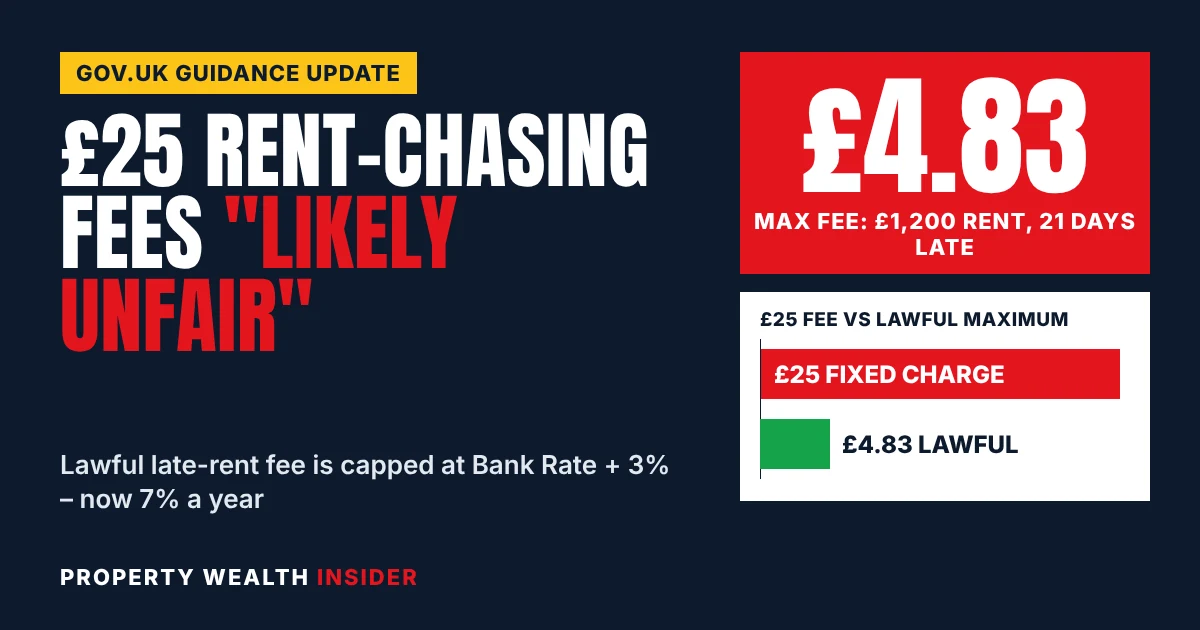
- With Bank Rate at 4% (since 5 November 2026), the cap is 7% a year: just £4.83 on £1,200 rent that is 21 days late.
- Requiring a banned payment risks a penalty of up to £5,000, or up to £30,000 or prosecution for a repeat within 5 years.
- The Tenant Fees Act 2019 applies in England only. Wales has its own law.
What changed on gov.uk
The guide was first published on 1 May 2026, when the Renters’ Rights Act reforms took effect. The 12 November update’s change note reads: “Added guidance on damages for breach of contract and requirements to pay for cleaning.”
The law itself has not changed. Damages for breach of a tenancy agreement have been a permitted payment under Schedule 1, paragraph 5 of the Tenant Fees Act 2019 since June 2019. What is new is official guidance on where the line sits, with real-world examples of clauses that cross it.
Three principles run through the new text:
- Actual loss only. You can only require damages to recover losses or costs you have actually incurred because of the breach.
- Evidence. Any claim must be backed by evidence of the loss or cost, and you should give that evidence to the tenant. The exceptions are the two default fees (late rent and lost keys) set out in the tenancy agreement.
- No penalties. Claims aimed at deterring a breach or punishing a tenant are generally not enforceable.
The guidance adds that in most cases damages should come from the deposit at the end of the tenancy. You can claim during the tenancy where that is appropriate. Its example is a broken window the tenant is responsible for, where the repair cannot reasonably wait.
The charges now flagged as likely unfair
Gov.uk lists four example clauses that are “likely to be considered unfair terms” because they impose fixed charges or penalties not linked to a genuine loss. Here they are, alongside the lawful way to recover the same money.
| Clause flagged as likely unfair | Why it fails | What you can do instead |
|---|---|---|
| £25 fixed charge for any letters, emails or phone calls chasing arrears 7 days or more overdue | Fixed charge, not a genuine loss, and triggered before the 14-day point | Charge the statutory late-rent fee (interest at up to 3% above Bank Rate) once rent is 14 days late, if the tenancy agreement allows it |
| A blanket £100 per hour for a contractor visit for repairs or maintenance | Set rate, not the actual cost | Where the tenant caused the damage, claim the contractor’s actual invoice as damages and give the tenant a copy |
| A fixed £50 charge for a missed contractor appointment | Fixed penalty | If the contractor actually charged you a call-out fee, claim that evidenced cost |
| £25 plus VAT for a letter about late rent; £75 plus VAT for a personal visit | Fixed charges for arrears admin | The late-rent default fee is the route for arrears; admin time is not a separate charge |
| Automatic end-of-tenancy cleaning fee | Gov.uk says any automatic requirement to pay for cleaning would likely be a prohibited payment | If the property is not returned in the condition it was let (allowing for fair wear and tear), claim evidenced cleaning costs from the deposit or as damages |
Note the difference between “unfair term” and “prohibited payment”. An unfair term is one a court or tribunal is unlikely to enforce. A prohibited payment, such as a routine cleaning fee, is banned outright under the Tenant Fees Act and can lead to a penalty.
The only late-rent fee you can charge
The Act allows exactly one charge for late rent: a default fee, which must be written into the tenancy agreement. Gov.uk says you should make the tenant aware of it before they sign. The rules are in Schedule 1, paragraph 4:
- The rent must not have been paid in full within the 14-day period starting on the due date. Gov.uk puts it as “overdue by at least 2 weeks”.
- The fee is capped at interest at 3% a year above the Bank of England base rate.
- It is worked out day by day, for each day after the due date, on the rent still unpaid at the end of that day. Once the 14-day point passes, the fee can therefore cover the whole period back to the day after the due date.
- Landlord and agent cannot both charge for the same default.
The Bank of England’s official Bank Rate rose from 3.75% to 4% on 5 November 2026, so the cap is now 7% a year. The formula is: unpaid rent × 7% × days late ÷ 365.
Worked example: £1,200 rent due on 1 December is still unpaid 21 days later. The maximum fee is £1,200 × 7% × 21 ÷ 365 = £4.83. At 14 days it would be £3.22; at 30 days, £6.90. A single £25 “chasing” letter is over five times the lawful maximum at three weeks.
Part-payments change the sum. Gov.uk says that if the amount owed changes, for example when the tenant pays some of it or the next rent falls due, you should recalculate on the new sum for the days it is outstanding, using any new base rate. Say the tenant pays £600 of that £1,200 on 11 December and the rest on 22 December. The rent was not paid in full within 14 days, so a fee is allowed: 9 days on £1,200 (£2.07) plus 11 days on £600 (£1.27), a maximum of £3.34.
Gov.uk also asks landlords to apply default fees case by case. It may not be appropriate to charge one if the tenant gave a reasonable explanation and notice, normally pays on time, or was hit by something outside their control, such as a banking outage or a delayed Housing Benefit or Universal Credit payment.
Late rent interest calculator
Enter the overdue rent and how many days late it is. The calculator tells you whether a late-payment fee is allowed yet and the most you can lawfully charge. It assumes the overdue amount and Bank Rate stay the same over the period.
Late rent interest calculator
Guide only, not legal advice. Uses simple daily interest on the unpaid amount for each day after the due date (Tenant Fees Act 2019, Sch. 1 para 4). The fee must be in the tenancy agreement. If part-payments are made or Bank Rate changes, recalculate for each period. England only.
What you can still charge tenants
Under the Tenant Fees Act, anything not on the permitted list is banned. According to gov.uk, these are the only payments you can require in connection with a tenancy in England:
| Permitted payment | The limit |
|---|---|
| Rent | Only once the tenancy agreement is signed. From 1 May 2026, no rent before signing, and a maximum of 1 month’s rent in advance between signing and the start date |
| Tenancy deposit | Up to 5 weeks’ rent if annual rent is below £50,000; up to 6 weeks’ if £50,000 to £100,000. Must be protected |
| Holding deposit | Up to 1 week’s rent per tenancy |
| Change to the tenancy at the tenant’s request | Up to £50, or more if you can show higher costs are reasonable |
| Ending early without correct notice | No more than the rent you would have received with correct notice |
| Utilities, communication services, council tax | No profit on resale; council tax and TV licence cannot be a separate payment to you |
| Late rent default fee | Rent 14+ days overdue; interest capped at 3% above Bank Rate |
| Lost key or security device | Reasonable cost, with written evidence given to the tenant |
| Damages for breach of contract | Actual losses only, supported by evidence |
Requiring a tenant to take out a loan, buy insurance or sign up to a service is also a prohibited payment, although a tenant can choose to use a deposit replacement product or a professional guarantor service. The Act does not cover social housing assured tenancies, shared ownership leases, holiday lets, excluded licences or lettings with annual rent above £100,000.
Use this quick checker to see where a charge stands.
Is this charge allowed?
Guide only, based on gov.uk guidance updated 12 November 2026. England only. A tribunal or court decides each case on its facts.
Penalties for getting it wrong
Local councils enforce the Act. Under section 8, a council can issue a financial penalty of up to £5,000 for requiring a prohibited payment.
A further breach within 5 years of a previous penalty or conviction is a criminal offence under section 12. The council can then impose a penalty of up to £30,000 or prosecute, where the fine is unlimited. The offence is also a banning order offence, which can stop you letting or managing property and put you on the rogue landlord database.
Separately, the tenant can apply to the First-tier Tribunal to have a prohibited payment returned. An unfair (but not prohibited) charge is more likely to come back to bite you at deposit-dispute or court stage, when the clause cannot be enforced.
Wales: the Tenant Fees Act does not apply. Welsh lettings are covered by the Renting Homes (Fees, Discrimination etc.) (Wales) Act 2019, which has its own list of permitted payments, so check that law if you let in Wales.
What to do now
- Pull out your tenancy template and your agent’s terms of business. Search for “£”, “admin”, “fee”, “charge”, “call-out” and “cleaning”.
- Strike out fixed charges for chasing letters, calls, visits, missed appointments and set contractor rates. Replace them with wording that the tenant is liable for reasonable, evidenced costs actually incurred because of their breach.
- Rewrite your late-rent clause so it charges interest at no more than 3% above Bank of England base rate, only once rent is 14 days late, on the amount unpaid.
- Remove any automatic cleaning fee. Rely on a good check-in inventory so you can evidence condition at the end.
- Keep receipts for everything: contractor invoices, locksmith bills, cleaning invoices. Send the tenant a copy with any claim.
- Talk to your agent. Landlord and agent cannot both charge for the same late payment, and the agent’s fee list must be published on its website and in its adverts.
- Refund anything you should not have taken before a tenant reports it. That is far cheaper than a £5,000 penalty.
- No fixed fee for arrears letters, emails, calls or visits
- Late-rent fee only after 14 days, at no more than Bank Rate + 3% (7% now)
- No blanket hourly contractor rate or missed-appointment fee
- No automatic or professional cleaning charge
- Key replacement charged at evidenced cost only
- Tenancy change fee no more than £50 unless higher cost is evidenced
- No rent taken before signing; no more than 1 month in advance
- Deposit no more than 5 weeks’ rent (6 weeks if rent is £50,000+ a year), and protected
- Agent and landlord not double-charging for the same default
FAQ
Can a landlord charge a late payment fee for rent?
Yes, in England, if the tenancy agreement includes it and the rent has not been paid in full within 14 days of the due date. The fee is capped at interest at 3% above Bank of England base rate on the unpaid rent, which is 7% a year with Bank Rate at 4%.
Does late rent interest start from the due date or after 14 days?
You cannot charge anything until the 14-day period has passed. Once it has, the Act calculates the maximum fee for each day after the due date that rent remains unpaid, so it can cover the days before the 14-day point as well.
Can a landlord charge for sending arrears letters?
Gov.uk says a fixed £25 charge for letters, emails or calls chasing arrears, or £25 plus VAT per letter and £75 plus VAT per visit, is likely to be an unfair term. The lawful route is the capped late-rent default fee.
Can I charge a tenant for a missed contractor appointment?
Not as a fixed fee: gov.uk gives a fixed £50 missed-appointment charge as an example of a likely unfair term. If you were actually billed for the wasted visit, you can claim that cost as damages with evidence.
Can landlords charge for professional cleaning at the end of a tenancy?
Not routinely. An automatic cleaning requirement would likely be a prohibited payment. If the property is not returned in the condition it was let, allowing for fair wear and tear, you can claim evidenced cleaning costs from the deposit or as damages.
What is the fine for charging a banned tenant fee?
Up to £5,000 for a first breach. A repeat within 5 years is a criminal offence, with a penalty of up to £30,000 or prosecution and an unlimited fine, and it can lead to a banning order.
Sources
- GOV.UK: Fees you can charge as part of a tenancy (updated 12 November 2026)
- Tenant Fees Act 2019, Schedule 1: permitted payments
- Tenant Fees Act 2019, section 8: financial penalties
- Tenant Fees Act 2019, section 12: offences
- Bank of England: Official Bank Rate history
- Renting Homes (Fees, Discrimination etc.) (Wales) Act 2019
This article is news and general guidance only. It is not financial, legal or tax advice.