Wales moves to limit no-fault evictions: 6-month rule explained
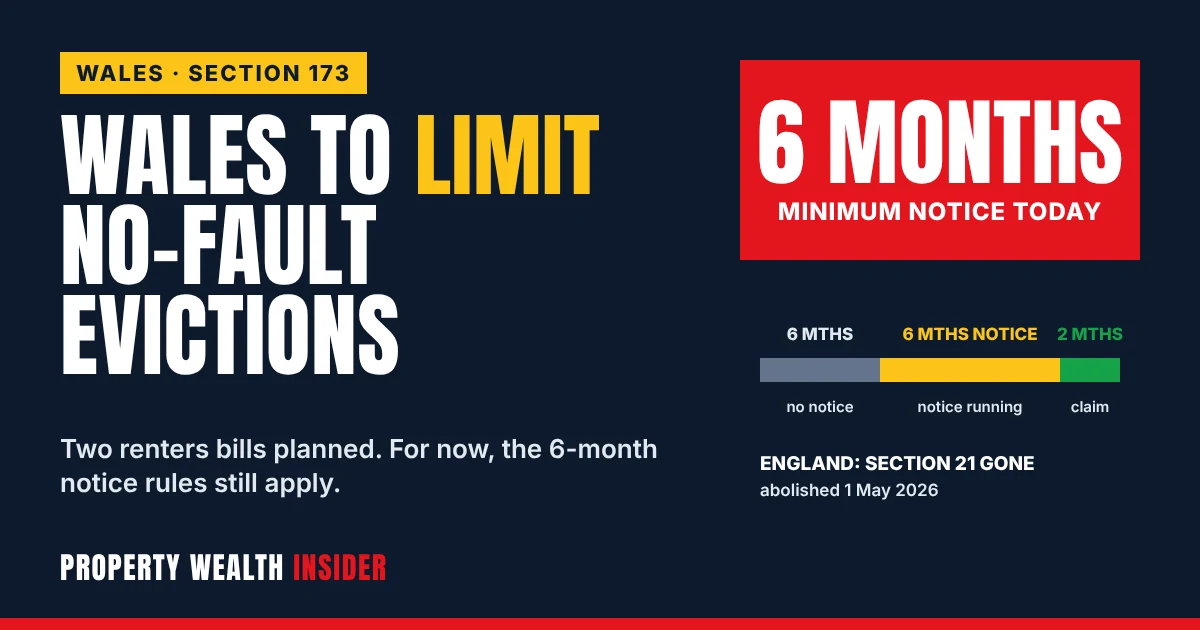
Wales is lining up two new laws for private renting, and the second is aimed squarely at the no-fault eviction. Cabinet Minister Siân Gwenllian told the Senedd on 11 November 2026 that a first renters bill will go after poor landlords, beef up tenant protection and force the sharing of renting data, with a second bill “later on in this Government’s term” designed to limit no-fault evictions.
Note the word: limit, not abolish. Nothing changes today. Welsh landlords can still end a periodic standard occupation contract with a section 173 notice under the Renting Homes (Wales) Act 2016, provided they give six months’ notice and pass a long list of compliance checks.
That puts Wales on a very different track from England, where section 21 was abolished on 1 May 2026. If you let property in Wales, here is exactly where the rules stand now, what is coming, and a calculator to get your notice dates right.
Key facts
- The Welsh Government plans two renters bills: the first targets poor landlords, tenant protection and mandatory renting data; the second aims to limit no-fault evictions.
- Today a section 173 notice in Wales must give at least 6 months’ notice and cannot be given in the first 6 months of occupation.
- Once the date in the notice arrives, you have just 2 months to start a possession claim. Miss it and you are barred from serving again for another 6 months.
- England abolished section 21 on 1 May 2026 under the Renters’ Rights Act 2025. Wales has not.
- Average private rent in Wales hit £848 a month in September 2026, up 4.1% in a year (ONS).
What the minister actually said
The comments came in Senedd questions on 11 November 2026, in reply to Becca Martin MS, who asked for an update on plans “to end no-fault evictions”. Siân Gwenllian, Cabinet Minister for Local Government, Housing and Planning, answered in Welsh. The Senedd’s official English record reads:
“The first renters Bill will tackle poor landlords, will strengthen protection for tenants, and make it a requirement to share data related to renting. This will then lay firm foundations for a second renters Bill later on in this Government’s term, and that will seek to deal with cases of no-fault evictions, in order to limit them.”
She added that the second bill would be “fed by the evidence” from the first, and that the government “will need the support of other parties” to get there. Later in the same session she said the second bill “could begin to lead to fair rents in the private sector”.
None of this is new law yet. No bill has been published. It builds on the First Minister Rhun ap Iorwerth’s legislative statement of 14 July 2026, which promised a bill to strengthen private renters’ rights and, over the Senedd term, legislation to “restrict no-fault evictions by private landlords”.
Propertymark, which met officials in July, says it expects the first rental bill in 2027, focused on rent data and on giving Rent Smart Wales stronger enforcement powers. It warns that any removal of section 173 must come with workable possession grounds and a realistic look at court capacity, and that new data duties must not swamp smaller agents.
How section 173 works today
Since 1 December 2022, most private lets in Wales have been standard occupation contracts under the Renting Homes (Wales) Act 2016, as amended by the Renting Homes (Amendment) (Wales) Act 2021. Section 173 is the Welsh no-fault route. These are the rules in force now:
| Rule | What the Act says | Section |
|---|---|---|
| Who can use it | Landlord under a periodic standard contract | s.173 |
| Minimum notice | Date in notice at least 6 months after the day the notice is given (2 months for contracts in Schedule 8A) | s.174, s.174A |
| Earliest you can serve | Not before the end of 6 months starting with the occupation date (or of the original contract, for a substitute contract) | s.175 |
| Compliance blocks | Cannot serve while in breach of key duties: written statement, deposit, EPC, gas safety, electrical report, smoke and CO alarms and more | s.176, Sch. 9A |
| Rent Smart Wales | Cannot serve if not registered, or not licensed and no licensed agent appointed | Housing (Wales) Act 2014, s.44 |
| Claim window | Possession claim not before the date in the notice, and not after 2 months starting with that date | s.179 |
| Missed the window | No new section 173 notice for 6 months from the last day you could have claimed | s.177(4)-(5) |
| Withdrawn notice | One replacement allowed within 28 days of the first; otherwise wait 6 months | s.177(1)-(3), s.180(3) |
| Retaliation | Court may refuse possession if the claim is to dodge repair or fitness duties; then a 6-month bar on new notices | s.217, s.177A |
Put the first two rules together and a contract-holder gets at least 12 months in the home before a no-fault notice can end it. If the court is satisfied the ground is made out, it must make a possession order unless the claim is retaliatory (subject to any human rights defence).
Worked example: a contract starts on 1 March 2026. The earliest you can give a section 173 notice is 1 September 2026. Hand it over on 18 November 2026 and the earliest date you can put in it is 18 May 2027. Your possession claim must then be issued between 18 May and 17 July 2027.
Section 173 notice date calculator
Enter the occupation date and when the contract-holder gets the notice. The tool works out your key dates under sections 174, 175, 177 and 179, rounding the awkward month-end cases the safe way.
Wales section 173 notice date calculator
Guide only, not legal advice. Assumes a periodic standard occupation contract on the standard six-month rules (not Schedule 8A or 9 contracts, or converted contracts with transitional rules). The Act does not fix a deemed delivery day for posted notices, so the post margin is a cautious buffer, not a legal rule. Always add a few days’ extra headroom and check Schedule 9A compliance first.
When you cannot serve a section 173 notice
Schedule 9A is where most Welsh notices die. If any of these apply at the moment you give notice, it is invalid:
- No written statement of the contract given under section 31. If you were late providing it, you must wait six months from the day you did.
- No section 39 notice giving your address for service.
- Deposit problems: not protected in an authorised scheme, initial requirements not met, or prescribed information not given, unless the deposit has been returned or a court application has been resolved. Unlawful forms of security must also be returned.
- Prohibited payments or holding deposits under the Renting Homes (Fees etc.) (Wales) Act 2019 not repaid.
- No EPC given as required, no gas safety record given or displayed, or the home treated as unfit because of missing smoke or carbon monoxide alarms or a missing electrical condition report.
Separately, section 44 of the Housing (Wales) Act 2014 bars a section 173 notice where the landlord is not registered with Rent Smart Wales for the property, or is not licensed and has not appointed a licensed agent to do all property management. There is a 28-day grace period after the landlord’s interest is assigned to them.
Worked example: on a £848-a-month let (the Welsh average), a notice thrown out because the gas safety record was never handed over sends you back to the start: fix it, re-serve, wait at least another six months. That is £5,088 of rent-months. If the contract-holder is in arrears, that is real money lost.
Miss the claim window and it is worse. In our first example, a claim not issued by 17 July 2027 means no new notice until 17 January 2028, and a new end date no earlier than 17 July 2028. A full extra year: 12 x £848 = £10,176.
Wales v England: no-fault evictions compared
| Wales | England | |
|---|---|---|
| No-fault route | Section 173 notice, in force | Section 21 abolished 1 May 2026 |
| Main law | Renting Homes (Wales) Act 2016 | Renters’ Rights Act 2025 |
| Minimum no-fault notice | 6 months | No longer available |
| Old notices | Not applicable | Section 21 notices served before 1 May 2026: court proceedings had to start by 31 July 2026 |
| What next | Second renters bill to limit no-fault evictions, later this Senedd term | Possession only on statutory grounds |
The Renters’ Rights Act’s tenancy reforms apply in England; Welsh occupation contracts run on their own law. The UK Government says 11 million private tenants in England are now covered by the new regime. Welsh ministers have said openly they want to close the gap, but have chosen the softer word “limit”.
What the court figures show
Ministry of Justice figures for county courts in Wales show accelerated procedure claims (the fast-track route the MoJ says is used when a tenancy is near its end) jumped in 2022 and 2023, around the switch to the new Act, then dropped to 486 in 2025. Standard private landlord claims have held at around 930 to 990 a year since 2022.
In the first half of 2026 there were 231 accelerated claims in Wales (125 in the first quarter, a revised figure, and a provisional 106 in the second). The minister’s first bill, with its data duties, is meant to give the government better evidence before it touches section 173.
What Welsh landlords should do now
- Do not panic-serve. Section 173 stays in force until a new Act is passed and commenced. No bill has been published.
- Audit every contract against Schedule 9A: written statement, section 39 address notice, deposit paperwork, EPC, gas record, electrical report, alarms.
- Check Rent Smart Wales: registration for each property, and a licence for you or a licensed agent.
- If you do need possession, run the dates through the calculator, use the prescribed Welsh form, and keep proof of how and when it was given.
- Diary the claim window the day you serve. Two months goes fast.
- Get your rent records in order. The first bill will make renting data sharing a legal requirement, though the detail is not yet published.
- Written statement given (and to any new contract-holder)
- Section 39 notice of landlord’s address given
- Deposit protected and prescribed information served
- No unrepaid prohibited payments or holding deposit
- Valid EPC given
- Current gas safety record given or displayed
- Electrical condition report given
- Working smoke alarms and, where needed, CO alarms
- Rent Smart Wales registration and licence in place
- At least 6 months since the occupation date
- Notice date at least 6 months away, claim window in the diary
FAQs
Has Wales banned no-fault evictions?
No. Section 173 notices remain valid in Wales. The Welsh Government plans a second renters bill later this Senedd term that would seek to limit no-fault evictions. It has not been published.
How much notice does a landlord have to give in Wales?
For a section 173 notice on a periodic standard contract, at least six months, and it cannot be given in the first six months of occupation. Some contracts in Schedule 8A have a two-month minimum.
How long is a section 173 notice valid for?
You can make a possession claim from the date in the notice until the end of two months starting with that date. After that the notice cannot be used, and you must wait six months before serving another.
Does section 21 still apply in Wales?
No. Since 1 December 2022 most Welsh private tenancies have been occupation contracts under the Renting Homes (Wales) Act 2016, and the equivalent no-fault route is section 173. Section 21 was abolished in England on 1 May 2026.
Can I serve a section 173 notice if I’m not registered with Rent Smart Wales?
No. Section 44 of the Housing (Wales) Act 2014 stops you giving the notice unless you are registered for the property and licensed, or have appointed a licensed agent for all property management work.
When will the new Welsh renters bills become law?
No dates are confirmed. The minister said the second bill would come “later on in this Government’s term” and would need cross-party support. Propertymark says it expects the first bill in 2027.
- Senedd Record of Proceedings, Plenary 11 November 2026, OQ64888
- Welsh Government: first phase of legislation, 14 July 2026
- Renting Homes (Wales) Act 2016 (sections 173-180, 217, 237, Schedule 9A)
- Renting Homes (Amendment) (Wales) Act 2021
- Housing (Wales) Act 2014, section 44
- Rent Smart Wales
- GOV.UK: Historic protections for renters in action across England
- Ministry of Justice: Mortgage and landlord possession statistics, April to June 2026
- ONS: Private rent and house prices, UK, October 2026
- Propertymark: Welsh Rental Bill planned for 2027
This article is news and general guidance only, not financial, legal or tax advice.