20% hazard shock as Oxford moves to renew landlord licensing
Oxford City Council wants to keep citywide landlord licensing for another five years. Its Cabinet approved a public consultation on 18 November 2026 to renew the selective licensing scheme when the current one expires at midnight on 31 August 2027.
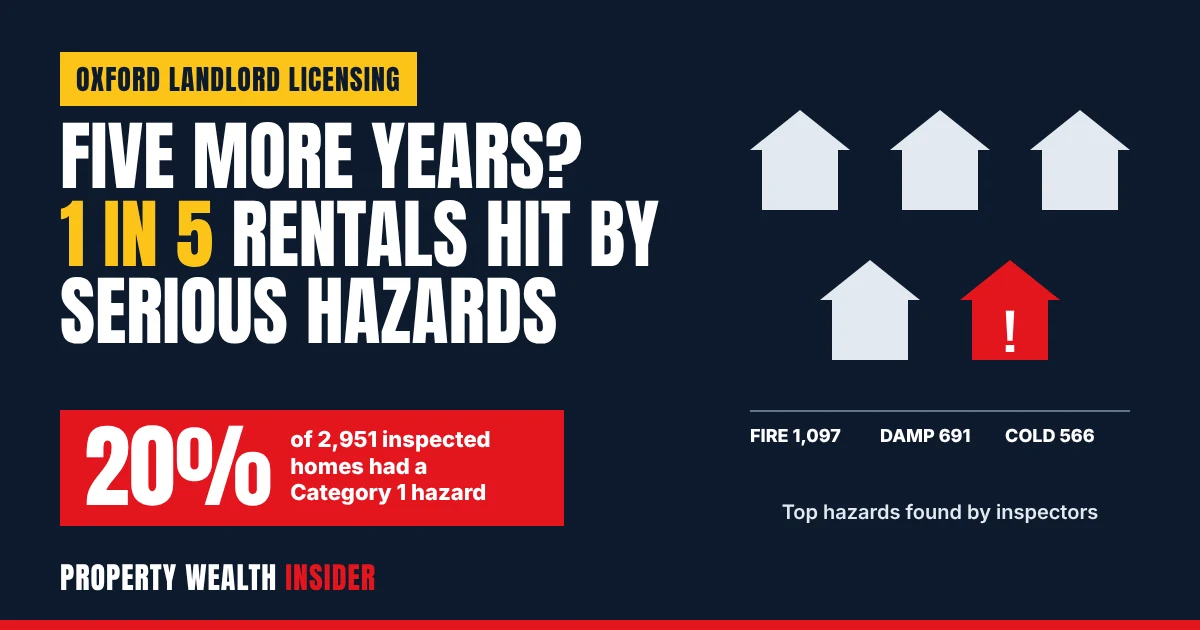
The council’s case rests on its own inspection data: one in five of the 2,951 rented homes it inspected had a Category 1 hazard, the most serious rating under the Housing Health and Safety Rating System (HHSRS). Fire hazards topped the list, followed by damp and mould, then excess cold.
The renewal is a proposal, not a decision. But if you let a home in Oxford, you have about 12 weeks to have your say. And wherever you let in England, those three hazards are what councils keep finding, so it pays to fix them before an inspector knocks.
Key facts
- Oxford inspectors found a Category 1 hazard in 590 of 2,951 homes (20%), and Category 2 hazards in a further 1,285 (44%).
- The most common hazards were fire (1,097 homes), damp and mould (691) and excess cold (566).
- The consultation opened on 19 November 2026 and runs for 12 weeks. If approved, a new scheme would start on 1 September 2027 and run to 2032.
- A standard Oxford licence currently costs £853 (£612 if accredited). Letting without one defaults you to the £1,803 higher rate.
- In England, the maximum civil penalty for a licensing offence is now £40,000 for conduct from 1 May 2026, and a rent repayment order can claw back up to 2 years’ rent.
What Oxford is proposing, and what is already in force
Selective licensing applies only in England, and only where a council has designated an area. Oxford’s designation covers the whole city and requires a licence for privately rented homes that are not already licensed as houses in multiple occupation (HMOs). HMOs sit under separate HMO licensing, which this story does not cover.
Private renting is unusually big in Oxford. The 2021 Census put it at 32.2% of households, against 20.5% across England. The council says more than 14,500 properties had been licensed by March 2026.
| Item | Status | Date |
|---|---|---|
| Current citywide scheme | In force | 1 September 2022 to midnight 31 August 2027 |
| Cabinet approves renewal consultation | Done | 18 November 2026 |
| Public consultation | Open now | 12 weeks from 19 November 2026 |
| Cabinet decision on renewal | Proposed | Spring 2027 |
| Renewed scheme starts | Proposed | 1 September 2027, running to 2032 |
| £40,000 maximum civil penalty | In force (England) | Conduct from 1 May 2026 |
| Rent repayment orders up to 2 years’ rent | In force (England) | From 1 May 2026 |
| Revised HHSRS (21 hazards) | In force (England) | Inspections started from 22 June 2026 |
The council has not yet confirmed the fees for a renewed scheme. All the fees below are today’s 2026/27 rates, so check the consultation documents for what is proposed from 2027.
What the inspections found
The council’s review of the scheme’s first four years found that 744 properties were improved after it stepped in. It served 206 formal enforcement notices and orders, which it says is 45% more than the annual average in the two years before licensing. Tenants complained about conditions in licensed homes 1,162 times, an average of 291 a year compared with 185 before the scheme.
The council compares its 20% with a national rate of 12%. That matches the English Housing Survey’s 2022-23 figure for private renter households. The latest survey, covering homes in 2024, puts it at about 10% of private rented homes and 9% of all homes.
One caveat: inspections target homes the council has concerns about, so Oxford’s 20% is not a fair rate for the whole city. Even so, more than a third of inspected homes had a fire hazard, which tells you where inspectors look first.
How to fix the top hazards before an inspection
England’s HHSRS changed on 23 June 2026. The number of hazards fell from 29 to 21, and the old bands A to J became High, Medium and Low. A High score (1,000 or more) is a Category 1 hazard, and the council must act on it. For Category 2 hazards, action is up to the council.
The government’s landlord and agent guide sets out what inspectors expect. Here is what it says about the hazards Oxford found most often, plus electrical safety and falls.
| Hazard | What inspectors expect | Quick fixes |
|---|---|---|
| Fire and explosions | A working smoke alarm on every storey with living accommodation. A CO alarm in any room with a fixed combustion appliance (gas cookers are excluded). Annual gas safety check. Furniture you supply must meet fire safety rules. | Test and replace alarms, file the gas certificate, check that fire doors and escape routes in flats are clear. |
| Damp and mould | Watertight walls and roof, with no visible damp or mould in any room. | Fix leaks and gutters, fit extractor fans in kitchens and bathrooms, treat the cause rather than painting over mould. |
| Excess cold | Heating that can warm the living room to 21°C and other habitable rooms to 18°C when it is -1°C outside. At least 250mm of loft insulation. A 50mm jacket on a hot water cylinder that is not pre-insulated. | Service the boiler, top up loft insulation, fix draughty windows and doors. |
| Electrical | Installation checked by a competent electrician at least every 5 years, with the report given to tenants within 28 days. | Diary your EICR renewal date and complete remedial work promptly. |
| Falls | Handrails 900–1,000mm high on stairs with four or more risers. Window restrictors where a fall is possible. | Fit handrails and restrictors, fix loose stair coverings and uneven floors. |
Licence fees vs penalties: the numbers
You pay Oxford’s fees in two stages, by card only. A first licence lasts one year. If you renew before it expires, the renewal can extend it to five years from your original application.
| Oxford fee (1 April 2026 – 31 March 2027) | Stage one | Stage two | Total |
|---|---|---|---|
| Accredited landlord or full-management agent | £323 | £289 | £612 |
| Standard new application | £323 | £530 | £853 |
| Higher rate (unlicensed over 12 weeks, the default) | £323 | £1,480 | £1,803 |
| Renewal of a one-year licence, made before expiry | £138 | £72 | £210 |
| Paper application surcharge (new) | – | – | £313 |
Watch the default. The council charges the £1,803 higher rate unless you can show that the property became licensable within the last 12 weeks. The £612 accredited rate also needs evidence submitted with the application.
Worked example 1: a landlord with three Oxford flats applies at the standard rate and renews on time. That costs 3 × (£853 + £210) = £3,189, or about £638 a year over five years. With accreditation, it costs 3 × (£612 + £210) = £2,466.
Worked example 2: one flat is let unlicensed at £1,600 a month. The licence alone now costs £1,803. The council can also impose a civil penalty of up to £40,000 for conduct from 1 May 2026, under section 249A of the Housing Act 2004. Or it can prosecute, where the fine is unlimited.
On top of that, the tenant or council can seek a rent repayment order for up to two years’ rent: 24 × £1,600 = £38,400, less any universal credit paid towards the rent. In the worst case, that is roughly £80,000 of exposure for one flat that should have cost £853 to license.
These are maximums. Councils set the actual penalty using their own policies.
Calculator: hazard self-check and licence cost
Tick what is true for your property to get a hazard rating and a fix list. Then add your portfolio to compare licence costs at today’s Oxford fees with your maximum exposure if you let unlicensed.
HHSRS hazard self-check and licence cost estimator
Guide only, not legal advice. The risk rating is a simple self-check, not an HHSRS assessment. Fees are Oxford’s 2026/27 rates; fees for a renewed scheme are not yet confirmed. Exposure assumes the maximum £40,000 civil penalty plus 24 months’ rent repayment per property. Real penalties are usually lower and are set by council policy.
How renewals work and how to respond
Under Part 3 of the Housing Act 2004, a selective licensing designation can last up to five years. It must meet at least one legal condition, such as poor property conditions, anti-social behaviour or low demand. A renewal is legally a new designation, so the council has to consult again.
Since 23 December 2024, councils in England have not needed the Secretary of State’s sign-off for a scheme of any size. The decision rests with Oxford’s Cabinet, which makes the consultation the main point where landlords can influence the outcome. Government guidance requires at least 10 weeks of consultation; Oxford has chosen 12.
Twelve weeks from 19 November 2026 takes the consultation to around mid-February 2027. Confirm the exact closing date on the council’s consultation finder or with the licensing team before you rely on it.
Responses carry the most weight when they are specific and backed by evidence. Useful points to cover:
- Fees: the proposed fee level, whether the accredited discount is fair, and whether well-run landlords with clean inspections should pay less.
- Targeting: whether citywide coverage is justified, or whether the hazard data supports focusing on particular areas or property types.
- Service: your real experience of processing times, inspections and communication from the council.
- Transition: how existing licences will be handled when the current designation ends on 31 August 2027.
What Oxford landlords should do now
- Check every licence. Make sure each non-HMO let has a selective licence and note when it expires. Late renewals are treated as new applications.
- Run the hazard self-check above on each property, starting with fire, damp and cold.
- Get your paperwork together: gas safety record, EICR, alarm test log and photos of completed repairs.
- Consider accreditation, or a full-management agent, to qualify for the £612 rate on new applications.
- Act quickly on tenant reports of damp, mould or heating faults. Complaints are a common reason for a reactive inspection.
- Respond to the consultation before it closes, and keep a copy of what you submit.
- Selective licence in place for each property (expiry date in your diary)
- Smoke alarm on every storey; CO alarm by fixed combustion appliances
- Gas safety record under 12 months old
- EICR under 5 years old and copy given to tenants
- No visible damp or mould; extractor fans working
- Heating able to reach 21°C in the living room and 18°C in other rooms; loft insulation 250mm
- Handrails and window restrictors fitted where needed
- Consultation response submitted
FAQs
Is Oxford’s selective licensing being renewed?
Not yet. The council has only approved a consultation. The Cabinet is due to decide in spring 2027, and a renewed scheme would start on 1 September 2027. The current scheme stays in force until 31 August 2027 either way.
How much is a selective licence in Oxford?
At 2026/27 rates, a standard new licence is £853, the accredited rate is £612 and the higher rate is £1,803. Renewing a one-year licence before it expires costs £210. Fees for a renewed scheme have not yet been confirmed.
What is the fine for not having a selective licence?
In England, councils can impose a civil penalty of up to £40,000 for conduct from 1 May 2026 (£30,000 before then), or prosecute, where the fine is unlimited. Tenants can also seek a rent repayment order of up to two years’ rent.
What is a Category 1 hazard?
It is a hazard that scores 1,000 or more, the High band, under the HHSRS. The council has a legal duty to take action on it, for example by serving an improvement notice.
Does selective licensing apply in Wales or Scotland?
Not this regime. The Housing Act 2004 selective licensing rules, the £40,000 penalty and the revised HHSRS described here apply in England. Wales and Scotland have their own landlord registration and licensing systems.
Sources
- Oxford City Council: Council looks to renew landlord licensing scheme (19 November 2026)
- Oxford City Council: Selective licensing fees and charges
- Oxford City Council: Selective licensing background information
- Oxford City Council: Selective licensing scheme in third year (25 March 2026)
- ONS: Census 2021 area changes, Oxford
- English Housing Survey 2024-25: housing quality
- English Housing Survey 2022-23: housing quality and condition
- Housing Act 2004, section 249A
- Housing Act 2004, section 95
- The Financial Penalties (Housing Offences and Breach of Banning Orders) Regulations 2026
- Housing and Planning Act 2016, section 44 (rent repayment orders)
- The Housing Health and Safety Rating System (England) (Amendment) Regulations 2026
- MHCLG: Landlord and agent guide to the HHSRS
- MHCLG: Selective licensing in the private rented sector, a guide for local authorities
This article is news and general guidance only. It is not financial, legal or tax advice.