Rental Listings Hit 7-Year High, Up 13.6%: Landlord Void Alert
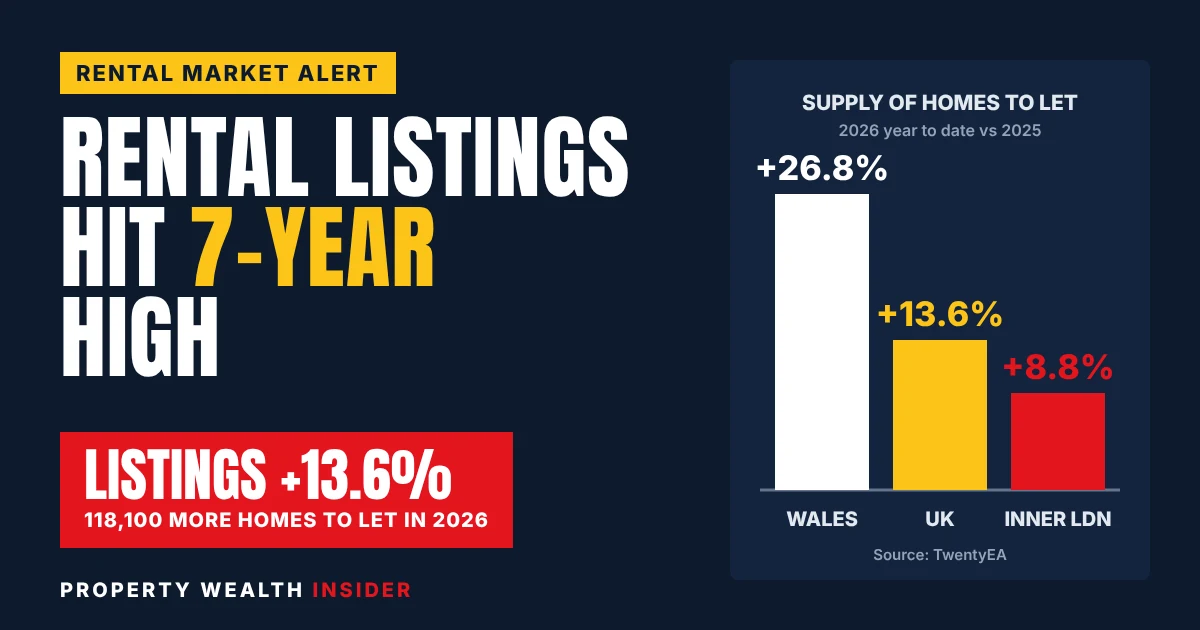
The number of homes advertised to let has hit its highest level in seven years, even as landlords sell up at a record pace. TwentyEA’s 2026 year-to-date analysis, published on 25 September 2026, found the supply of properties to let up 13.6% on 2025, an extra 118,100 homes.
The same research shows landlords leaving the private rented sector at 562 properties a day in Q3 2026. The gap is being filled by build-to-rent operators, who are now advertising heavily on the main property portals.
For a private landlord, that means more competition for every tenant. Homes that are priced wrong, look tired or are slow to show will sit empty, and every empty week is rent you never get back. Below we break down the numbers, show how to test whether a small rent cut beats a long void, and set out a plan to let faster that stays within the Renters’ Rights Act rules in England.
Key facts
- Homes to let are at a seven-year high: supply is up 118,100, or 13.6%, in 2026 year to date (TwentyEA).
- Wales saw the biggest rise in supply at +26.8%. Inner London had the smallest at +8.8%, and Northern Ireland was the only region with no rise.
- Build-to-rent homes advertised directly on the portals are up 22% year on year, and 34% in London.
- Landlords are exiting at 562 homes a day (Q3 2026), up from 495 a day a year earlier and 167 a day in 2020.
- Official ONS figures show UK private rents up 3.8% to £1,411 in the 12 months to October 2026.
The numbers: a seven-year high in listings
TwentyEA tracks homes coming to market across UK property listings. In its 2026 year-to-date analysis it found the supply of homes to let up 118,100 on the previous year. That is 13.6% higher than in 2025 and the highest stock level it has recorded in seven years.
Supply grew by double digits in every price bracket. Every UK region except Northern Ireland saw more homes listed, and outside Inner London the rise was more than 10% everywhere.
| Market | Supply change, 2026 YTD | What it means for landlords |
|---|---|---|
| UK overall | +13.6% (+118,100 homes) | More choice for tenants, so pricing and presentation matter more |
| £0–£800 pcm | +14.5% | More competition at the budget end |
| £800–£1,500 pcm | +16.0% | The fastest-growing bracket, where most mainstream buy-to-lets sit |
| Wales | +26.8% | The biggest rise in supply anywhere in the UK |
| Inner London | +8.8% | The smallest rise, but still a lot of new competition |
| Northern Ireland | No rise | The only region where rental stock did not grow |
| Build-to-rent, advertised directly | +22% UK, +34% London | Professionally run blocks are now competing on the same portals as you |
TwentyEA called this “great news for tenants”, with less upward pressure on rents and more choice. For landlords it is the other side of the same coin: a tenant who can choose will compare your home against more alternatives than at any time in seven years.
Why listings are rising while landlords sell
The exodus has not stopped. TwentyEA says around 50,600 rental homes left the sector in Q3 2026, or 562 a day. That is up from 495 a day in Q3 2025 and more than three times the 167 a day seen in 2020.
It puts the total lost over the decade at 834,800 homes, or 18.6% of rental stock nationally. In 2025 alone the figure was close to 181,000.
So where are the extra listings coming from? TwentyEA points first to build-to-rent. Operators that used to market whole developments through their own websites are now listing on the main portals to reach more renters. Directly advertised build-to-rent stock is up 22% year on year nationally and 34% in London.
It also suggests the end of fixed terms in England is playing a part. Under the Renters’ Rights Act, every assured tenancy in England became a rolling periodic tenancy on 1 May 2026. The most notice a landlord can require from a tenant is two months, according to gov.uk guidance. TwentyEA stresses that it is early days, but more frequent moves mean more re-lets, and every re-let carries the risk of a void.
Its conclusion is that the market is changing shape. Smaller and accidental landlords are selling, while professional landlords buy, especially cheaper stock, and institution-funded new-build rentals add to supply.
What it means for rents
The official measure is still rising. The ONS Price Index of Private Rents, released on 18 November 2026, shows the average UK private rent up 3.8% to £1,411 in the 12 months to October 2026 (provisional). England was £1,472 (+4.0%) and Wales £849 (+3.9%). Among England’s regions, the North West was highest at 5.6% and the South West lowest at 3.3%.
TwentyEA’s own rental price figures in the same September analysis tell a more mixed story. Wales led at 13.9%, followed by the West Midlands (6.8%) and the East Midlands (4.3%). It recorded falls in the East of England (-7.7%), Yorkshire and the Humber (-4.0%), the North West (-2.4%), Outer London (-2.3%), the North East (-1.6%) and the South West (-0.4%).
Why the two measures differ: the ONS index covers rents across private tenancies generally, including tenants who are not moving. TwentyEA’s figures come from its own property market data. When competition for tenants rises, rents on homes coming to market tend to feel it first, so if you are re-letting now, take your local evidence more seriously than the national average.
The real cost of a void: worked examples
When supply outstrips demand, many landlords hold out for their asking rent and wait. The maths often says that is the expensive choice.
Example. A two-bed advertised at £1,400 pcm. That is £323 a week (£1,400 x 12 / 52). While empty, the landlord also pays about £180 a month in council tax and utilities, or £42 a week. So each void week costs £365 before the mortgage is even counted.
| Over 12 months | Hold at £1,400 pcm | Cut 3% to £1,358 pcm |
|---|---|---|
| Expected void | 6 weeks | 2 weeks |
| Rent collected | £14,862 | £15,669 |
| Extra empty-property costs | £249 | £83 |
| Mortgage and fixed costs (£750 pcm) | £9,000 | £9,000 |
| Net cash | £5,612 | £6,586 |
Cutting the rent by £42 a month leaves the landlord £974 better off in year one. The break-even point is about 3.3 weeks: if the full-price void would be longer than that, the cut pays.
Stretch it to 24 months and the gap narrows to £470, because the lower rent keeps running. Remember that in England rent can only be increased once a year using the section 13 process and Form 4A, with at least two months’ notice, so a lower starting rent is not quick to undo.
If the property would let in three weeks at £1,400 anyway, holding firm wins by about £120. That is why the honest void estimate, ideally from your agent’s let-agreed evidence on similar homes, is the number that decides it.
Void cost and pricing calculator
Put in your own numbers to see whether holding out or pricing sharper earns you more.
Void cost and pricing calculator
Guide only, not financial advice. Weekly rent is monthly rent x 12 / 52. Net cash ignores tax, agent fees and rent increases. Use let-agreed evidence for similar homes to estimate void weeks.
How to let faster without breaking the rules
In England the Renters’ Rights Act changed how homes are marketed from 1 May 2026. According to gov.uk, any written advert must state a specific rent, not a range, and you cannot ask for, encourage or accept offers above it. A council can fine you up to £7,000 for a first breach. Wales, Scotland and Northern Ireland have their own rules.
That means the old trick of listing high and letting tenants bid is gone. The advertised rent is the ceiling, so get it right first time.
- Price on let-agreed evidence, not asking prices. Ask your agent what similar homes actually let for in the last three months and how long they took.
- Run the numbers above. If a 2-5% lower rent cuts your void by more than the break-even weeks, advertise at the lower figure from day one.
- Start marketing as soon as notice lands. Tenants can give up to two months’ notice. Use that window to advertise, with access agreed in line with the tenancy.
- Win on presentation. With more listings, the first photo decides the click. Professional photos, a floorplan and a fresh clean cost far less than a week empty.
- Widen your pool legally. You cannot discriminate against applicants on benefits or with children, and you must consider pet requests and not refuse without a valid reason. Treat both as extra demand, not risk.
- Move fast on applicants. Book viewings within 48 hours, have referencing lined up and keep the holding deposit to the one-week maximum.
- Review after 14 days. If enquiries are thin, reduce the advertised rent rather than waiting a month. Never hint at other offers to push applicants higher.
- Advert shows one fixed rent figure (no ranges, no “offers over”)
- Rent set using recent let-agreed comparables
- Void cost and break-even weeks worked out
- Professional photos and floorplan ready
- Property cleaned, small repairs done before first viewing
- No blanket bans on benefits or children in adverts or agent instructions
- Pet request process ready (written response within 28 days)
- Holding deposit no more than one week’s rent; tenancy deposit within the legal cap
- No rent taken before the tenancy agreement is signed
- Diary note to review price after 14 days on the market
FAQ
Is there an oversupply of rental property in the UK?
Not a glut, but more choice than for years. TwentyEA says homes to let are at a seven-year high, up 13.6% in 2026 year to date, with much of the growth from build-to-rent operators advertising on the portals.
Why is rental supply rising if landlords are selling?
TwentyEA points to build-to-rent stock now listed on the main portals (up 22% nationally), professional landlords buying, and periodic tenancies in England meaning homes come back to market more often. Meanwhile 562 rental homes a day left the sector in Q3 2026.
Can I accept a higher offer than the advertised rent?
Not in England. Since 1 May 2026 landlords and agents cannot ask for, encourage or accept offers above the advertised rent, and written adverts must state a specific rent. A first breach can bring a fine of up to £7,000.
Should I reduce my rent to avoid a void period?
Often, yes. In our example a 3% cut that saves four void weeks is worth £974 in year one. Use the calculator: if your realistic void at full price is longer than the break-even figure, the lower rent earns more.
How much does an empty rental property cost per week?
The lost rent (monthly rent x 12 / 52) plus any bills you pick up while it is empty. On £1,400 pcm with £180 a month of council tax and utilities, that is about £365 a week, and the mortgage still has to be paid.
- TwentyEA: Why is rental stock rising if landlords are exiting? (25 September 2026)
- TwentyEA: Over 500 properties are leaving the lettings sector per day (15 September 2026)
- ONS: Private rent and house prices, UK, November 2026
- GOV.UK: Rental bidding, a guide for landlords
- GOV.UK: Renters’ Rights Act, an overview for landlords
- GOV.UK: Assured periodic tenancies, a guide for landlords
This article is news and general guidance only. It is not financial, legal or tax advice.