Landlord costs soar 43% in 10 years: has your rent kept up?
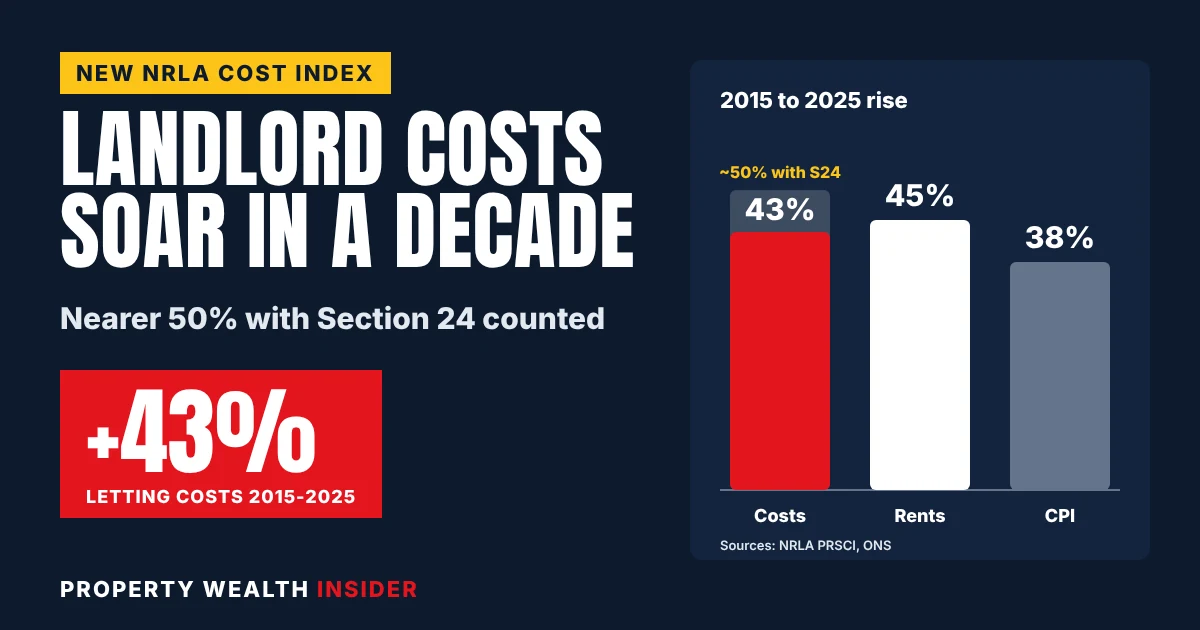
The cost of letting out a home rose by 43% between 2015 and 2025, according to a new index launched by the National Residential Landlords Association (NRLA) on 23 November 2026. Once the loss of full mortgage interest relief is factored in, the association puts the real rise closer to 50%.
The Private Rented Sector Cost Index (PRSCI) is the first attempt to track a landlord’s whole basket of costs, from mortgage interest and repairs to agent fees, insurance and safety certificates, in the same way the ONS tracks consumer prices. It was rebuilt and independently checked by ChamberlainWalker Economics.
The headline is only half the story. The index itself shows rents rose by a similar amount over the decade, but not at the same time. Costs exploded in 2021 to 2024 while rents lagged, and that squeeze hit mortgaged, higher-rate taxpayers hardest. Below we unpack the numbers, show you how Section 24 changes the maths, and give you a calculator to test your own property.
Key facts
- Landlord letting costs rose 43% from 2015 to 2025 (index 142.7, 2015 = 100), against 38% for CPI inflation.
- Including the Section 24 mortgage interest restriction, the NRLA’s economists estimate the rise is closer to 50%.
- Private rents rose 45% over the same decade on ONS figures, so costs and rents ended up broadly level.
- Between 2021 and 2024 costs jumped 50% while rents rose 22%: the real squeeze.
- Mortgage interest is 38% of the cost basket and added 23.5 of the 42.7 index points of growth.
- From 6 April 2027 property income tax rates rise; Budget 2026 proposes 24% / 44% / 49% (England, Wales and Northern Ireland).
What the new cost index measures
Official statistics already track what tenants pay (the ONS Price Index of Private Rents) and general prices (CPI). Nothing official tracked what it costs a landlord to provide the home. The PRSCI fills that gap.
It prices a fixed basket of 14 cost items, grouped into five “pillars”, using official ONS and Bank of England series plus two industry datasets (ABI insurance premiums and BCIS trade labour rates). The weights come from what landlords told the NRLA and Pegasus Insight they actually spent in 2025.
- Finance (38.3%): mortgage interest, driven by Bank of England buy-to-let two-year fixed rates (smoothed over eight quarters) multiplied by the ONS house price index.
- Repairs and maintenance (23.0%): upkeep and repairs.
- Management (20.8%): letting and management fees, ground rent and service charges, accountancy and legal fees.
- Insurance and regulatory compliance (14.3%): insurance, gas safety, EICRs, licensing fees and energy efficiency work.
- Voids and utilities (3.8%): energy, water and council tax when a property is empty or in HMOs.
Three caveats matter. It is a pre-tax measure, so Section 24 is not in the 43%. It describes the average landlord, including those with no mortgage, so a heavily geared landlord will have seen far more than 38% of their spending go on interest. And it is a national average that ignores regional differences in costs, rents and licensing.
Costs vs rents vs inflation: the real picture
We checked the NRLA’s comparison figures against the ONS’s own data. Using annual averages, CPI rose 38.4% between 2015 and 2025 and UK private rents rose 45.4%. Both match the report.
| Period | Landlord costs (PRSCI) | Private rents (ONS) | CPI (ONS) |
|---|---|---|---|
| 2015 to 2021 | -3% | +12% | +12% |
| 2021 to 2024 | +50% | +22% | +20% |
| 2024 to 2025 | -1% | +6% | +3% |
| 2015 to 2025 | +43% (about +50% with Section 24) | +45% | +38% |
Read that table carefully. For six years, ultra-low mortgage rates actually pushed headline costs down while rents climbed. Then rate rises and the energy crisis drove costs up by half in three years, peaking at 147.5 in the third quarter of 2024. Rents have since caught up: by the first quarter of 2026 the rent index stood at 148.4 against 137.2 for costs.
That recovery is not the end of it. The PRSCI X, which strips out interest rate swings, was 135.3 in early 2026, close to its highest level and still rising. The report also flags new buy-to-let lending rates climbing back to around 4.4% to 4.5% in April and May 2026, which could reverse the recent fall.
What tenants pay now: the ONS put the average UK private rent at £1,411 a month in October 2026, up 3.8% on a year earlier. In England it was £1,472 (+4.0%) and in Wales £849 (+3.9%).
Mortgage interest did most of the damage
Finance costs supplied just over half of the 42.7-point rise. That is partly higher rates (the smoothed buy-to-let rate went from 3.8% in 2015 to 4.6% in 2025) and partly bigger loans: house prices rose about 47% over the decade, so anyone buying or refinancing needs to borrow more pounds.
| Cost pillar | Share of 2025 basket | Price change 2015 to 2025 | Index points added |
|---|---|---|---|
| Finance (mortgage interest) | 38.3% | +75.5% | 23.5 |
| Insurance and regulatory compliance | 14.3% | +50.8% | 6.8 |
| Repairs and maintenance | 23.0% | +23.1% | 6.2 |
| Management | 20.8% | +16.5% | 4.2 |
| Voids and utilities | 3.8% | +60.2% | 2.0 |
| All costs | 100% | +42.7% | 42.7 |
Outside finance, insurance and compliance is the biggest driver, up 51%. The report links that to mandatory electrical safety checks from 2020, rising trade labour rates for safety certificates and higher building costs for energy efficiency work. Repairs (+23%) and management (+17%) actually rose more slowly than CPI.
Worked example: a landlord whose costs were £10,000 in 2015 and matched the index would be paying about £14,270 in 2025. If their rent was £900 a month in 2015 and tracked the ONS index, it would be about £1,309 now. Rent up £4,900 a year, costs up £4,270, before tax.
Why Section 24 pushes the rise towards 50%
Since 6 April 2020, individual landlords of residential property cannot deduct mortgage interest and other finance costs from rental income. Instead they get a tax reduction worth 20% of the lowest of: their finance costs, their property profits, or their total non-savings income above the personal allowance. Unused finance costs can be carried forward. The restriction was phased in from April 2017 and applies to individuals, including partners in property partnerships.
For a basic-rate taxpayer that is roughly neutral. For higher and additional-rate taxpayers, every £1,000 of interest now costs £200 or £250 more in tax than it used to. That is why the index’s economists estimate the 2025 reading would be nearer 150 than 143 if tax were included.
Worked example (2026-27, England): rent £1,100 a month (£13,200 a year), mortgage interest £6,000, other costs £3,500. Cash profit is £3,700. A higher-rate landlord is taxed at 40% on £9,700 (£3,880), less a 20% credit on the £6,000 interest (£1,200), so pays £2,680. That leaves £1,020. If interest were fully deductible, tax would be £1,480 and they would keep £2,220. Section 24 costs them £1,200 a year.
It is about to get tougher. Finance Act 2026 creates separate property income tax rates from 6 April 2027 and gives finance cost relief at the new “property basic rate”. At Budget 2026 on 28 October 2026 the government said it will legislate in Finance Bill 2026-27 to set those rates two points higher than already enacted.
| Tax year | Status | Basic / higher / additional on property income | Finance cost credit |
|---|---|---|---|
| 2026-27 (now) | In force | 20% / 40% / 45% | 20% |
| 2027-28 | Enacted in Finance Act 2026 | 22% / 42% / 47% | 22% (property basic rate) |
| 2027-28 | Proposed at Budget 2026, Finance Bill 2026-27 | 24% / 44% / 49% | 24% if enacted (property basic rate) |
Where it applies: the property rates cover England, Wales and Northern Ireland. Scottish taxpayers pay Scottish income tax rates, and the Scottish Parliament and the Senedd have been given powers to set their own property rates.
On the proposed rates, our higher-rate example pays £2,828 in 2027-28 and keeps £872, down from £1,020. The NRLA’s chief executive, Ben Beadle, put it bluntly at the launch: “Not every cost is within the Government’s control, but tax policy certainly is.”
Calculator: has your rent kept up with your costs?
Enter one property’s figures. The calculator applies Section 24 correctly (interest not deducted, credit at the basic or property basic rate), then shows the rent you would need if your costs rose by the percentage you choose. The default is the index’s 43%.
Has your rent kept up with your costs?
Guide only, not tax or financial advice. Assumes all property profit falls in the band you choose, ignores the personal allowance and band thresholds, and caps the finance cost credit at property profit (unused interest can be carried forward). Uses rates for England, Wales and Northern Ireland; Scottish taxpayers differ. 2027-28 proposed rates are not yet law.
Two rent targets are shown because they answer different questions. “Same £ profit” keeps your pounds in hand flat, which is a real-terms cut. “Same margin” keeps profit as the same share of rent, which means rent must rise by exactly the cost increase.
What to do now: a seven-step cost review
- Build your own index. Pull your 2015 (or first full year) and latest accounts and work out the percentage change in each of the five pillars. Compare with the table above.
- Check your fix dates. The index uses an eight-quarter average because rate changes feed through slowly. Note when each mortgage product ends and what today’s rates would do to your interest bill.
- Run the 2027-28 tax numbers. Use the calculator on the proposed 24% / 44% / 49% setting and budget for the extra tax from 6 April 2027.
- Attack insurance and compliance. It is the fastest-rising non-finance cost. Re-quote insurance, bundle gas and electrical checks, and plan energy efficiency work rather than doing it in a rush.
- Benchmark your rent. In England, the NRLA notes that under the Renters’ Rights Act an in-tenancy rent increase must reflect open market rent if challenged at tribunal. Your costs do not set the rent; the local market does. Use comparable listings.
- Review your ownership structure. If you are a higher-rate taxpayer with large interest bills, get advice on whether a different structure makes sense, accounting for stamp duty and capital gains costs of any transfer.
- Decide property by property. If a property’s cost-to-rent ratio is above 80% and rent cannot rise, consider refinancing, paying down debt, or selling.
- Latest 12 months of rent received per property
- Mortgage statements showing interest only (not capital)
- Product end dates and current remortgage quotes
- Insurance renewal dates and two alternative quotes
- Gas safety, EICR and EPC due dates
- Agent fee invoices and management contract terms
- Licensing fees and renewal dates
- Your expected income tax band for 2026-27 and 2027-28
- Three local comparable rents for each property
FAQ
How much have landlord costs gone up since 2015?
By 43% between 2015 and 2025 on the NRLA’s Private Rented Sector Cost Index, or closer to 50% once the Section 24 restriction on mortgage interest relief is included. CPI rose 38% over the same period.
Have rents risen faster than landlord costs?
Over the full decade, slightly: UK private rents rose about 45% on ONS data against 43% for costs. But costs rose 50% in 2021 to 2024 while rents rose 22%, and including Section 24 costs are ahead for many mortgaged landlords.
What is the biggest cost for landlords?
Mortgage interest, at 38% of the average landlord’s spending in 2025. It accounted for 23.5 of the 42.7 points of cost growth since 2015. Repairs and maintenance is next at 23%.
How does Section 24 work in 2026-27?
Individual landlords cannot deduct residential mortgage interest from rental income. They get a 20% tax reduction on the lowest of finance costs, property profits or adjusted total income, with unused costs carried forward. It applies to individual landlords, including partners in property partnerships.
Is landlord tax going up in April 2027?
Yes. Finance Act 2026 already sets property income rates of 22%, 42% and 47% from 6 April 2027, with finance cost relief at the property basic rate. Budget 2026 proposes raising them to 24%, 44% and 49% through Finance Bill 2026-27. They apply in England, Wales and Northern Ireland.
Can I use the cost index to justify a rent rise?
Not on its own. The NRLA says the index is context, not a tool for setting an individual rent. Rents are set by the local market, and in England a challenged increase is judged against open market rent.
Sources
- NRLA: Private Rented Sector Cost Index launch (23 November 2026)
- NRLA: The Private Rented Sector Cost Index (PRSCI) launch briefing and methodology
- ONS: Price Index of Private Rents, UK monthly price statistics (18 November 2026)
- ONS: CPI index 00, all items (D7BT)
- HMRC: Restricting finance cost relief for individual landlords
- Finance Act 2026 (legislation.gov.uk)
- HM Treasury / HMRC: Budget 2026 overview of tax legislation and rates
- HMRC: Income Tax changes to tax rates for property and savings income
This article is news and general guidance only, not financial, legal or tax advice. Take professional advice on your own circumstances.