Cardiff landlord hit with £3,509 bill for re-letting banned flats
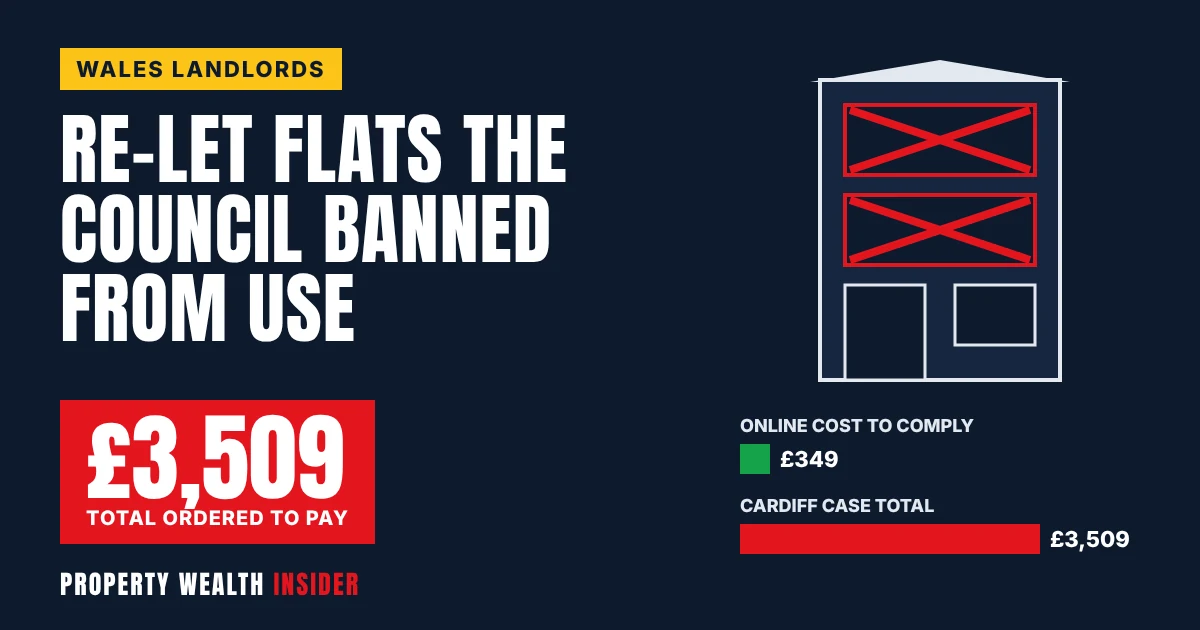
A Cardiff landlord has been ordered to pay £3,509 after admitting he re-let two flats that the council had banned from being lived in, while also being unregistered and unlicensed with Rent Smart Wales.
Cardiff Council says Said Moussef, 67, pleaded guilty to six charges at Cardiff Magistrates’ Court on 9 October 2026. The case covers both of the main compliance tests every Welsh landlord faces: Rent Smart Wales registration and licensing, and the housing-standards enforcement councils can use when a home is dangerous.
If you let property in Wales, this is your reminder that getting compliant costs a few hundred pounds online. Staying non-compliant can cost far more, and it can also stop you ending a contract. This guide covers Wales only. Where England differs, we say so.
Key facts
- Total payable in the Cardiff case: £3,509. That was made up of a £1,520 fine for Rent Smart Wales offences, £476 for breaching two Prohibition Orders, £750 costs and a £763 victim surcharge.
- Registering with Rent Smart Wales online costs £60 for a new registration and lasts 5 years.
- A landlord licence costs £254 online. Self-managing landlords must also complete approved training, and the online landlord course is £35.
- Letting a home that is subject to a Prohibition Order is an offence under s.32 of the Housing Act 2004. The court can impose an unlimited fine, plus up to £20 a day if the breach continues after conviction.
- Instead of prosecuting, councils can offer fixed penalties of £150 or £250. A tribunal can also order a landlord to repay up to 12 months of rent.
What happened in the Cardiff case
According to Cardiff Council’s announcement, a complaint in March 2026 led to an inspection of a building on Kings Road in Riverside. Officers found people living in the first-floor and second-floor flats, even though both flats were subject to Prohibition Orders and the required works had never been carried out.
The council says the landlord admitted under caution that he had re-let the flats in October and November 2025. Inspectors listed several hazards: a fire alarm system that was not good enough, fire doors that were defective or incomplete, damp, trip and fall hazards, and problems with the layout of the second-floor flat. The first-floor tenants also could not control their own heating, because their boiler was inside the ground-floor flat and they had no access to it.
Rent Smart Wales confirmed that the flats were not registered and that the landlord was not licensed. The case has now gone to Rent Smart Wales, which will decide whether he is still a “fit and proper person” to hold a licence. That question can matter more than the fine.
| Item | Amount | What it was for |
|---|---|---|
| Fine: Rent Smart Wales offences | £1,520 | Not registered (s.4) and not licensed (s.7), Housing (Wales) Act 2014 |
| Fine: Prohibition Order breaches | £476 | Two Prohibition Orders breached |
| Council’s costs | £750 | Prosecution costs |
| Victim surcharge | £763 | Statutory surcharge |
| Total | £3,509 | Source: Cardiff Council, 14 October 2026 |
What a Prohibition Order actually means
Prohibition Orders come from Part 1 of the Housing Act 2004, which applies in both England and Wales. Councils assess hazards using the Housing Health and Safety Rating System (HHSRS). If a council finds a serious category 1 hazard, a Prohibition Order is one of the actions it can take under section 20. It can also make one for a category 2 hazard under section 21.
An order bans the premises it names from being used, or from certain uses, until the hazard is dealt with. For a building of flats, it can cover individual flats or parts of the building.
Under section 32, it is an offence to use premises, or allow them to be used, against an order you know is in force. The court can impose a fine at level 5 on the standard scale. For offences committed since 12 March 2015 that fine is unlimited. On top of that, the court can add up to £20 for every day the breach continues after conviction. The only defence is a “reasonable excuse”.
Under section 25, the council must revoke an order once it is satisfied the hazard no longer exists. So do the works, get the council to confirm they are done, and get the order revoked in writing before anyone moves in.
Separate contract duty in Wales: landlords must also keep the home fit for human habitation for the whole occupation contract. This duty comes from section 91 of the Renting Homes (Wales) Act 2016 and The Renting Homes (Fitness for Human Habitation) (Wales) Regulations 2022. It applies whether or not the council has taken any action.
Registration vs licensing: two separate duties
Many landlords get caught out here. Wales has two separate legal requirements under Part 1 of the Housing (Wales) Act 2014, and they have been compulsory since 23 November 2015.
- Registration (s.4) is about the landlord and the property. Every landlord of a home let on a domestic tenancy in Wales must register with Rent Smart Wales, giving their details and the addresses they let. The immediate landlord must register personally. An agent cannot register for you.
- Licensing (ss.6 and 7) is about who does the work. If you carry out letting tasks yourself, you need a licence. Letting tasks include viewings, tenant checks, preparing the contract and doing the inventory. Management tasks need a licence too: collecting rent, being the tenant’s main contact, arranging repairs or access, inspecting the property and serving notice. The alternative is to use a licensed agent for all of these tasks.
There is also a third duty that is easy to miss. Under section 13, it is an offence to appoint an agent who is not licensed, or to keep using one, if you know or should know they are unlicensed. Rent Smart Wales has a public register where you can check.
| Rent Smart Wales item | Online fee | Standard (paper) fee | Valid for |
|---|---|---|---|
| New landlord registration | £60 | £102 | 5 years |
| Registration renewal (within 84 days before expiry) | £48 | £87 | 5 years |
| Landlord licence | £254 | £327 | 5 years |
| Landlord licence, renewed 42+ days before expiry | £230 | £302 | 5 years |
| Landlord licence training course (online) | £35 | n/a | Required for licence |
Fees are taken from the Rent Smart Wales Fee Policy (from 1 April 2025) and the current pages on rentsmart.gov.wales. If a registration lapses, you pay the new-registration fee again, not the cheaper renewal fee.
The penalties: fines, fixed penalties and rent repayment
| Offence | Maximum court fine | Fixed penalty (s.29) |
|---|---|---|
| Not registered (Housing (Wales) Act 2014, s.4) | Level 3: £1,000 | £150 |
| Letting work without a licence (s.6) | Unlimited | £250 |
| Management work without a licence (s.7) | Unlimited | £250 |
| Using an unlicensed agent (s.13) | Level 4: £2,500 | £150 |
| Breaching a Prohibition Order (Housing Act 2004, s.32) | Unlimited, plus up to £20 a day after conviction | Not available under s.29 |
Under section 29, an authorised officer can offer a fixed penalty instead of prosecution. The penalty is £150, or £250 where the offence carries an unlimited fine. If you pay within 21 days, you cannot be convicted of that offence.
The bigger risks come from the tribunal:
- Rent repayment orders (ss.32-33). Where a section 7 or section 13 offence has been committed, the residential property tribunal can order a landlord to pay back rent to the tenant, or housing benefit or universal credit to the council. The order can cover up to 12 months.
- Rent stopping orders (s.30). While a section 7 or section 13 offence continues, the tribunal can order that rent stops being payable. The tenant’s other rights under the contract carry on as normal.
- No landlord’s notice (s.44). You cannot serve a section 173 landlord’s notice, or the other “no-fault” type notices under the Renting Homes (Wales) Act 2016, if you are not registered. You also cannot serve one if you are not licensed and have not appointed a licensed agent to do all the management work.
- Losing your licence (s.20). When Rent Smart Wales decides whether someone is “fit and proper”, it must consider any breach of housing or landlord and tenant law. If you lose your licence, you cannot self-manage anywhere in Wales.
Worked example: Sian lets one flat in Swansea at £800 a month and manages it herself. She has registered, but she has no licence. Becoming compliant online costs £254 for the licence plus £35 for training, a total of £289. If the council offers a fixed penalty for the section 7 offence, that is another £250. If her tenant applies to the tribunal for a rent repayment order, the most it could order is 12 × £800 = £9,600. Her compliance cost is about 3% of that maximum.
Rent Smart Wales compliance checker
Answer five questions to get a red, amber or green status. The checker also lists your actions, what it costs to fix them online, and the penalties you could face meanwhile.
Am I Rent Smart Wales compliant?
Guide only, not legal advice. Fees are from the Rent Smart Wales Fee Policy (April 2025) and current course prices, so check rentsmart.gov.wales before paying. Fines are statutory maximums; councils and courts decide case by case. Wales only.
What to do now: step by step
- Check the public register. Search for your own registration and licence on Rent Smart Wales and make sure every rental address is listed. If you use an agent, check their licence number as well.
- Register if you have not. It costs £60 online, compared with £102 on paper, and lasts five years. Joint owners use one registration, with one lead landlord.
- Decide who manages. If you handle viewings, rent, repairs or inspections yourself, take the training (£35 online) and apply for a licence (£254 online). If you would rather not, appoint a licensed agent for all of the letting and management work.
- Look for council paperwork. Check whether any improvement notice or Prohibition Order is in force, including any you inherited when you bought the property. Do not let a property that is under an order until the council revokes the order in writing.
- Fix the hazards in this case. Fire detection, fire doors, damp and trip hazards all came up in Cardiff, so check them first. Make sure each tenant can control their own heating.
- Diary your renewals. Apply within 84 days before expiry for the cheaper renewal fee. For the £230 early licence renewal, apply at least 42 days before expiry.
- Rent Smart Wales registration in date, with every rental address listed
- Landlord licence in date, or a licensed agent appointed for all letting and management work
- Agent’s licence number checked on the public register
- No improvement notice or Prohibition Order outstanding, or the works done and the revocation confirmed in writing
- Fire alarm system and fire doors suitable for the building
- Damp and trip hazards dealt with
- Each tenant can access and control their heating
- Registration and licence expiry dates in the diary
How this compares with England
Prohibition Orders, the HHSRS and the section 32 offence all come from the Housing Act 2004, so the same rules apply in England. An English landlord who re-lets a prohibited flat commits the same offence.
The Rent Smart Wales layer is different. Every self-managing landlord in Wales must be registered and licensed. That is why the Cardiff landlord faced extra charges, and why a Welsh landlord who is unregistered or unlicensed loses the right to serve a landlord’s notice. If you have property in both countries, treat them as two separate regimes.
FAQs
Do I need a Rent Smart Wales licence if I use a letting agent?
Not if a licensed agent does all of the letting and management work. You must still register yourself and your properties. If you carry out any of the listed tasks yourself, such as collecting rent or arranging repairs, you need your own licence.
How much is the fine for not registering with Rent Smart Wales?
Not registering is a section 4 offence, with a fine of up to £1,000 (level 3). The council can offer a £150 fixed penalty instead. Being unlicensed carries an unlimited fine or a £250 fixed penalty, and can lead to a rent repayment order.
Can I let a property with a Prohibition Order on it?
Not for any use the order bans. Letting it anyway is an offence under section 32 of the Housing Act 2004. Do the works first. The council must revoke the order once it is satisfied the hazard has gone.
Can I evict a tenant in Wales if I am not registered or licensed?
Not with a landlord’s notice under section 173. Section 44 of the Housing (Wales) Act 2014 blocks that notice, and some other termination notices, until you are registered and either licensed or using a licensed agent for all management work.
How long does a Rent Smart Wales registration last?
Five years. Licences also last five years. If a registration lapses, you pay the full new-registration fee rather than the renewal fee.
- Cardiff Council: Cardiff landlord ordered to pay over £3,500 following Rent Smart Wales offences (14 October 2026)
- Housing (Wales) Act 2014, Part 1 (ss.4, 6, 7, 8, 13, 20, 29, 30, 32, 33, 44)
- Housing Act 2004, Part 1 (ss.20, 21, 25, 32)
- Sentencing Act 2020, s.122 (standard scale of fines)
- Renting Homes (Wales) Act 2016, s.91
- The Renting Homes (Fitness for Human Habitation) (Wales) Regulations 2022
- Rent Smart Wales Fee Policy, April 2025
- Rent Smart Wales: Landlord registration
- Rent Smart Wales: Landlord and agent licensing
This article is news and general guidance only. It is not legal, financial or tax advice.