Burton landlord licence crackdown: 16 streets, £40,000 fines
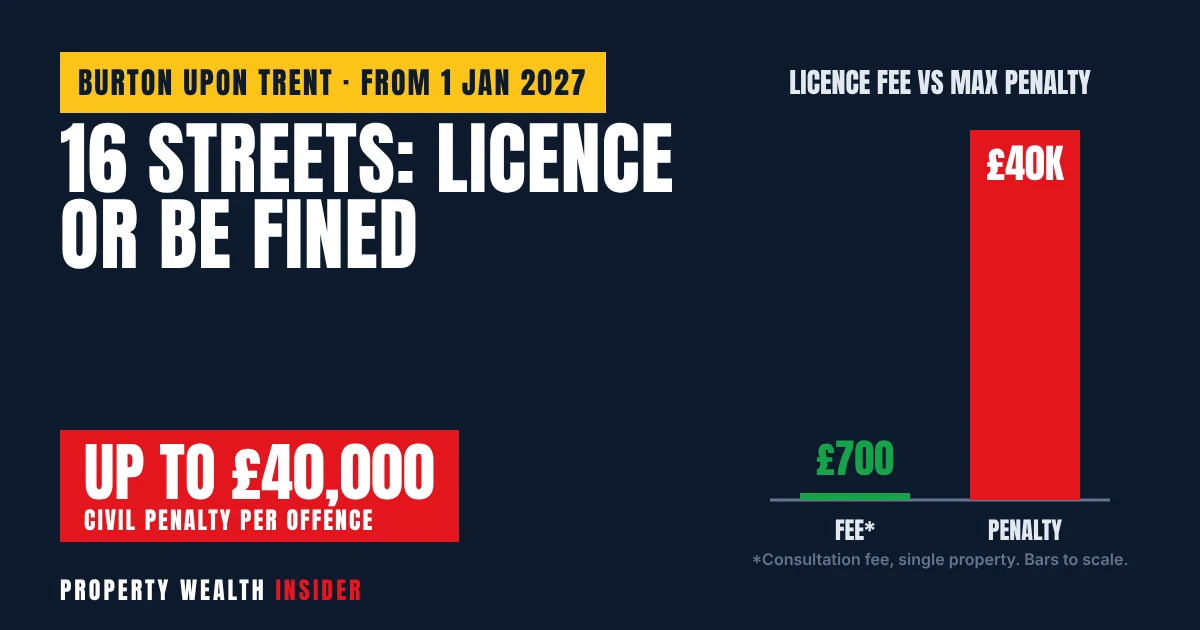
Landlords on 16 streets in Burton upon Trent will need a council licence for every privately rented home from 1 January 2027. East Staffordshire Borough Council has confirmed a new selective licensing designation that runs until 31 December 2031.
That is about ten weeks away. Letting a home in the zone without a licence is a criminal offence. Since 1 May 2026 the council can fine landlords up to £40,000 per offence instead of prosecuting, and tenants can claim back up to two years’ rent.
The scheme covers streets including Derby Street, Horninglow Road, Shobnall Road and Wetmore Road. If you own, let or manage a single flat or house there, it applies to you, not only to portfolio landlords.
Key facts
- Selective licensing applies to 16 named streets in Burton upon Trent, East Staffordshire (England).
- The designation runs from 1 January 2027 to 31 December 2031, which is five years, the legal maximum.
- The council’s consultation set the standard fee at £700 per single-let property and £800 for an HMO, with discounts for early, accredited and multi-property applications.
- For offences from 1 May 2026, the maximum civil penalty is £40,000 (it was £30,000).
- Tenants can seek a rent repayment order of up to 2 years’ rent for an unlicensed home.
- A licence application that is duly made before the start date gives you a legal defence to the offence of letting without a licence.
What East Staffordshire has agreed
Selective licensing is a power under Part 3 of the Housing Act 2004. It lets a council require a licence for almost every privately rented home in a set area, not just HMOs. Councils can only use it on specific grounds, including poor property conditions, anti-social behaviour, low housing demand, deprivation, migration and crime.
The council ran a ten-week consultation from 23 January to 3 April 2026. It proposed licensing on 16 streets chosen for their high share of private rented homes and poor property conditions. At the time the consultation said the scheme would start in October 2026. After the consultation, the council confirmed that the designation will start on 1 January 2027 and end on 31 December 2031.
Councils no longer need approval from the Secretary of State. Under the government’s General Approval 2024, in effect since 23 December 2024, councils can confirm a scheme of any size themselves. A designation cannot come into force until three months after it is made, which is why the start date is New Year’s Day.
This is not East Staffordshire’s first scheme. Its current designation began on 12 September 2022 and covers nine Burton streets, including Queen Street, Branston Road and Uxbridge Street. A designation can last no more than five years, so that scheme must end by September 2027.
The 16 streets in the scheme
These are the 16 streets named in the council’s consultation and in the confirmed scheme. The council has not published a property count by street in the material we could check. Use its designated area map or call the team to confirm your address, because one end of a long road can be treated differently from the other.
| # | Street | # | Street |
|---|---|---|---|
| 1 | Anglesey Road | 9 | Horninglow Road North |
| 2 | Belvedere Road | 10 | Oak Street |
| 3 | Byrkley Street | 11 | Princess Street |
| 4 | Calais Road | 12 | Shobnall Road |
| 5 | Derby Street | 13 | Thornley Street |
| 6 | Edward Street | 14 | Victoria Crescent |
| 7 | High Street | 15 | Wetmore Road |
| 8 | Horninglow Road | 16 | Wyggeston Street |
Watch the names. Shobnall Road is in the new scheme. Shobnall Street is in the current 2022 scheme. Horninglow Road and Horninglow Road North are listed separately.
What it will cost you
The council’s consultation set a standard fee of £700 for a single property and £800 for a house in multiple occupation that does not need a mandatory HMO licence. It said discounts would be available for early applications, accredited landlords and second or later properties. The NRLA’s October 2026 update reports the confirmed fee as £700 per property, with the same three discounts.
We could not find the discount amounts or the final fee schedule published on the council’s website, so check the figure on your invoice. A licence lasts no more than five years and covers one property only. It cannot be transferred if you sell.
Worked example 1: You own one terraced house on Princess Street let at £750 a month. At £700 the licence works out at £140 a year, or about £11.67 a month over the five-year scheme. That is about 1.6% of the rent.
Worked example 2: You own three flats on Derby Street let at £650 a month each. At the full fee you pay £2,100, or £420 a year across the portfolio. Each flat costs about £11.67 a month, which is 1.8% of the rent. A multi-property discount would lower this.
Calculator: licence cost vs penalty risk
Enter your numbers to compare the cost of licensing over the scheme’s life with your maximum exposure if you do not license. The default fee is the £700 from the consultation. Change it if your invoice shows a different amount.
Burton licence cost and risk calculator
Guide only, not legal or financial advice. Maximum exposure assumes the £40,000 statutory cap on a civil penalty per property, plus a rent repayment order for the months entered. Councils set actual penalties under their own enforcement policy, often well below the cap. A tribunal cannot order more than the rent the tenant paid, and universal credit paid towards rent is deducted. The scheme is treated as five years (1 January 2027 to 31 December 2031).
Penalties if you do not license
Under section 95 of the Housing Act 2004, letting a house that should be licensed but is not is an offence. On conviction the fine is unlimited. Since 1 May 2026, the Renters’ Rights Act 2025 has also made superior landlords liable, as well as the person who manages or controls the property. Breaching a licence condition is a separate offence.
Instead of prosecuting, the council can impose a civil penalty under section 249A. From 1 May 2026 S.I. 2026/319 raised the cap from £30,000 to £40,000. The new cap applies only where the offence happened on or after that date, so it covers every offence under the new Burton scheme.
Tenants, or the council where universal credit paid the rent, can also apply for a rent repayment order. For unlicensed-house offences committed from 1 May 2026, section 44 of the Housing and Planning Act 2016 allows repayment of up to two years’ rent, up from 12 months. If you have already received a civil penalty or been convicted, the tribunal must normally order the maximum.
| Sanction | Legal basis | Maximum (offences from 1 May 2026) |
|---|---|---|
| Prosecution for letting unlicensed | Housing Act 2004 s.95(1), (5) | Unlimited fine |
| Civil penalty (instead of prosecution) | Housing Act 2004 s.249A | £40,000 per offence |
| Rent repayment order | Housing and Planning Act 2016 ss.40, 44 | Up to 2 years’ rent |
| Breach of licence condition | Housing Act 2004 s.95(2) | Civil penalty up to £40,000, or a fine on conviction |
Worked example 3: You fail to license a £750-a-month flat for the first two years of the scheme. You face a civil penalty of up to £40,000 and a rent repayment order of up to £18,000, which is £58,000 in total. Licensing would have cost £700.
The council does enforce. It has won an appeal over a £3,673 penalty on a Queen Street landlord who ignored repeated warnings. At the time it said it had issued nine penalties totalling more than £22,000 under the 2022 scheme.
Licence conditions you must meet
Schedule 4 of the Housing Act 2004 sets the conditions every licence must include. The council can add local conditions on top, so read your draft licence closely.
- A gas safety certificate from the last 12 months, produced to the council every year (if the property has gas).
- Electrical appliances and furniture you supply kept safe, with a safety declaration on demand.
- Every electrical installation in proper working order and safe for continued use.
- A working smoke alarm on every storey with living accommodation (bathrooms and toilets count).
- A working carbon monoxide alarm in any room with a fixed combustion appliance other than a gas cooker.
- A written statement of the terms of occupation given to each occupier.
- References demanded from anyone who wants to occupy the property.
- Any extra local conditions in your licence, such as management or anti-social behaviour rules.
What to do now: step by step
- Check your address. Compare it with the 16-street list and the council’s designated area map. If you are not sure, email selectivelicensing@eaststaffsbc.gov.uk or call 01283 508578.
- Check you are not exempt. A property that needs a mandatory HMO licence does not also need a selective licence. Some tenancies are exempt under S.I. 2006/370.
- Get your paperwork together. You need a current gas safety certificate, an electrical safety report, details of your smoke and CO alarms, a copy of your tenancy terms and your referencing process.
- Apply before 1 January 2027. Under s.95(3), an application that is duly made and still effective is a defence to the offence of letting without a licence. The council can grant a licence early, and it starts when the scheme does.
- Ask about discounts. Ask whether you qualify for the early-bird, accreditation or multi-property rates before you pay.
- Fix hazards first. The council inspects for safety and serious hazards. Deal with damp, mould and electrical faults before you apply.
- Diarise renewals. Licences last no more than five years and are not transferable. If you sell, the buyer must apply for a new one.
FAQs
Do I need a selective licence in Burton upon Trent?
You need one from 1 January 2027 if you let a private rented home on one of the 16 designated streets, unless an exemption applies. Homes on the nine streets in the 2022 scheme already need a licence under that designation.
How much is an East Staffordshire selective licence?
The council’s consultation set the fee at £700 for a single property and £800 for an HMO, with discounts available. Check the final amount with the council when you apply.
What is the fine for not having a selective licence?
For offences from 1 May 2026, the council can impose a civil penalty of up to £40,000 or prosecute, where the fine is unlimited. Tenants can also claim back up to two years’ rent.
How long does the Burton licensing scheme last?
It runs from 1 January 2027 to 31 December 2031. That is five years, the maximum the law allows for one designation.
Does selective licensing apply to HMOs?
Large HMOs that need a mandatory HMO licence are licensed under Part 2 instead. Smaller shared houses on the designated streets fall under the selective scheme, at the consultation’s £800 rate.
- East Staffordshire Borough Council: Selective Licensing Scheme
- East Staffordshire Borough Council: Selective Licensing Team wins appeal to enforce financial penalty notice
- Rolleston on Dove Parish Council agenda, February 2026, reproducing the council’s consultation notice (streets, fees, dates)
- NRLA: Your licensing update, October 2026 (confirmed dates and fee)
- Housing Act 2004, section 80
- Housing Act 2004, section 91
- Housing Act 2004, section 95
- Housing Act 2004, section 249A
- Housing Act 2004, Schedule 4
- The Financial Penalties (Housing Offences and Breach of Banning Orders) Regulations 2026
- Housing and Planning Act 2016, section 40
- Housing and Planning Act 2016, section 44
- Housing and Planning Act 2016, section 46
- Renters’ Rights Act 2025 (Commencement No. 2 and Transitional and Saving Provisions) Regulations 2026
- GOV.UK: Selective licensing in the private rented sector, a guide for local authorities
- The Selective Licensing of Houses (Specified Exemptions) (England) Order 2006
This article is news and general guidance only, not financial, legal or tax advice.