24% CGT on inflation ‘gains’ set to stay for landlords
Landlords hoping next week’s Budget would stop Capital Gains Tax biting on inflation look set to be disappointed. The National Residential Landlords Association (NRLA) has asked the Chancellor to tax only the real, inflation-adjusted gain when a rental property is sold. Press reports now suggest John Healey will leave CGT unchanged when he delivers the Budget on Wednesday 28 October 2026.
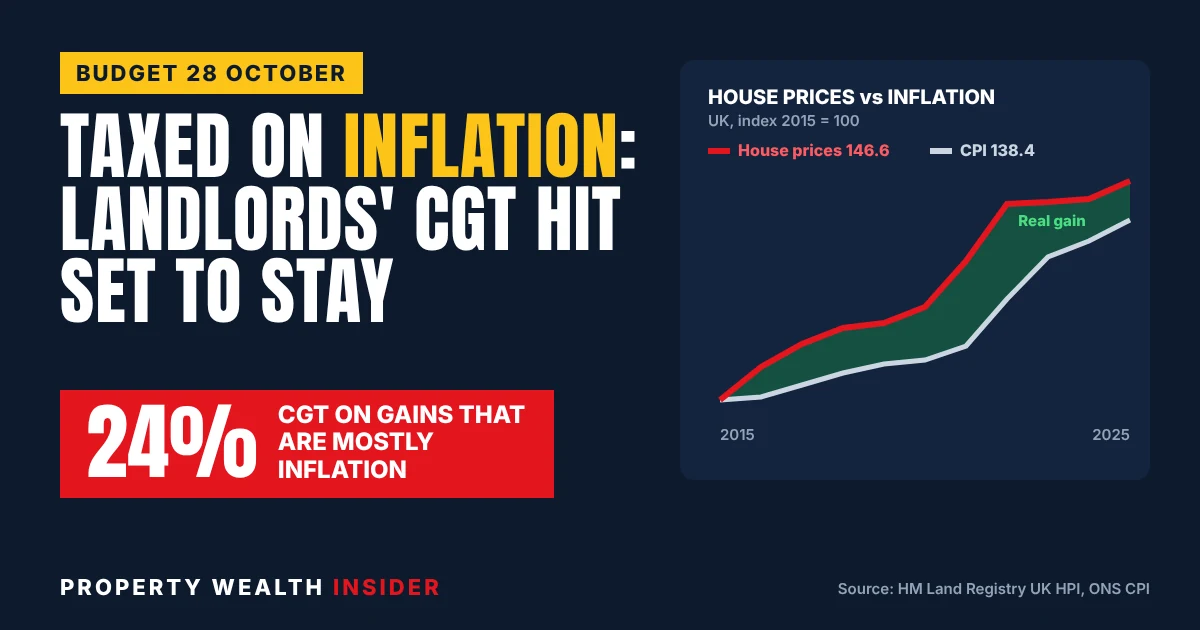
Why does this matter? Anyone who sells a buy-to-let today pays CGT on the full rise in price, even the part that simply kept pace with the cost of living. On a property held for 15 years, that can mean paying 24% tax on a gain that is mostly inflation.
This affects individual landlords selling residential property anywhere in the UK, plus anyone selling a former home that was let out. Below we set out the rules in force now, what the NRLA wants, and a calculator that shows how much of your gain is real.
Key facts
- CGT on gains for individuals is 18% within the basic rate band and 24% above it in 2026/27.
- The annual tax-free allowance is just £3,000, down from £6,000 in 2023/24.
- Sell a UK residential property and you must report and pay any CGT within 60 days of completion.
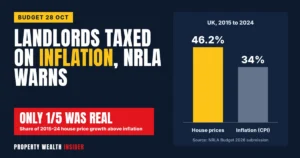
- The NRLA says only about one-fifth of house price growth between 2015 and 2024 was a real-terms gain. Our check of official data gives 21%.
- The Budget is on 28 October 2026. Reports say no CGT changes are planned, but nothing is confirmed until the Chancellor speaks.
What the NRLA wants, and what is expected
In a statement on 16 October 2026, the NRLA called for what it describes as fundamental CGT reform in the Chancellor’s first Budget. It argues that taxing inflation as if it were profit discourages investment in rental homes when supply is already tight.
Its proposal has three parts:
- Tax real gains only. Uplift the purchase price and qualifying capital costs for inflation before working out the gain.
- Reward long-term letting. Link relief to how long a property is held and used to house people, with no relief for quick buy-and-flip deals.
- Safeguards. The relief could not create or increase a loss, and could not exceed actual inflation. Genuine price growth would stay taxable.
Against that, national press reports say the Chancellor is not planning CGT changes at this Budget. Treat that as reporting, not policy: the Treasury has not confirmed it, and nothing is settled until the Budget speech. We will know for sure on 28 October.
How CGT on a rental sale works now
CGT is charged on the gain: the sale price minus what you paid and certain costs. HMRC lets you deduct costs of buying, selling and improving the property, such as estate agent and solicitor fees and improvement works like an extension. Normal maintenance, such as decorating, does not count.
Your rate depends on your income. Add your taxable gains (after the £3,000 allowance) to your taxable income. The part that falls within the £37,700 basic rate band is taxed at 18%. Anything above is taxed at 24%, according to gov.uk.
| Tax year | Rates on residential property gains (individuals) | Annual tax-free allowance |
|---|---|---|
| 2023/24 | 18% and 28% | £6,000 |
| 2024/25 | 18% and 24% (residential rates to 29 October 2024; the same main rates applied after that) | £3,000 |
| 2025/26 | 18% and 24% | £3,000 |
| 2026/27 | 18% and 24% | £3,000 |
Source: HMRC, Capital Gains Tax rates and allowances. Trustees and personal representatives pay 24%.
Former homes. If the property was once your main home, Private Residence Relief can cover the years you lived there, plus the last 9 months of ownership even if you had moved out. Letting Relief now only applies if you lived in the home at the same time as your tenants, and is capped at the lowest of your PRR, £40,000 and the gain made while letting part of the home.
The inflation problem in numbers
We tested the NRLA’s claim against official data. The UK average house price, averaged across each year, rose from £182,291 in 2015 to £260,532 in 2024, a rise of £78,241. Over the same period the ONS Consumer Prices Index rose from 100.0 to 133.9.
Uprate the 2015 price by CPI and it becomes £244,088. So only £16,444 of the £78,241 rise, about 21%, was a real gain. That matches the NRLA’s “about one-fifth”. Run the same sums to 2025 and the real share falls to around 18%.
This is not a new debate. Individuals used to get an indexation allowance that stripped inflation out of gains. HMRC’s own manual records that it was frozen from 1998, when taper relief arrived, and abolished in 2008. Taper relief itself was scrapped for disposals from 6 April 2008.
Calculator: nominal vs real gain
Enter your figures to see the CGT you would pay under today’s rules, what you would pay if only the inflation-adjusted gain were taxed, and your 60-day deadline. The inflation adjustment uses the official ONS CPI index.
CGT on your rental sale: nominal vs inflation-adjusted
Guide only, not tax advice. Uses 2026/27 rates (18% and 24%), the £37,700 basic rate band and the standard £12,570 Personal Allowance (tapered above £100,000). It does not model Scottish income tax bands, losses, reliefs for a former home, or jointly owned property. The “real gain” column shows how the NRLA’s proposal could work; it is not current law. CPI: ONS index D7BT annual averages, with 2026 using the latest month (September 2026: 144.1).
Worked examples
Example 1: the long-term landlord
Sarah bought a flat in 2010 for £150,000, paying £3,000 in buying costs. She spent £10,000 on an extension in 2016. She completes a £290,000 sale in December 2026, paying £4,500 in selling costs. Her other income is £40,000.
- Gain: £290,000 − £4,500 − £150,000 − £3,000 − £10,000 = £122,500.
- After the £3,000 allowance: £119,500 taxable.
- Her taxable income is £27,430 (£40,000 − £12,570), leaving £10,270 of the basic rate band. £10,270 × 18% = £1,848.60; £109,230 × 24% = £26,215.20.
- CGT due: £28,064, payable within 60 days of completion.
Now apply the NRLA’s idea. CPI rose from 89.4 (2010) to 144.1 (September 2026), so her £153,000 purchase cost uplifts to about £246,620, and the extension to about £14,310. Her real gain is roughly £24,576, and the tax on it would be about £4,562. That means around £23,500 of her bill is tax on inflation.
Example 2: the 2015 buyer
Tom bought for £180,000 in 2015 with £4,000 of costs and sold in 2025 for £260,000, paying £4,000 to sell. His income was £30,000. His nominal gain is £72,000 and his CGT bill £15,344. Adjusted for CPI (100.0 to 138.4), his purchase cost becomes £254,656, leaving a real gain of just £1,344. That is below the £3,000 allowance, so under an indexed system he would pay nothing.
The 60-day deadline
Whatever happens at the Budget, this rule is in force now. If you sell a UK residential property and CGT is due, you must report and pay within 60 days of completion using HMRC’s Capital Gains Tax on UK property account. Miss it and you may face interest and a penalty.
UK residents do not need to file the 60-day return if their total gains are below the tax-free allowance. Non-residents must report every disposal of UK property or land within 60 days, even if no tax is owed.
What to do now
- Do not rush a sale on a rumour. Reports suggest no change, but the Budget could still surprise. Wait for the documents on 28 October.
- Work out your gain now. Use the calculator above so you know your likely bill.
- Dig out every receipt. Purchase and sale legal fees, agent fees, and invoices for genuine improvements all cut your gain. Repairs and decorating do not.
- Think about timing. If your income dips in a particular tax year, more of the gain may fall in the 18% band.
- Check former-home reliefs. If you ever lived in the property, Private Residence Relief and the final 9 months rule could cut the bill.
- Set money aside and diarise the deadline. Day 60 from completion is the report-and-pay date.
- Get advice on bigger sales. A tax adviser can check ownership, losses and reliefs before you exchange.
- Completion statement from your original purchase
- Invoices for improvements (extensions, conversions, new rooms), with dates
- Estate agent and solicitor bills for the sale
- Your expected taxable income for the tax year of sale
- Dates you lived in the property, if ever
- HMRC Government Gateway login for the CGT on UK property account
- Deadline: completion date + 60 days, in your diary
FAQs
Will Capital Gains Tax change in the October 2026 Budget?
Press reports suggest the Chancellor is not planning CGT changes, but nothing is confirmed until the Budget on 28 October 2026. Check the official Budget documents on the day.
What is the CGT rate on selling a buy-to-let?
For individuals in 2026/27, it is 18% on gains that fall within the basic rate band once added to your taxable income, and 24% above it. The first £3,000 of gains is tax-free.
Is there still an inflation allowance for CGT?
Not for individuals. Indexation allowance was frozen from 1998 and abolished in 2008, so you pay CGT on the full nominal gain. The NRLA wants a form of inflation relief brought back for property.
How long do I have to pay CGT after selling a rental property?
You must report and pay within 60 days of completion, through HMRC’s Capital Gains Tax on UK property account. Late reporting or payment can lead to interest and a penalty.
Can I deduct refurbishment costs from my gain?
Improvement works, such as an extension, can be deducted. Normal maintenance such as decorating cannot. Keep invoices to prove what was spent and when.
Sources
- NRLA: Capital Gains Tax reform call, 16 October 2026
- HM Treasury: Chancellor’s letter confirming the Budget date
- GOV.UK: Capital Gains Tax rates
- HMRC: Capital Gains Tax rates and allowances by year
- GOV.UK: Tax when you sell property, work out your gain
- GOV.UK: Report and pay CGT on UK property within 60 days
- GOV.UK: Tax when you sell your home (Private Residence Relief, Letting Relief)
- GOV.UK: Income Tax rates and Personal Allowance
- HMRC Capital Gains Manual CG17895: taper relief and indexation
- ONS: CPI index 00 all items, 2015=100 (D7BT)
- HM Land Registry: UK House Price Index
This article is news and general guidance, not financial, legal or tax advice.