LHA frozen again: rents up 18.5% as housing benefit stuck at 2023
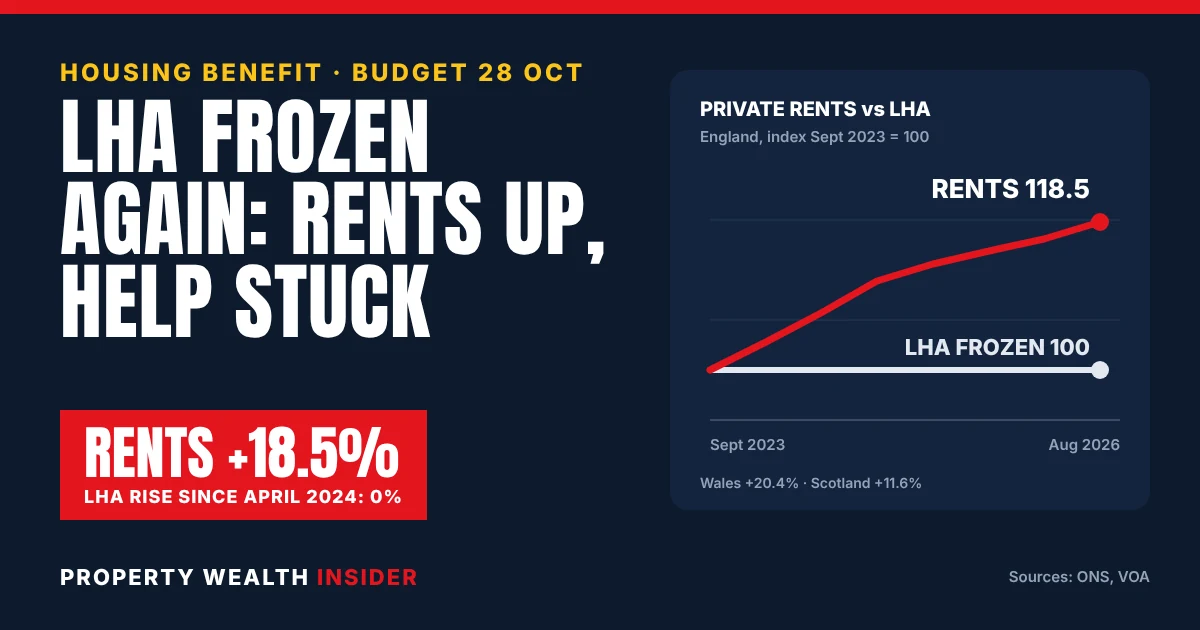
Housing benefit for private tenants has now been frozen for two years running, while rents have kept climbing. With the Chancellor due to deliver the Budget on Wednesday 28 October 2026, eight days from now, the big question for landlords is whether the freeze ends.
Local Housing Allowance (LHA), the cap on how much rent Universal Credit or housing benefit will cover for private tenants, has stayed at April 2024 rates in April 2025 and again in April 2026. Those rates were built from rents agreed in the year to September 2023. Since then, official ONS figures show private rents up 18.5% in England and 20.4% in Wales.
For landlords who let to tenants on benefits, this is not an abstract welfare row. Every pound the LHA falls behind is a pound your tenant has to find from elsewhere, or a pound that ends up as arrears on your rent account.
Key facts
- LHA rates for April 2025 and April 2026 are the same rates set in April 2024, based on lettings data to September 2023.
- ONS figures show average private rents up 18.5% in England and 20.4% in Wales between September 2023 and August 2026 (Scotland: 11.6%).
- Across England’s 152 rental areas, the 30th percentile 2-bed rent for the year to September 2025 is a median 15.4% higher than the frozen 2-bed LHA.
- In Central Greater Manchester the frozen 2-bed LHA is £201.37 a week, against a 30th percentile of £241.64: a gap of about £174 a month.
- The Budget is on 28 October 2026. No change to LHA has been announced.
How far behind LHA has fallen
The ONS Price Index of Private Rents was 18.5% higher in England in August 2026 than in September 2023, the month the current LHA data runs to. Wales is up 20.4% and Scotland 11.6%. LHA has not moved at all over the same period.
The government’s own figures show the gap area by area. Rent officers still calculate the 30th percentile of local rents every year, and the April 2026 tables publish them for the year to September 2025. Compared with those figures, the 30th percentile 2-bed rent is a median 15.4% higher than the frozen rate across England, and more than 30% higher in Tameside & Glossop and Bolton and Bury.
Citizens Advice, which made a similar case in its Falling Behind briefing last year, has urged the government to unfreeze LHA in the Budget.
How LHA is worked out, and why it has fallen behind
LHA applies to private tenants claiming the housing element of Universal Credit or housing benefit in England, Wales and Scotland. Rent officers split the country into broad rental market areas (BRMAs). For each one, they take a year of lettings evidence and find the 30th percentile: the rent that 30% of homes in that area cost or less.
A tenant’s support is the lower of their actual rent and the LHA rate for their area and household. Which rate applies depends on how many bedrooms the household is entitled to, not how many the home has:
- Shared accommodation rate (SAR): most single people under 35 with no children. Exceptions include care leavers under 25, people who have spent at least three months in a homeless hostel, some disabled people (for example on the PIP daily living component), and victims of domestic abuse or modern slavery.
- 1-bed rate: single people aged 35 or over, or couples with no children.
- Larger rates: one bedroom for each adult couple, each other adult aged 16 or over, two children of the same sex under 16, or two children under 10. Extra rooms can apply for a non-resident overnight carer or a child who can’t share because of a disability.
- 4-bed cap: there is no LHA rate above four bedrooms, and weekly maximums apply nationally (for example £412.86 for 2 bedrooms), which is why Central London’s 2-bed rate is capped far below the local market.
The 30th percentile figures are still calculated every year. The April 2026 rate tables publish them for the 12 months to September 2025. But under the Rent Officers (Modification) Order 2026, they were set aside and the April 2024 rates carried forward, exactly as happened in April 2025. The April 2024 rates themselves were based on lettings to the end of September 2023.
Scotland’s rates are frozen at the same 2024 levels, the Scottish Government confirms. Northern Ireland runs a separate system with its own eight BRMAs; its 2026/27 LHA rates are also frozen at 2025/26 levels.
The gap in eight areas
The government’s own rate tables let you measure the gap directly. The table compares the frozen 2-bed rate with the 30th percentile figure rent officers calculated for the year to September 2025, which was set aside. Rents have kept rising since then, so treat these as minimum gaps.
| Area (BRMA) | 2-bed LHA now (£/week) | UC monthly rate | 30th percentile, year to Sept 2025 (£/week) | Gap (£/month) | Gap % |
|---|---|---|---|---|---|
| Outer East London | £322.19 | £1,400.00 | £379.73 | £249 | 17.9% |
| Bristol | £252.00 | £1,095.00 | £287.67 | £155 | 14.2% |
| Central Greater Manchester | £201.37 | £875.00 | £241.64 | £174 | 20.0% |
| Birmingham | £172.60 | £750.00 | £205.97 | £145 | 19.3% |
| Leeds | £178.36 | £775.00 | £189.86 | £50 | 6.4% |
| Greater Liverpool | £136.93 | £595.00 | £166.85 | £130 | 21.9% |
| Tyneside | £126.58 | £550.00 | £149.59 | £100 | 18.2% |
| Sunderland | £109.32 | £475.00 | £126.58 | £75 | 15.8% |
Weekly rates and 30th percentiles from the VOA’s 2026-27 LHA tables; monthly figures from DWP’s Universal Credit LHA rates 2026 to 2027. Gap per month = weekly gap × 52 ÷ 12. Across all 152 English areas, the median 2-bed gap is 15.4%.
The wider market tells the same story. The ONS Price Index of Private Rents puts the average rent in England at £1,459 a month in August 2026, against £1,232 in September 2023. In Wales it rose from £702 to £846.
What it means for landlords: worked examples
A shortfall doesn’t automatically mean arrears. Many tenants top up from wages or other benefits. But the freeze shrinks that margin every month, and three situations come up most often.
Example 1: a 2-bed in Manchester
You let a 2-bed in the Central Greater Manchester BRMA for £1,050 a month. A tenant on Universal Credit entitled to two bedrooms gets £875 a month towards housing. They must find £175 a month, or £2,100 a year, from the rest of their income.
If they can only manage part of it, arrears build fast. A tenant who pays nothing towards the gap would owe £1,050, one full month’s rent, after six months. That is the point at which DWP guidance lets a landlord ask for a managed payment (see below).
Example 2: a single tenant aged 34 in Birmingham
A 34-year-old single tenant wants your £800-a-month one-bed flat. Unless an exception applies, they get the shared accommodation rate: £341.58 a month in Birmingham. The shortfall is £458.42 a month. On their 35th birthday they move to the 1-bed rate of £695.00, and the shortfall falls to £105.
Check age and exemptions before you agree the let. That single rule makes a four-fold difference.
Example 3: a family hitting the benefit cap
A larger family renting a 3-bed may have a generous LHA on paper but still not receive it. The benefit cap limits total benefits for most working-age households to £1,835 a month for couples and single parents outside Greater London, or £2,110.25 inside it. Any LHA rise in the Budget could be partly or fully swallowed by the cap unless the household is exempt, for example by earning at least £881 a month combined after tax.
LHA shortfall checker
Plug in the rent and your tenant’s LHA rate to see the monthly gap, and what a Budget uprating would do to it. Pick an area and bedroom entitlement to load a real 2026-27 rate, or type your own.
LHA shortfall checker
Guide only, not advice. Presets are 2026-27 weekly LHA rates from the VOA tables. Look up your tenant's own area on the LHA Direct tool. Universal Credit uses a published monthly figure that can differ from weekly × 52 ÷ 12 by a few pounds. The real award can be lower because of income, deductions or the benefit cap.
What to watch in the Budget on 28 October
The Chancellor has confirmed the Budget date as Wednesday 28 October 2026. Nothing has been announced on LHA, so everything below is what to look for, not what is happening.
- A full relink to the 30th percentile. This is what campaigners want. If rates were reset to the September 2025 figures already sitting in the VOA tables, the Manchester 2-bed would go from £201.37 to £241.64 a week.
- A partial or one-off uprating. A rise using older data, or a flat percentage, would narrow gaps but not close them. Use the checker above to test different percentages.
- Timing. LHA changes normally take effect in April. Even good news on 28 October is unlikely to reach tenants’ payments before April 2027.
- Another freeze. If nothing is said, assume April 2027 rates stay at April 2024 levels and plan your lets on that basis.
- The benefit cap. If LHA rises but the cap doesn’t, capped households may see little or no extra help.
What to do now
- Check the real entitlement. Look up the BRMA and rate on LHA Direct, then confirm the tenant’s bedroom entitlement and age. For Universal Credit, use DWP’s monthly rate tables.
- Work out the gap before you sign. Use the checker. Talk honestly with the applicant about how they will cover it: wages, other benefits, or a guarantor.
- Set rent with the LHA in mind. If you want to keep a good benefit tenant long term, a rent at or near the LHA can cost less than a void or a possession claim. Run both numbers.
- Point tenants to local help. In England, Discretionary Housing Payments ended on 31 March 2026. Councils now pay a Housing Payment from the Crisis and Resilience Fund to UC or housing benefit claimants with a housing cost shortfall. In Wales and Scotland, tenants can still apply for a Discretionary Housing Payment. These are discretionary, usually short-term awards.
- Act early on arrears. Under DWP’s alternative payment arrangements guidance, you can ask for the housing element to be paid to you (a managed payment) when arrears reach two months’ rent, or when the tenant has underpaid for more than two months and owes at least one month’s rent. Apply through the Apply for a Direct Rent Payment service. The tenant has 7 days to object, and their UC is paused until a decision.
- Keep records. A clear rent ledger is the evidence DWP will ask for if the tenant disputes the arrears.
- Tenant’s BRMA and LHA rate checked on LHA Direct
- Bedroom entitlement confirmed (age 35 rule, children, carers)
- Monthly shortfall calculated and discussed with the tenant
- Benefit cap position checked for larger households
- Tenant told about Housing Payment (England) or DHP (Wales and Scotland)
- Rent ledger up to date and arrears thresholds noted
- Diary note to check LHA announcements after 28 October
FAQ
Is Local Housing Allowance frozen in 2026?
Yes. The rates in force from 1 April 2026 are the same as those set in April 2024, in England, Wales and Scotland. Northern Ireland’s 2026/27 rates are also frozen.
When will LHA rates go up?
No increase has been announced. Any change is likely to be set out at a fiscal event such as the Budget on 28 October 2026 and would normally take effect from April.
How is the LHA rate calculated?
Rent officers find the 30th percentile of rents in each broad rental market area for each size of home, subject to national maximums. A tenant gets the rate for the number of bedrooms their household is entitled to, or their actual rent if that is lower.
Can a landlord get Universal Credit paid directly?
Yes, in some cases. You can request a managed payment if arrears reach two months’ rent, or one month’s rent after more than two months of underpaying, using the online Apply for a Direct Rent Payment service. In Scotland, tenants can also choose to have their housing payment sent straight to their landlord.
What is the shared accommodation rate?
It is the LHA rate for a single room in a shared house. It applies to most single people under 35 without children, unless they fall into an exempt group such as care leavers under 25 or some disabled claimants.
Do Discretionary Housing Payments still exist?
Not in England, where they were replaced by the Housing Payment part of the Crisis and Resilience Fund on 1 April 2026. They still exist in Wales and Scotland.
Sources
- VOA: Local Housing Allowance rates April 2026 to March 2027 (tables)
- DWP: Universal Credit Local Housing Allowance rates 2026 to 2027
- The Rent Officers (Housing Benefit and Universal Credit Functions) (Modification) Order 2026
- VOA: LHA rates April 2024 to March 2025
- ONS: Price Index of Private Rents, monthly price statistics (16 September 2026)
- ONS: Private rent and house prices, UK: September 2026
- HM Treasury: Chancellor’s letter confirming the Budget date
- GOV.UK: Housing costs and Universal Credit
- DWP: Universal Credit alternative payment arrangements
- DWP: Crisis and Resilience Fund guidance for local authorities in England
- GOV.UK: Benefit cap amounts
- Scottish Government: LHA rates 2026 to 2027
- Northern Ireland Housing Executive: LHA rent levels
- Citizens Advice: Falling Behind briefing on the LHA freeze
This article is news and general guidance only. It is not financial, legal or tax advice.