£150 Warm Home Discount: Is Your Tenant Missing Out?
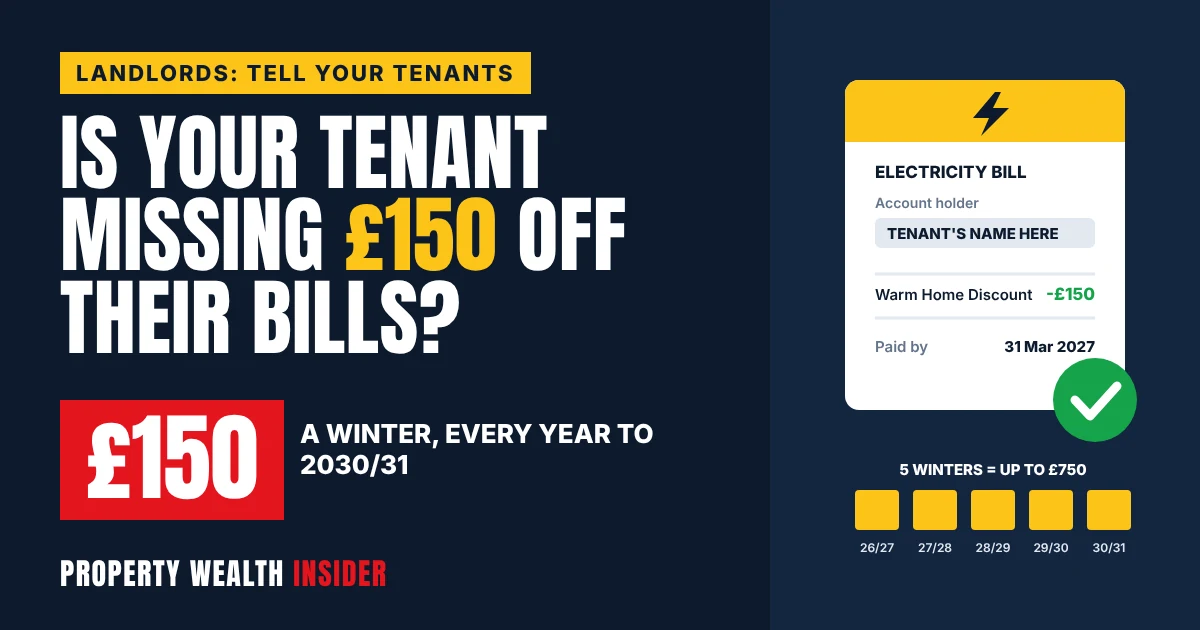
Thousands of tenants could lose out on a £150 cut to their electricity bills this winter for one simple reason: their name is not on the bill. The Warm Home Discount has been renewed for five more winters, to 2030/31, and the letters confirming who gets it start landing between late October 2026 and early January 2027.
The landlord body the NRLA is urging landlords to remind tenants to check they qualify, especially tenants whose energy is included in the rent. Landlords can’t claim the discount themselves, but they can make it much easier for tenants to get it, and the same tenants can open the door to a government-funded upgrade of up to £33,200 for the property.
This guide covers who qualifies in England, Wales and Scotland, why all-inclusive lets and HMOs usually miss out, what you can do about it, and how the Warm Homes: Local Grant works for landlords in England.
Key facts
- The Warm Home Discount is a one-off £150 discount off the electricity bill each winter. It is not paid as cash.
- Government has confirmed the scheme will run for five more years, 2026/27 to 2030/31.
- To qualify for 2026/27, the tenant (or partner) had to be getting a qualifying benefit and be named on the electricity bill on 23 August 2026.
- In England and Wales, 96% of recipients got it automatically in 2025/26. Anyone told to call the helpline must do so by 26 February 2027.
- 17.4% of privately rented households got the rebate in 2025/26, out of 5.52 million core-group households across Great Britain.
- Warm Homes: Local Grant (England only): one rental home per landlord fully funded (up to £33,200), then a 50% landlord contribution.
What has been announced
The previous scheme regulations ran out on 31 March 2026. In January 2026 the Department for Energy Security and Net Zero (DESNZ) published its response to its consultation, confirming the scheme continues for a five-year period from winter 2026/27 to winter 2030/31.
Eligibility in England and Wales stays as it was in 2025/26, when the old “high cost to heat” test was scrapped. Now anyone named on the bill who gets a qualifying means-tested benefit can get it. The two old groups have been merged into a single “Core Group”. Government estimates around 6 million households across Great Britain get the rebate.
The discount is funded through a levy on all domestic energy bills. The DESNZ impact assessment puts the 2025/26 cost at around £974 million, or about £39 on the average dual-fuel bill. Your own tenants are paying for it either way, so it makes sense for eligible ones to claim it.
Which tenants qualify, nation by nation
The rules differ by nation, and Northern Ireland is not covered at all. For 2026/27 the key test date was 23 August 2026, according to the official gov.uk guidance.
| Nation | Who qualifies (2026/27) | How it is paid |
|---|---|---|
| England and Wales | On 23 August 2026: supplier is in the scheme; tenant or partner gets Universal Credit, Housing Benefit, income-related ESA or Pension Credit; tenant or partner named on the electricity bill | Mostly automatic through DWP data matching. Some households get a letter asking them to call the helpline by 26 February 2027 |
| Scotland: Core Group | Same supplier and bill-name tests on 23 August 2026, plus Pension Credit; or Universal Credit with an extra amount for disability; or a disability or pensioner premium of income-related ESA; or a child under 5 at home with unemployed Universal Credit or income-related ESA (plus some mortgage-interest loan cases) | Automatic |
| Scotland: Broader Group | Other low-income households who meet the supplier’s own criteria | Apply to the electricity supplier. Places are limited, so apply early |
| Northern Ireland | Not covered | See the Affordable Warmth scheme |
Prepayment meters still qualify. The supplier will usually send a top-up voucher or credit the meter instead. If the same company supplies gas and electricity, the tenant may be able to have it applied to the gas bill instead. It does not affect Cold Weather Payments or Winter Fuel Payments.
The supplier must be in the scheme. The gov.uk list includes British Gas, EDF, E.ON Next, Octopus Energy, OVO, ScottishPower, So Energy, Utilita and Utility Warehouse, among others.
Worked example: a tenant in a one-bed flat in Cardiff has claimed Universal Credit since 2024 and has had the Octopus account in their own name since moving in. They should get £150 off automatically by 31 March 2027 without doing anything. If nothing changes, that’s £750 over the five winters to 2030/31.
Bills included in rent: HMOs and all-inclusive lets
This is the biggest trap for renters. The rebate goes onto an electricity account, and the person getting the benefit (or their partner) must be named on it. Where the landlord or agent holds the account and recharges tenants through the rent, nobody in the property meets that test.
In its consultation response, government acknowledged that the need for “a direct relationship with your energy supplier” leaves out households who pay for energy through a landlord. It decided that widening support to them could not be funded within the existing budget, so the rule stays for now.
Worked example: a six-room bills-included HMO in Manchester has three tenants on Universal Credit. The electricity account is in the landlord’s name, so none of them qualifies, and the household misses out on the £150 it could have had. A single account can only get one discount, so even switching the whole house’s account into one tenant’s name would bring in £150, not £450. That’s why the decision for HMOs is mostly about future lets, not this winter.
What landlords can realistically do:
- Single lets with bills included: consider moving the electricity account into the tenant’s name at the next renewal. If the tenant qualifies, that’s worth £150 a winter to them.
- HMOs on one meter: the account usually has to stay with you. Point eligible tenants to the helpline on 0800 030 9322 to confirm their position, and in Scotland to their own supplier’s support.
- New tenants: at check-in, ask them to put the account in their own name quickly. Anyone who wasn’t named on the bill on 23 August 2026 has missed this winter’s discount. Next year’s qualifying date has not been published yet.
Warm Home Discount eligibility checker
Send this to a tenant, or go through it together. It uses the 2026/27 rules published on gov.uk and assumes the £150 rebate continues each winter to 2030/31.
Warm Home Discount eligibility checker
Guide only, based on the gov.uk rules for 2026/27. It is not a decision on eligibility. DWP data matching and the helpline decide the outcome, and Scottish suppliers set their own Broader Group criteria. Helpline: 0800 030 9322.
How many renters get it
The 2025/26 expansion was a big change. Official DESNZ statistics show 5.52 million households in Great Britain got core-group rebates, up about 2.3 million on the year before, with 96% paid automatically. In Great Britain, 17.4% of privately rented households got the rebate, compared with 49.1% in social housing and 9.1% of owner-occupiers.
Warm Homes: Local Grant: the upgrade money for landlords
Tenants who get the Warm Home Discount often also qualify a property for the Warm Homes: Local Grant. That grant funds insulation, heat pumps, solar panels and smart controls through local councils. It is England only. Wales and Scotland run their own schemes.
Under the DESNZ policy guidance updated in July 2026, the property must be privately owned (owner-occupied or privately rented), have an EPC of D to G, and house a low-income household. The household qualifies through any one of three routes: living in an eligible low-income postcode; getting a means-tested benefit (including Universal Credit, Housing Benefit, income-related ESA and Pension Credit); or having a gross household income under £36,000, or under the after-housing-costs thresholds.
Cost caps were raised in July 2026 to £16,600 for energy performance work plus £16,600 for low carbon heating per home, as an average across each council’s project. For landlords, the guidance says:
| Private rented home | Max grant | Landlord contribution required |
|---|---|---|
| First property (one per landlord, fully funded) | £33,200 (£16,600 + £16,600) | £0 |
| Second and later properties | £16,600 (£8,300 + £8,300) | 50% of cost (£16,600 at the cap) |
Worked example: a landlord owns three EPC E terraces in Stoke-on-Trent, each let to a tenant on Universal Credit. The council’s survey recommends a £14,000 insulation and controls package for the first house, which is fully funded, so the landlord pays £0. A £16,000 package on the second house is split 50:50, with £8,000 from the grant and £8,000 from the landlord. The tenant pays nothing either way.
There are conditions. Landlords sign a declaration and must not raise rents as a direct result of the upgrades. The grant counts as a subsidy, capped at £315,000 of Minimal Financial Assistance over three financial years. Homes rated F or G need a registered exemption under the minimum energy efficiency rules, because the grant can’t be used just to bring a home up to the legal minimum. Funding runs from April 2025 to March 2028 and depends on your council still having money left, so check early.
What landlords should do now: step by step
- Map your lets. List which properties have electricity in the tenant’s name and which are bills-included.
- Send a short reminder now. Tell tenants that letters arrive from late October 2026 to early January 2027, and give them the helpline (0800 030 9322, Monday to Friday 8am to 6pm).
- Flag the deadline. Anyone asked for more information, or who hears nothing by early January, must contact the helpline before 26 February 2027.
- Scotland: tell tenants who aren’t in the automatic group to apply to their supplier straight away, because Broader Group places are limited.
- Review bills-included single lets before the next renewal, and add an “electricity account in your name” step to new-tenant check-in.
- England: check the Local Grant. If a tenant is on benefits or under the income threshold and the EPC is D to G, start the application on gov.uk and pick your first, fully funded property carefully.
- Electricity account holder recorded for every property
- Warm Home Discount reminder sent to all tenants
- Helpline number 0800 030 9322 shared, with the 26 February 2027 deadline
- Supplier checked against the gov.uk participating list
- Bills-included lets reviewed for renewal
- Check-in pack updated: tenant puts electricity in own name
- EPC ratings checked (D to G may qualify for the Local Grant in England)
- Council Warm Homes: Local Grant funding status checked
FAQ
Can a tenant get the Warm Home Discount if bills are included in the rent?
Usually not. The tenant or their partner must be named on the electricity bill on the qualifying date, which was 23 August 2026 for this winter. If the landlord or agent holds the account, the tenant doesn’t meet that test.
How much is the Warm Home Discount in 2026/27?
£150, taken off the electricity bill (or the gas bill, if the supplier agrees) by 31 March 2027. It is not paid in cash. Prepayment customers usually get a voucher or credit.
Do I need to apply for the Warm Home Discount?
In England and Wales, almost never: 96% of rebates were paid automatically in 2025/26. Some people get a letter asking them to call the helpline. In Scotland, people outside the automatic Core Group must apply to their supplier.
How long has the Warm Home Discount been extended for?
Five winters, from 2026/27 to 2030/31, under the government response published in January 2026.
Can landlords get a grant for insulation if their tenant is on benefits?
In England, yes, through the Warm Homes: Local Grant, if the home is EPC D to G and the council has funding. One property per landlord is fully funded (up to £33,200). After that, landlords pay 50%.
What is the Warm Home Discount helpline number?
0800 030 9322, Monday to Friday, 8am to 6pm. Relay UK users dial 18001 then 0800 229 4325.
Sources
- GOV.UK: Warm Home Discount Scheme (eligibility, dates, helpline, suppliers)
- DESNZ: Continuing the Warm Home Discount Scheme, government response (January 2026)
- DESNZ: Continuing the Warm Home Discount Scheme, impact assessment
- DESNZ: Warm Home Discount statistics, 2025 to 2026
- DESNZ: Warm Home Discount data tables 2025/26
- GOV.UK: Apply for the Warm Homes: Local Grant
- DESNZ: Warm Homes: Local Grant policy guidance (July 2026)
- NRLA: Warm Home Discount extended
This article is news and general guidance only, not financial, legal or tax advice.