Connells: 1.5% house price growth in 2027 won’t beat inflation
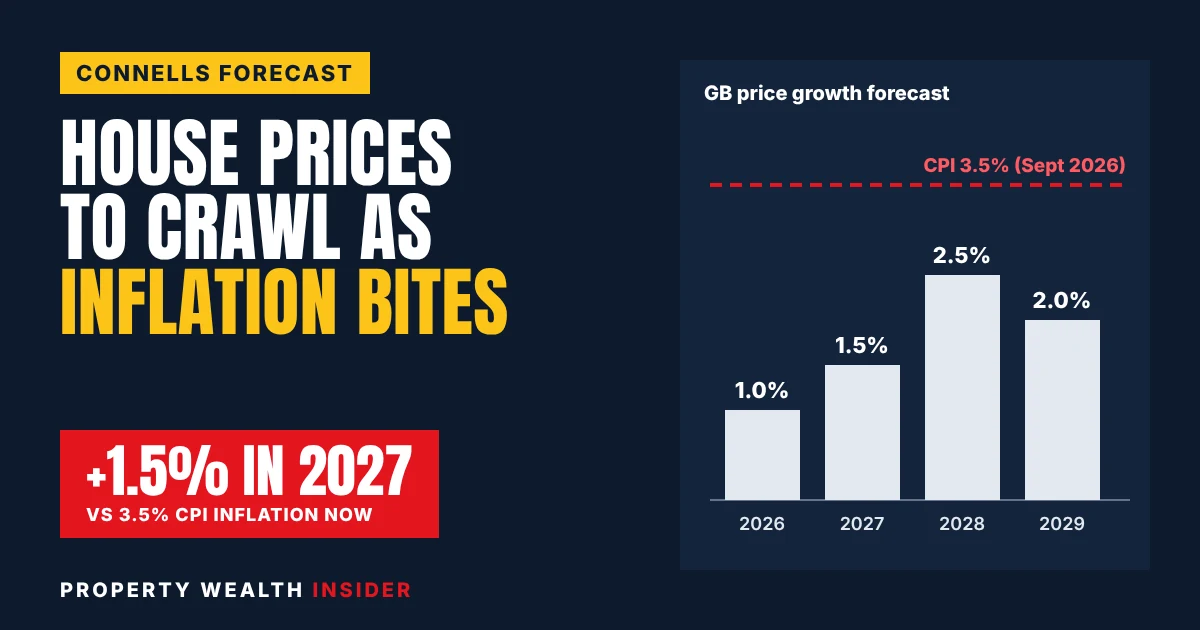
Landlords waiting for a house price boom to rescue their numbers should not hold their breath. Connells Group, one of Britain’s biggest estate agency and lettings groups, published forecasts on 2 November 2026 predicting house price growth of just 1.5% in 2027, peaking at 2.5% in 2028 before easing to 2% in 2029.
With CPI inflation running at 3.5%, that means property values are still shrinking in real terms. Connells says prices are on course to rise more slowly than inflation for a fourth year in a row in 2026, with sales running around 100,000 below where it expected at the start of the year.
For buy-to-let investors across Great Britain, the message is blunt: for the next few years, returns will have to come from rent, sensible borrowing and buying well, not from riding a rising market.
Key facts
- Connells forecasts GB house prices up 1.0% in 2026, 1.5% in 2027, 2.5% in 2028 and 2.0% in 2029 – a cumulative 7.2% from Q4 2025 to Q4 2029.
- Completions forecast at around 1.1 million in 2027, just under 1.2 million in 2028 and around 1.1 million in 2029.
- CPI inflation hit 3.5% in September 2026, up from 3.1% in August (ONS).
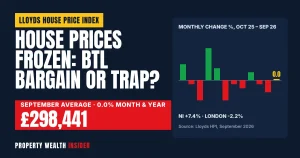
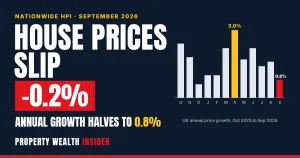
- Nationwide’s October index shows annual price growth slowing to 0.5%, the weakest since January 2024.
- Average mortgage rate paid by Connells’ buyers rose from 4.14% at the start of 2026 to 5.22% in October.
- London is forecast to fall 1.0% in 2026 before rising 2.0% in 2027.
The Connells forecast year by year
Connells’ forecasts cover Great Britain and are built on the ONS House Price Index. The 2026 figure is the change over the year to the fourth quarter. The full set is below.
| Year | GB house price growth | London | GB completions |
|---|---|---|---|
| 2026 | 1.0% | -1.0% | About 100,000 below Connells’ start-of-year expectation |
| 2027 | 1.5% | 2.0% | Around 1.1 million |
| 2028 | 2.5% | 2.5% | Just under 1.2 million |
| 2029 | 2.0% | Not given | Around 1.1 million |
| Q4 2025 to Q4 2029 | 7.2% cumulative | – | – |
The forecast rests on mortgage rates easing. Connells assumes no more than two Bank Rate rises over the next six months, while financial markets are pricing in four or five over the next year. Bank Rate is currently 3.75%, and the next Monetary Policy Committee decision is due on 5 November 2026.
Research director Aneisha Beveridge spelled out the downside risk: “if rates remain around 5%, the risk of small house price falls in 2027, rather than growth, increases significantly.”
Connells has published no rent forecast alongside these figures.
Why “rising” prices are really falling
A house price that rises 1% while everyday prices rise 3.5% buys less than it did a year ago. That is a real-terms fall, even though the number on the valuation goes up.
Connells puts the gap starkly: over the past five years CPI has risen 21.8%, while house prices across Great Britain have risen 10.9% and London prices just 0.9%. Beveridge said that “fewer moves have not translated into widespread price falls”, because wage growth has supported affordability and inflation has quietly done the correcting instead.
The bars only clear today’s inflation rate if inflation falls. Connells expects inflation to be close to the Bank’s 2% target by 2028, which is why its forecast has prices edging back into real growth that year. If inflation stays higher for longer, even the 2028 peak would be a real-terms loss.
Where the market is right now
The official numbers back up Connells’ gloomy tone. Here is the latest from each primary source.
| Measure | Latest figure | Source and period |
|---|---|---|
| UK average house price | £273,000, up 0.9% a year (down from 1.2% in July) | UK HPI, August 2026 |
| England / Wales / Scotland | +0.4% / +3.1% / +2.9% | UK HPI, August 2026 |
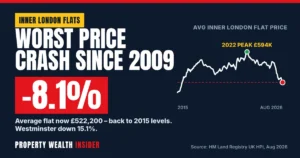
| London average price | £554,430, down 2.2% a year | UK HPI, August 2026 |
| Nationwide annual growth | 0.5% (from 0.8% in September); average £273,566 | Nationwide, October 2026 |
| CPI inflation | 3.5% (from 3.1% in August) | ONS, September 2026 |
| Average UK private rent | £1,406 a month, up 3.8% a year | ONS, September 2026 |
| UK residential transactions | 94,800 (seasonally adjusted), 4% lower than a year earlier | HMRC, September 2026 (provisional) |
| Bank Rate | 3.75% | Bank of England, held 17 September 2026 |
Nationwide’s chief economist Robert Gardner said “forward-looking indicators suggest further softness in the near term”, pointing to weak buyer enquiries, a dip in consumer confidence and markets expecting Bank Rate rises.
One bright spot for landlords: rents are still rising faster than prices. UK rents rose 3.8% in the year to September, against house price growth of 0.9% to August. That gap is what keeps yields from collapsing in a flat market.
What it means for a landlord: worked examples
Example 1: the 2026 squeeze
Take a property worth the UK average of £273,000. A 1% rise adds £2,730 on paper. But with inflation at 3.5%, the new value is worth about £266,406 in today’s money, a real-terms loss of roughly £6,600.
Example 2: following the Connells path to 2029
A £250,000 buy-to-let growing at 1.5%, 2.5% and 2% over 2027 to 2029 would be worth about £265,300, a nominal gain of around £15,300. If inflation averaged 2.5% a year over those three years (our assumption, not a Connells figure), that value is worth about £246,350 in today’s money. You would be roughly £3,650 worse off in real terms, before rent.
Example 3: why leverage and inflation cut both ways
Put down a 25% deposit of £62,500 on the same £250,000 property. A 1.5% rise in 2027 adds £3,750, which is a 6% return on your cash. And inflation shrinks your debt too: a £187,500 mortgage loses about £6,340 of real value in a year of 3.5% inflation.
The catch is the interest. At 5.22%, the average rate Connells’ homebuyers were paying in October (buy-to-let rates vary), interest on £187,500 is about £9,790 a year. Whether a leveraged landlord wins or loses now depends almost entirely on whether rent covers that bill comfortably.
Real return calculator
Plug in your own property to see what Connells-style growth means once inflation is stripped out, and how much your net rent has to do. Defaults use the UK average price and rent from the ONS.
Real return calculator
Guide only, not financial advice. Rent and costs are held flat and no tax, buying or selling costs are included. Connells’ forecasts are for Great Britain as a whole; your area will differ.
On the defaults (£273,000 property, £16,872 rent, £13,000 costs, 2.5% inflation, five years) the property is worth about £301,400 in cash terms but around £6,600 less than today in real terms. Net rent turns that into a real gain of roughly £11,400.
London, the North East and Scotland
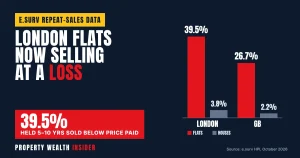
The split across the country is wide. Connells expects London prices to fall 1% in 2026, with inner London down 4.5% and outer London down 0.5%. It then sees outer London rebounding 3% in 2027 and inner London edging up 0.5%.
The strongest performers are tipped to be the North East and Scotland, each forecast to grow 4% in 2028, with cumulative growth to Q4 2029 of 13.1% and 12.5% respectively. Southern markets are expected to benefit from lower rates, but stretched affordability and property tax costs should keep their recovery subdued.
For landlords this matters more than the national number. A North East property following Connells’ regional path would comfortably beat 2% inflation; a central London flat on the inner London path may not keep pace for years.
What to do now
- Re-run your numbers on real returns. Use the calculator above with your own rent, costs and a realistic inflation figure. If the real total is negative, act now rather than hoping for growth.
- Stress-test your mortgage. Connells’ own warning is that rates staying near 5% raises the risk of small price falls in 2027. Check your fixed-rate end date and what a 5% to 6% product does to your cash flow.
- Watch 5 November. The Bank of England’s next rate decision will shape whether Connells’ “no more than two rises” assumption holds.
- Focus on yield, not capital growth. With rents rising 3.8% against prices up 0.9%, buy and hold decisions should be judged on net yield first.
- Look regionally. If you are buying, the forecasts favour the North East and Scotland over inner London. Check local figures on the UK House Price Index before committing.
- Price realistically if selling. With completions forecast at around 1.1 million in 2027 and Nationwide growth at 0.5%, over-ambitious asking prices will sit.
- Calculated my real (inflation-adjusted) return for each property
- Noted every fixed-rate end date and the likely refinance rate
- Checked rent against the local market and planned any increase properly
- Reviewed running costs and void allowance for 2027
- Checked my area’s latest UK HPI figures, not just the national average
- Decided whether each property is a hold, improve or sell
FAQ
Will house prices go up in 2027?
Connells forecasts a 1.5% rise across Great Britain in 2027. It warns that if mortgage rates stay around 5%, small falls become significantly more likely.
What does a real-terms fall in house prices mean?
It means prices are rising more slowly than inflation, so a home buys less in goods and services than before. A 1% price rise with 3.5% inflation is a real fall of about 2.4%.
How many homes will be sold in 2027?
Connells expects around 1.1 million completions in Great Britain in 2027, just under 1.2 million in 2028 and around 1.1 million in 2029.
Will London house prices fall?
Connells forecasts a 1% fall in London in 2026, then 2% growth in 2027. The latest UK HPI shows London prices down 2.2% in the year to August 2026.
Is buy-to-let still worth it if prices barely rise?
It can be, but the return has to come mainly from net rent. If rent comfortably covers interest and costs, a property can still make a real gain even while its value falls in real terms. Run your figures through the calculator above.
Sources
- Connells Group: House price growth to remain modest (2 November 2026)
- UK House Price Index summary: August 2026
- ONS: Consumer price inflation, UK: September 2026
- ONS: Private rent and house prices, UK (latest)
- Nationwide House Price Index: October 2026
- HMRC: UK monthly property transactions commentary
- Bank of England: Bank Rate
This article is news and general guidance only. It is not financial, legal or tax advice.