Landlord confidence crashes to 23% even as 85% turn a profit
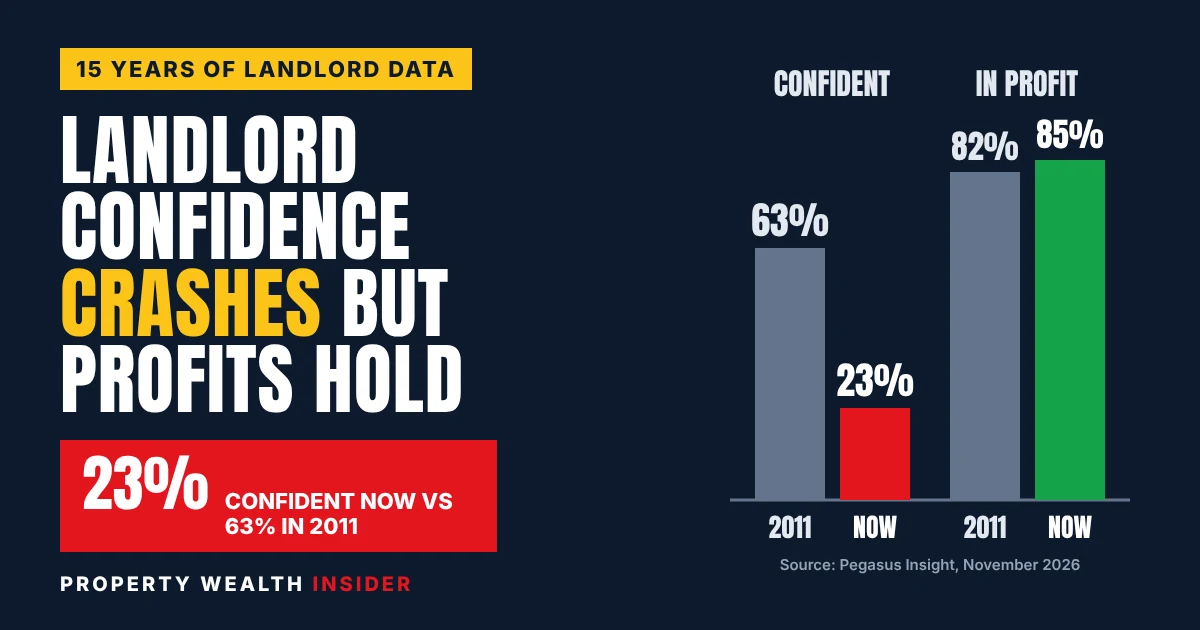
Only 23% of landlords now feel confident about the prospects for their own letting business, down from 63% in 2011. That comes from a new 15-year comparison by the research firm Pegasus Insight, which also found that more landlords are making a profit today than back then.
That gap is the real story. Arrears are down, profits are steady and yields have barely moved. But landlords are older, their portfolios are smaller, more of them own outright, and most say the job has got harder.
Pegasus presented the findings on 3 November 2026 to the buy-to-let lenders who subscribe to its Landlord Trends research. Below we set out what changed, how it compares with the government’s own landlord survey, and give you a calculator to check whether your rental business is beating the average.
Key facts
- Just 23% of landlords are confident about their own letting business, compared with 63% in 2011.
- Yet 85% report making a profit (up from 82%), and the share hit by rent arrears has fallen from 50% to 28%.
- Average rental yield is 6.4%, compared with 6.7% in 2011.
- The average landlord is now 63 (56 in 2011) with 8 properties (11.8), and 43% own their whole portfolio outright (25%).
- 24% hold at least one property in a limited company, up from 17% in Q3 2020.
The 15-year scorecard: 2011 vs now
Pegasus compared its latest findings with results going back to 2011, covering landlords’ finances, confidence, investment plans and borrowing. Its directors Bethan Cooke and Mark Long first started researching landlords about 20 years ago while at BVC-BDRC, then set up Pegasus Insight in February 2023.
Here is every headline figure from the Pegasus press release, side by side.
| Measure | 2011 | Now | Change |
|---|---|---|---|
| Confident about own letting business | 63% | 23% | -40 pts |
| Feel positive about being a landlord | 77% | 25% | -52 pts |
| Believe landlords are respected | 7% | 2% | -5 pts |
| Say being a landlord has got harder | 66% | 89% | +23 pts |
| Say it allows them to earn a living | 62% | 48% | -14 pts |
| Report making a profit | 82% | 85% | +3 pts |
| Experienced rent arrears | 50% | 28% | -22 pts |
| Average rental yield | 6.7% | 6.4% | -0.3 pts |
| Average landlord age | 56 | 63 | +7 years |
| Average portfolio size | 11.8 | 8 | -3.8 homes |
| Average number of BTL mortgages | 8.8 | 5.9 | -2.9 |
| Own entire portfolio outright | 25% | 43% | +18 pts |
The press release does not give a sample size, fieldwork dates or a breakdown by UK nation, so treat these as trend indicators from one long-running tracker rather than official statistics.
Why profitable landlords have lost faith
On paper, the business works. More landlords are in profit than in 2011 and far fewer are chasing arrears. The yield has only slipped by 0.3 percentage points.
Pegasus puts the slump in mood down to the cumulative weight of policy. Bethan Cooke points to the 2015 decision to restrict mortgage interest tax relief (Section 24) as “a turning point”, with repeated tax and regulatory changes since. Her warning: a landlord “can run a profitable business and still decide that further investment is no longer worth the uncertainty or effort.”
The “earn a living” figure is telling. Only 48% now say letting allows them to earn a living, against 62% in 2011. Making a profit is not the same as making enough to justify the time, risk and capital tied up.
Tax context: the 28 October 2026 Budget set property income tax rates of 24%, 44% and 49% from April 2027 for individuals in England, Wales and Northern Ireland, to be legislated in Finance Bill 2026-27. We have covered the detail separately; the point here is that net returns face another squeeze.
Who the typical landlord is now
The Pegasus landlord is older, less indebted and more likely to run through a company. The average age has risen from 56 to 63, the average portfolio has shrunk from 11.8 homes to 8, and the average number of buy-to-let mortgages has fallen from 8.8 to 5.9.
Company ownership is growing fast. 24% hold at least one property in a limited company, up from 17% in Q3 2020. Among those, the average number of company-held homes has risen from 7.6 to 12.7, which is 75% of their portfolios, compared with 57% six years ago.
How does that compare with the whole market? The government’s English Private Landlord Survey 2024 (England only, over 9,000 landlords, fieldwork April to May 2024) paints a picture of much smaller operators.
| Measure | Pegasus Insight (now) | English Private Landlord Survey 2024 |
|---|---|---|
| Age | Average 63 | Median 59; 64% aged 55 or older |
| Portfolio size | Average 8 properties | 45% own one property; 38% own 2 to 4; 17% own 5 or more |
| Company ownership | 24% have at least one property in a limited company | 6% let as a company, 1% both ways; companies hold 15% of tenancies |
| Borrowing | 43% own entire portfolio outright | 41% have no borrowing on any property |
The two surveys measure different groups, so the numbers are not like-for-like. Pegasus’s average portfolio of eight suggests it captures more experienced, larger landlords, the people lenders most want to understand. The government data shows that half of all tenancies (49%) belong to landlords with five or more properties, so the mood of that group matters for renters’ supply.
Both sources agree on two things: landlords are ageing, and a large minority are mortgage-free. That second point means a big slice of the market is now insulated from interest rates but fully exposed to tax and regulatory costs.
Calculator: are you beating the average landlord?
Enter one property (or your whole portfolio as totals). The tool works out your gross and net yield, your annual profit before tax, and your interest cover ratio (ICR) at a stress rate, which is how buy-to-let lenders test affordability.
Is your rental business beating the average landlord?
Guide only, not financial advice. Profit is before income or corporation tax and assumes an interest-only mortgage. The 6.4% benchmark is the average yield reported in Pegasus Insight’s research. Lender ICR tests and stress rates vary by lender, product and borrower; 125% and 145% are examples (TSB, for instance, uses these for basic and higher or additional rate taxpayers).
Gross yield is annual rent divided by property value. Net yield here deducts running costs but not mortgage interest, so you can compare a geared and a mortgage-free property fairly. The ICR uses whichever is higher: your actual rate or the stress rate you enter.
Worked examples: geared vs mortgage-free
Take a £250,000 buy-to-let let at £1,333 a month (£16,000 a year), a 6.4% gross yield that exactly matches the Pegasus average. Running costs are £3,500 a year, so the net yield is 5.0% (£12,500 divided by £250,000).
| Scenario | Loan | Annual interest | Profit before tax | ICR at 5.5% stress |
|---|---|---|---|---|
| A: 60% loan at 5.0% | £150,000 | £7,500 | £5,000 | 194% (passes 145%) |
| B: 75% loan at 5.0% | £187,500 | £9,375 | £3,125 | 155% (passes 145%) |
| C: 75% loan, refixed at 6.0% | £187,500 | £11,250 | £1,250 | 142% at 6.0% (fails 145%) |
| D: owned outright | £0 | £0 | £12,500 | n/a |
Scenario B shows how thin the margin gets with high gearing: a one-point rise in the rate (C) cuts profit from £3,125 to £1,250, and the loan would no longer pass a 145% test for a higher-rate borrower at that rate.
Scenario D explains why 43% of Pegasus landlords now own outright. The same home makes £12,500 a year before tax with no rate risk. The catch is that £250,000 of capital is earning a 5.0% net return, and every pound of profit is exposed to income tax at the new property rates from April 2027.
The figures are before tax. For an individual landlord, mortgage interest is not deducted from rental profit; instead you get a basic-rate tax credit, which is why higher-rate landlords in scenarios A to C keep less than the table suggests. Run your own numbers past an accountant.
Your rental business health check
Low confidence is not a plan. Before you decide to sell, hold or grow, work through these steps with real figures.
- Pull last year’s real numbers. Rent actually received (not the asking rent), every cost, and interest paid, property by property.
- Benchmark each property. Use the calculator above. Any home well below a 6.4% gross yield or losing money before tax needs a reason to stay.
- Stress-test your mortgages. List every fixed rate and its end date. Re-run the calculator at the rate you would get today and see which loans fall below 125% or 145% cover.
- Model the tax change. Ask your accountant what the April 2027 property income rates mean for your net profit, and whether a limited company structure is worth reviewing for future purchases.
- Check arrears and voids. Only 28% of landlords had arrears in the Pegasus research. If you are above that, review referencing, rent guarantees and how quickly you act.
- Decide your five-year plan. Grow, hold or wind down. Your age, your lender’s maximum age criteria and remaining loan terms all matter; Pegasus says the ageing landlord base has implications for lenders’ mortgage terms and age criteria.
- Rent received and costs for the last 12 months, per property
- Gross and net yield calculated for every home
- All fixed-rate end dates in a diary, with six months’ notice
- ICR checked at today’s rates for any loan due to refinance
- Accountant review booked before April 2027
- Arrears and void days logged for the year
- Decision recorded: grow, hold, or sell (and which properties)
FAQ
Are landlords still making money in 2026?
Most are. Pegasus Insight found 85% of landlords report making a profit, up from 82% in 2011, and the average rental yield is 6.4%. Only 48% say it allows them to earn a living, though.
What is a good rental yield in the UK?
There is no single figure, but the average reported in the Pegasus research is 6.4%. Compare your gross yield with that, then check your net yield after costs, which is what actually pays the mortgage.
How old is the average UK landlord?
63, according to Pegasus Insight, up from 56 in 2011. The government’s English Private Landlord Survey 2024 found a median age of 59, with 64% aged 55 or older.
How many landlords use a limited company?
Pegasus found 24% hold at least one property in a limited company, up from 17% in Q3 2020. Across all landlords in England, the government survey found 6% let as a company and 1% both personally and through a company.
What interest cover ratio do buy-to-let lenders need?
It varies by lender. As an example, TSB requires rent to cover 125% of stressed mortgage interest for basic-rate taxpayers and 145% for higher or additional-rate taxpayers. Check your lender’s criteria or ask a broker.
- Pegasus Insight press release: Landlords face crisis of confidence despite resilient profitability (3 November 2026)
- Pegasus Insight: Landlord Trends research
- MHCLG: English Private Landlord Survey 2024 main report
- HMRC: Income Tax, changes to tax rates for property and savings income (Budget 2026)
- TSB Intermediary: buy-to-let affordability criteria
This is news and general guidance, not financial, legal or tax advice.