Buy-to-let repossessions jump 10% to 690 – are you next?
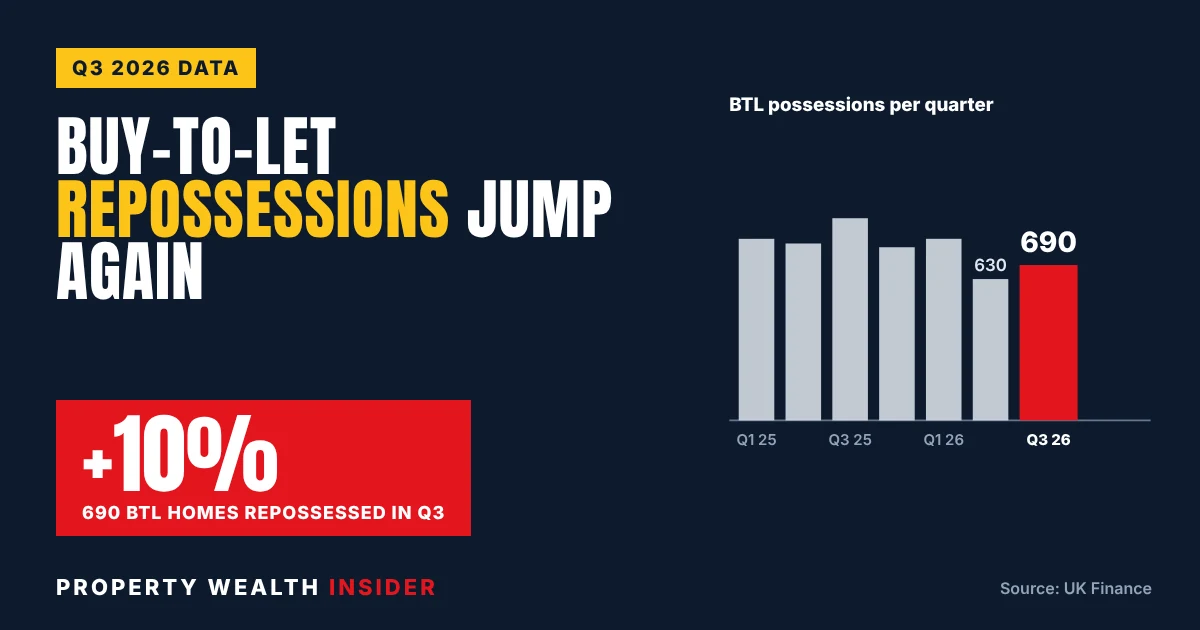
Lenders took 690 buy-to-let properties into possession between July and September 2026, up from 630 in the previous quarter, according to UK Finance’s latest arrears and possessions update published on 12 November 2026.
That is a 10% quarterly jump, and it lands a week after the Bank of England raised Bank Rate to 4%. The bigger picture is calmer: repossessions are still 23% lower than a year ago, and the number of landlords behind on their mortgage keeps falling.
We covered the second-quarter numbers in October. This is the Q3 update, and the more useful question for landlords: what actually tips a buy-to-let into repossession, and how do you spot the warning signs months before your lender does?
Key facts
- 690 buy-to-let properties were repossessed in Q3 2026, up 10% on Q2 (630) but down 23% on Q3 2025 (900).
- 8,170 buy-to-let mortgages were in arrears of 2.5% or more of the balance, 0.43% of all BTL mortgages: down 3% on the quarter and 22% on the year.
- The one figure going the wrong way: early-stage BTL arrears (2.5% to 5% of the balance) rose 4% to 3,090.
- Homeowner arrears fell to 76,080 (0.87% of mortgages), the tenth quarterly fall in a row. Homeowner possessions were flat at 1,150.
- Bank Rate rose from 3.75% to 4% on 5 November 2026. The next decision is due on 17 December 2026.
What the Q3 2026 figures show
UK Finance’s figures cover first-charge mortgages across the whole UK. They are grossed up from a sample of lenders to represent the full market, and there is no split by nation or region.
The buy-to-let possession count has bounced around for two years. It peaked at 900 in Q3 2025, fell to 630 in Q2 2026, and has now edged back up to 690. Possessions lag arrears by months, so this rise mostly reflects borrowers who got into trouble well before the latest rate rise.
Arrears are a better guide to what comes next, and they are still falling. The share of buy-to-let mortgages in arrears was 0.69% at its 2024 peak. It is now 0.43%, with 8,170 loans behind compared with 10,430 a year earlier.
The warning sign: early arrears are rising
Look inside the total and one band has turned. UK Finance splits arrears by how far behind a borrower is, measured as a share of the outstanding loan. Every band shrank in Q3 except the lightest one.
| BTL arrears band (share of balance) | Q3 2026 | Change on Q2 2026 | Change on Q3 2025 |
|---|---|---|---|
| 2.5% to 5% | 3,090 | +4% | -18% |
| 5% to 7.5% | 1,370 | -3% | -26% |
| 7.5% to 10% | 850 | -9% | -33% |
| Over 10% | 2,860 | -7% | -19% |
| All arrears over 2.5% | 8,170 | -3% | -22% |
That rise in fresh arrears is small, but it is the first quarterly increase in that band since Q4 2023. These are landlords who have only recently slipped behind, and they are the pool that future repossessions are drawn from.
Here is the catch in the definition. A loan only counts once arrears reach 2.5% of the balance. On a £200,000 interest-only mortgage at 5.5%, the monthly payment is about £917, and 2.5% of the balance is £5,000. That is roughly five and a half missed payments before you even appear in these figures.
The takeaway: by the time a landlord shows up in the national arrears data, the problem is months old. The time to act is the first month the rent does not cover the mortgage, not the first missed payment.
What a 4% Bank Rate means for your payments
The Monetary Policy Committee voted 8-1 on 4 November to lift Bank Rate by 0.25 percentage points to 4%, saying inflationary pressure in the pipeline was now enough to warrant a rise. One member voted for 4.25%. The result was announced on 5 November.
Tracker and variable-rate borrowers feel that immediately. Fixed-rate borrowers feel it when their deal ends. As a rough guide, every 0.25-point rise adds about £42 a month to a £200,000 interest-only loan.
| £200,000 mortgage, 25 years | Interest-only | Repayment |
|---|---|---|
| Payment at 4.75% | £792 a month | £1,140 a month |
| Payment at 5.5% | £917 a month | £1,228 a month |
| Extra cost per month | £125 | £88 |
Rates in the table are illustrations, not current product rates. The point is that a landlord coming off a cheaper fix can see the monthly bill jump by well over £100 with no change in rent.
Lenders test this when they lend. The Prudential Regulation Authority’s buy-to-let underwriting rules (SS13/16) say the industry standard minimum interest cover ratio is 125%, meaning rent must be at least 1.25 times the mortgage interest, tested at a stressed rate of at least 5.5% unless the rate is fixed for five years or more. Lenders can set a higher bar.
How a buy-to-let repossession actually happens
Many landlords assume they get the same protections as a homeowner. Mostly they do not.
Most BTL loans are unregulated. When the Financial Conduct Authority brought in the consumer buy-to-let regime in March 2016, it noted that the vast majority of buy-to-let lending is unregulated. Only “consumer buy-to-let” (for example, an accidental landlord letting a former home) gets FCA conduct protections. Landlords borrowing as a business, including through a limited company, do not.
The court pre-action protocol does not cover you. In England and Wales, the civil courts’ mortgage arrears pre-action protocol makes lenders share payment histories, discuss options and treat possession as a last resort. Paragraph 4.3 states plainly: “The protocol does not apply to Buy To Let mortgages.”
Lenders can appoint a receiver. Instead of going to court, a lender can appoint a Law of Property Act receiver to take control of the property, either to collect the rent and manage it or to sell it. Government guidance recommends that tenants are told clearly who to pay. Your rental income can be redirected away from you.
Your tenants have some protection. In England and Wales, the Mortgage Repossessions (Protection of Tenants etc) Act 2010 means a lender must give 14 days’ notice at the property before enforcing a possession order. Tenants whose tenancy the lender never agreed to can ask for possession to be delayed by up to two months. If you let without your lender’s consent, expect that to come out.
Calculator: test your arrears risk
Enter your own figures to see your monthly payment, your rental cover against a 125% or 145% interest cover test, what is left each month after costs and empty months, and how long your cash buffer would last if the rent stopped tomorrow.
BTL arrears early-warning calculator
Guide only, not financial advice. It ignores tax, fees and rate changes during the term. Check your actual payment and terms with your lender.
Worked example (the defaults above): rent of £1,300, a £200,000 interest-only loan at 5.5% and £240 a month of other costs. The payment is about £917, so rental cover is 142%, which passes a 125% test but just fails 145%. Allowing one empty month a year, the effective rent is about £1,192, leaving only £35 a month. A £5,000 reserve covers about 4.3 months of mortgage and costs if the rent stops, and the loan breaks even at about 5.71%.
That landlord is not in arrears and looks fine on paper. But a second empty month, a new boiler or a rate rise of about a quarter of a point would put them into a monthly shortfall. That is exactly the profile behind the rise in early arrears.
What to do now: a step-by-step plan
- Know your fix end date. Write down when each deal ends and what your payment would be on the lender’s revert rate. Start looking for a new deal well before it ends.
- Run the numbers on every property. Use the calculator at today’s rates and at 1 percentage point higher. Any property that goes into a shortfall needs a plan now.
- Build a cash buffer. Aim for at least three months of mortgage payments and running costs per property, held separately from your day-to-day account.
- Review the rent. If the rent is below market, check the rules for raising it where your property is. Rent increase rules differ across England, Wales, Scotland and Northern Ireland.
- Call your lender before you miss a payment. Options such as a temporary switch to interest-only, a term extension or a payment plan are far easier to agree before arrears build. Because the pre-action protocol does not cover BTL, do not wait for your lender to come to you.
- Check you have consent to let. If you are letting a former home on a residential mortgage, get consent to let or switch to a buy-to-let product. Letting without consent can be a breach of your mortgage terms.
- Consider selling on your terms. If a property cannot pay its way, a planned sale usually beats a forced sale by a receiver.
- Fixed-rate end date and revert rate noted for every mortgage
- Rental cover checked against 125% at today’s rate and at +1 point
- Monthly surplus calculated after agent fees, insurance, service charge, maintenance and voids
- Cash reserve covering at least 3 months of payments and costs per property
- Consent to let in place (or a BTL mortgage) for every let property
- Lender’s arrears contact number saved, ready to call at the first sign of a shortfall
- Rent reviewed against local market and the rules for your nation
FAQs
How many buy-to-let properties were repossessed in 2026?
UK Finance figures show 810 in Q1 2026, 630 in Q2 and 690 in Q3, a total of 2,130 for the first nine months. Q4 figures are due on 11 February 2027 (provisional date).
Are buy-to-let repossessions going up?
They rose 10% between Q2 and Q3 2026, but they are 23% lower than in Q3 2025. Overall BTL arrears are still falling, although the earliest arrears band rose 4% in the latest quarter.
Can a lender repossess a buy-to-let without going to court?
A lender can appoint a Law of Property Act receiver to collect the rent or sell the property, depending on the mortgage terms. To evict occupiers it will generally still need a possession order, and in England and Wales it must give 14 days’ notice at the property before enforcing one.
Are buy-to-let mortgages regulated by the FCA?
Most are not. Only “consumer buy-to-let” loans, such as those taken by someone letting a former home without acting as a business, have FCA conduct protections. Landlords borrowing for business purposes, including limited companies, are outside that regime.
What happens to my tenants if my buy-to-let is repossessed?
In England and Wales, the lender must post notice at the property before enforcing a possession order, and tenants whose tenancy the lender did not authorise can ask for possession to be postponed by up to two months. If a receiver is appointed, tenants should be told who to pay rent to.
What is a good rental cover ratio for buy-to-let?
The PRA describes 125% as the industry standard minimum, tested at a stressed interest rate of at least 5.5% for loans not fixed for five years or more. Individual lenders can require more, so check your lender’s criteria.
Sources
- UK Finance: Arrears and possessions data
- UK Finance: Mortgage Arrears and Possessions Update, Q3 2026 (12 November 2026)
- Bank of England: Monetary Policy Summary and minutes, November 2026
- Prudential Regulation Authority: SS13/16 Underwriting standards for buy-to-let mortgage contracts
- Ministry of Justice: Pre-Action Protocol for Possession Claims based on Mortgage Arrears
- GOV.UK: Guidance to the Mortgage Repossessions (Protection of Tenants etc) Act 2010
- FCA: CP15/3 Buy-to-let mortgages, implementing the Mortgage Credit Directive Order 2015
- GOV.UK: Mortgage and landlord possession statistics
This article is news and general guidance, not financial, legal or tax advice.