Section 21 Stampede: Accelerated Possession Claims Rocket 68%
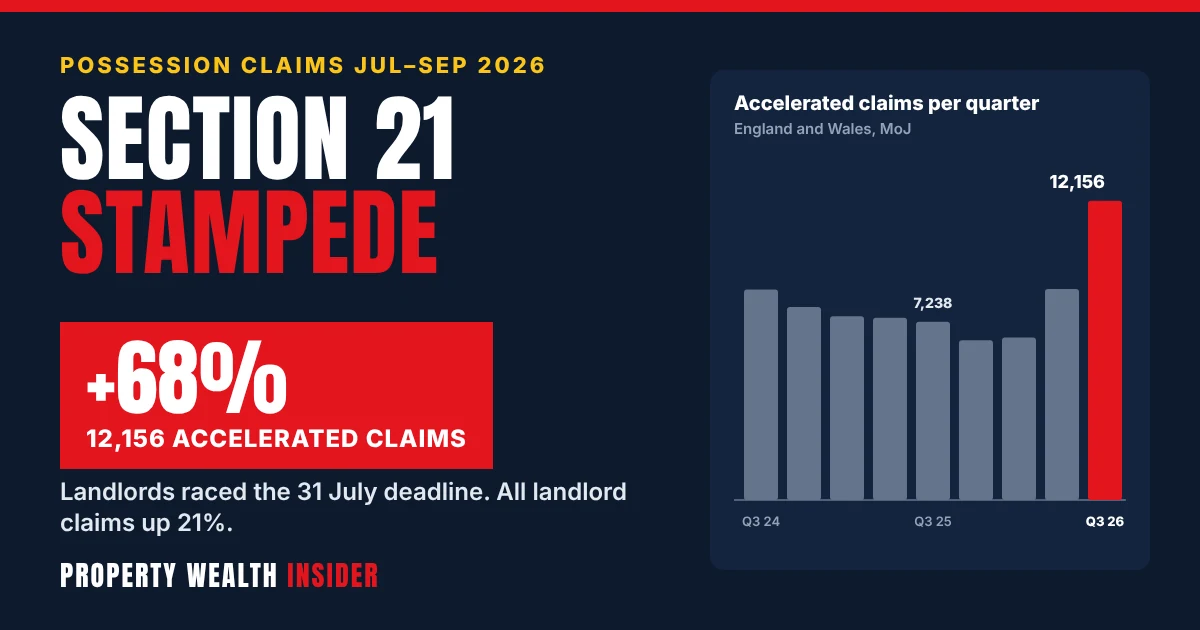
Landlords stampeded to court before section 21 shut for good. Ministry of Justice figures published on 12 November 2026 show 12,156 accelerated possession claims were issued in England and Wales between July and September 2026, up 68% on a year earlier and the highest quarterly figure since quarterly records began in 2009.
That surge pushed total landlord possession claims up 21% to 28,249. It is the first full quarter since the Renters’ Rights Act 2025 took effect on 1 May 2026, and the quarter that contained the hard 31 July 2026 deadline for using any section 21 notice served before the cut-off.
Last quarter we reported claims up 6% to 23,635. This quarter’s jump is far bigger, and it marks the end of an era. From here on, every private landlord in England who needs a property back has to use a section 8 ground, prove it, and wait. Below we break down the numbers, what the court timeline really looks like now, and what an eviction is likely to cost you.
Key facts
- Accelerated possession claims hit 12,156 in July to September 2026, up 68% from 7,238 a year earlier.
- All landlord possession claims rose 21% to 28,249, the most in a single quarter since July to September 2019.
- Accelerated claims made up 43% of all landlord claims, compared with 31% social landlord and 26% private landlord standard claims.
- Repossessions by county court bailiffs fell 10% to 6,886.
- Median time from claim to repossession was 25.9 weeks, down from 27.4 weeks.
- Section 21 ended in England on 1 May 2026. The last day to apply to court on an old notice was 31 July 2026.
The numbers: a last-minute section 21 rush
The MoJ bulletin covers county court possession actions in England and Wales. The headline is simple: claims and orders went up, while warrants and actual repossessions went down.
| Landlord possession action | Jul–Sep 2025 | Jul–Sep 2026 | Change |
|---|---|---|---|
| Accelerated claims | 7,238 | 12,156 | +68% |
| Private landlord standard claims | 7,308 | 7,291 | Stable |
| Social landlord standard claims | 8,773 | 8,802 | Stable |
| All landlord claims | 23,319 | 28,249 | +21% |
| Possession orders | 18,243 | 20,196 | +11% |
| Warrants issued | 11,512 | 10,760 | −7% |
| Repossessions by bailiffs | 7,680 | 6,886 | −10% |
| Median weeks, claim to repossession | 27.4 | 25.9 | −1.5 weeks |
Every bit of the rise came from the accelerated route. Standard claims from private and social landlords were flat. London courts handled 9,483 landlord claims, 34% of the total and up 21% on a year earlier.
Why accelerated claims spiked
The accelerated procedure was the paper-based route landlords used after a section 21 “no-fault” notice. The MoJ statisticians say the rise was “likely due to a large number being made following the commencement of the Renters’ Rights Act”.
The law is now fixed. The Renters’ Rights Act 2025 (Commencement No. 2 and Transitional and Saving Provisions) Regulations 2026 brought the tenancy reforms into force on 1 May 2026 for private assured tenancies, including section 2 of the Act, which abolishes assured shorthold tenancies.
Under Schedule 6 of the Act, a valid section 21 notice given before that date could only be used if the landlord asked the court to issue a claim within six months of giving the notice, or within three months of commencement if that came sooner. Three months from 1 May 2026 is 31 July 2026, and that is the deadline set out in government guidance. July to September is the quarter that deadline fell in.
Scope: The abolition of section 21 applies to England only. The MoJ figures cover England and Wales together. The Renters’ Rights Act changes do not apply to social housing let by private registered providers until 2027 at the earliest.
The pipeline: what happens to these claims next
Repossessions fell this quarter, but don’t read too much into that. Claims take months to turn into evictions. The MoJ’s own tracking table shows that, of the 28,249 claims issued in July to September 2026, only 7,949 (28%) had led to a possession order so far, and just 36 had ended in repossession by a bailiff.
Using the latest median timings, a claim took 7.7 weeks to reach an order, 15.0 weeks to reach a warrant and 25.9 weeks to reach repossession. Once a warrant was issued, it took a median 9.1 weeks for bailiffs to carry it out.
In practice, that means a large batch of section 21 cases issued in July is still working through the courts. Landlords with one of them should expect orders and bailiff dates to land over the winter and into spring 2027. Remember these are medians: half of cases take longer.
How possession works now: the section 8 grounds
Every new possession case in the private rented sector in England now runs on a section 8 notice using Form 3A, with one or more grounds. Mandatory grounds mean the judge must grant possession if you prove them. Discretionary grounds mean the judge decides whether eviction is reasonable. These are the notice periods in the government’s grounds for possession guidance.
| Ground | Type | Notice before applying to court | Key condition |
|---|---|---|---|
| Ground 1: landlord or family moving in | Mandatory | 4 months | Cannot take effect in first 12 months of a tenancy |
| Ground 1A: selling the property | Mandatory | 4 months | Cannot take effect in first 12 months of a tenancy |
| Ground 8: rent arrears | Mandatory | 4 weeks | At least 3 months’ rent (13 weeks if paid weekly or fortnightly) owed at notice and at hearing |
| Ground 10: any rent arrears | Discretionary | 4 weeks | Some rent owed |
| Ground 11: persistent late payment | Discretionary | 4 weeks | Rent repeatedly paid late |
| Ground 12: breach of tenancy | Discretionary | 2 weeks | Breach not related to rent |
| Ground 14: antisocial behaviour | Discretionary | None | Can apply straight away; no order within 14 days of notice |
Two traps on Ground 8. If the tenant pays the arrears down below 3 months by the hearing, the mandatory ground fails. And a tenant cannot be evicted under it if the arrears exist only because Universal Credit hasn’t been paid yet.
Court fees come from the HMCTS civil court fees list (EX50): £415 to issue a county court possession claim and £152 to issue a warrant of possession. That is £567 before any legal costs.
Possession cost and timeline estimator
Put in your own numbers to see how long a section 8 case could take from notice to bailiffs and what it might cost. The court stage defaults to the latest MoJ median of 25.9 weeks from claim to repossession.
Possession cost and timeline estimator
Guide only, not legal or financial advice. The court stage uses a national median: half of cases take longer, and defended claims or adjournments can add months. You can only keep deposit money in line with your scheme’s rules.
Worked examples in pounds
Example 1: rent arrears, Ground 8. Rent is £1,100 a month (about £254 a week). The tenant owes 3 months, £3,300, when you serve notice and pays nothing after that. With 4 weeks’ notice, a 1-week gap before you file and the 25.9-week median court stage, you’re looking at about 30.9 weeks.
That is a further £7,844 of unpaid rent on top of the £3,300 already owed: £11,144 of rent lost. Add £567 in court fees and the total is about £11,710. A £1,250 deposit leaves you around £10,460 out of pocket, before any legal fees. That’s why acting at the first missed payment matters.
Example 2: selling up, Ground 1A. Rent is £1,400 a month and the tenant is paying in full. You give 4 months’ notice, then the tenant does not leave. With a 1-week gap and the 25.9-week median, it could be about 44 weeks, more than ten months, before you have vacant possession. Your direct cost is the £567 in fees plus any legal costs, but the delay is the real hit if a buyer is waiting.
Example 3: a section 21 case already in court. If you issued an accelerated claim on or before 31 July 2026, it carries on until it concludes. If the judge makes a possession order, the tenant normally gets 14 days to leave, or up to 42 days in cases of exceptional hardship. If the claim is dismissed, the tenancy becomes an assured periodic tenancy under the new rules and you would have to start again with section 8.
What to do now: step by step
- Check any old notices. If you served a section 21 or section 8 notice before 1 May 2026 and didn’t ask the court to issue a claim by 31 July 2026, it can no longer be used. Start again with a new section 8 notice.
- Track arrears weekly. Ground 8 needs 3 months owed at notice and at the hearing. Keep a clear rent statement.
- Try managed payments first. If the tenant claims Universal Credit or Housing Benefit, ask DWP or the council to pay the rent to you directly.
- Get your compliance in order before serving. If you hold a deposit, it must be protected, with the prescribed information given, or the court will not grant possession (except under Grounds 7A and 14).
- Serve Form 3A correctly with the right ground, the right notice period and evidence. Record service on form N215.
- Issue promptly. For a section 8 notice given on or after 1 May 2026, you usually have up to 12 months to apply to court. Rent-only claims can go through Possession Claim Online; other grounds use forms N5 and N119.
- Apply for the warrant straight away (form N325) if the tenant doesn’t leave by the date in an outright order, then return the bailiff forms at least 3 working days before the eviction date.
- Old pre-1 May 2026 notices checked: issued by 31 July 2026, or start again
- Rent statement up to date, arrears in months calculated
- Deposit protected and prescribed information served
- Correct ground chosen, mandatory or discretionary
- Form 3A completed with the right notice period
- Proof of service kept (N215)
- Court fee budgeted: £415 claim, £152 warrant
- Diary date set to issue the claim when the notice expires
FAQ
Can I still use a section 21 notice in England?
No. Section 21 notices cannot be served on existing or new tenancies from 1 May 2026, and the last date to start court action on an old notice was 31 July 2026. Cases already issued by then carry on to a conclusion.
How long does an eviction take in 2026?
The latest MoJ median from claim to repossession is 25.9 weeks. Add the notice period for your ground (4 weeks for rent arrears, 4 months for moving in or selling) and the time it takes you to file.
How much rent arrears do I need for Ground 8?
At least 3 months’ rent if the rent is paid monthly, or 13 weeks’ rent if paid weekly or fortnightly. The arrears must be at that level both when you serve notice and at the hearing.
How much does it cost to evict a tenant through the courts?
Court fees are £415 to issue a county court possession claim and £152 for a warrant of possession. Legal fees and lost rent usually cost far more, as the estimator above shows.
Can I evict a tenant to sell the property?
Yes, under Ground 1A, with 4 months’ notice. It cannot take effect in the first 12 months of a tenancy, and it cannot be used on older assured tenancies that were not assured shortholds before 1 May 2026.
Sources
- Ministry of Justice: Mortgage and landlord possession statistics, July to September 2026
- MoJ statistical tables, July to September 2026 (Tables 4 to 7)
- Renters’ Rights Act 2025 (Commencement No. 2 and Transitional and Saving Provisions) Regulations 2026
- Renters’ Rights Act 2025, Schedule 6 (transitional provision)
- GOV.UK: Giving notice of possession to tenants before 1 May 2026
- GOV.UK: Grounds for possession, guidance for landlords and letting agents
- GOV.UK: Evicting tenants in England
- HMCTS: Civil court fees (EX50)
This article is news and general guidance only. It is not financial, legal or tax advice.