Pets Banned? Just 5% of Rentals Say Yes – and the 28-Day Rule
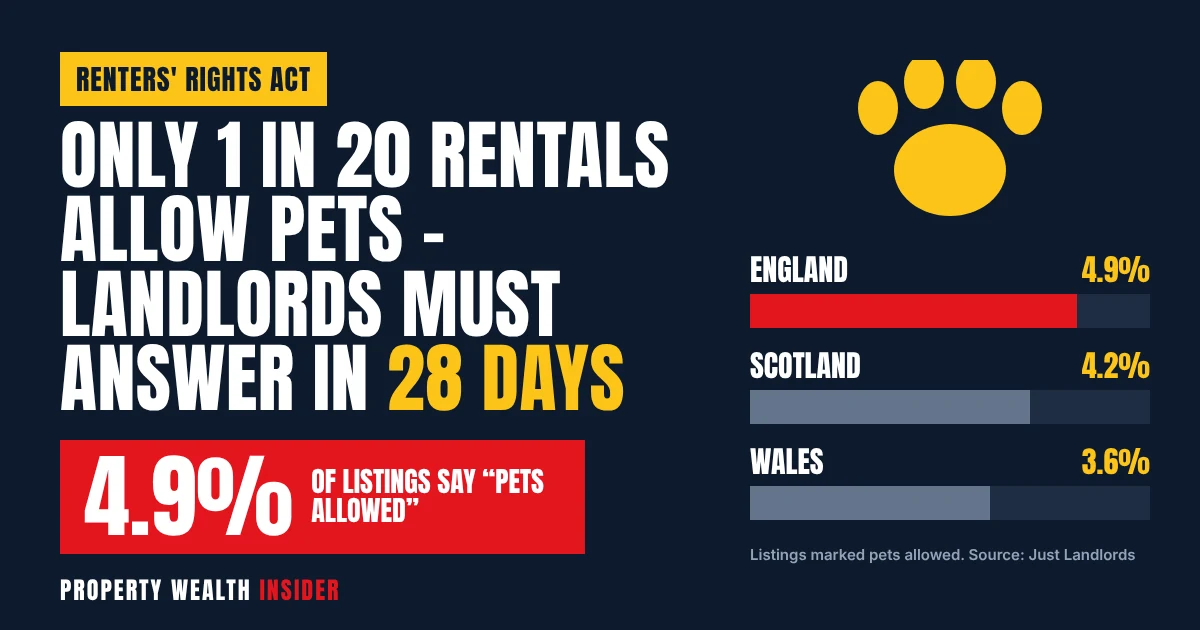
Only around one rental listing in twenty is advertised as “pets allowed”, according to new research from landlord insurer Just Landlords. It looked at 108,671 Zoopla listings across Great Britain this month and found just 5,317 carrying the label.
That gap now matters legally. Since 1 May 2026, tenants in England with an assured tenancy have a statutory right to ask to keep a pet, and landlords must answer in writing within 28 days and must not refuse unreasonably. A “no pets” line in your advert does not switch that duty off.
Below: the numbers by nation and county, exactly what the law says, which refusals stand up, how far a capped deposit really goes against pet damage, and a calculator that works out your response deadline.
Key facts
- Just 5,317 of 108,671 Zoopla rental listings analysed (about 4.9%) were marked “pets allowed”.
- By nation: England 4.9%, Scotland 4.2%, Wales 3.6%.
- Cheapest pet-friendly two-bed-equivalent rent by English county: County Durham at £477 a month. Dearest: Greater London at £3,187.
- In England, landlords must reply to a written pet request within 28 days (plus 7 days after receiving extra information, if you ask for it in time).
- Deposits stay capped at 5 weeks’ rent (annual rent under £50,000) or 6 weeks’ (£50,000 or more). There is no separate pet deposit.
What the research found
Just Landlords analysed Zoopla listings in November 2026, counting how many carried the “pets allowed” tag and adjusting rents to a two-bed equivalent so areas with different property sizes could be compared.
There were pockets of pet-friendliness. County Durham led English counties with 14% of listings marked pets allowed, ahead of Cornwall (12%) and North Yorkshire (8.5%). At the other end, Tyne and Wear managed just 0.5%. In London, Waltham Forest topped the boroughs at 15%, while Bromley sat at 1.4%.
On price, County Durham was also the cheapest English county for a pet-friendly two-bed equivalent at £477 a month, followed by Lancashire (£650). Greater London was the dearest at £3,187, then Oxfordshire (£2,187) and Surrey (£2,123). The research also found 59% of pet-friendly rentals had a garden.
The landlord takeaway: with so few homes openly advertised for pet owners, a well-run pet-friendly let has a much smaller pool of competing listings. And in England, refusing outright is no longer a simple option anyway.
The pet request rules in England
Section 11 of the Renters’ Rights Act 2025 inserts new sections 16A and 16B into the Housing Act 1988. They came into force on 1 May 2026 as part of phase one of the government’s implementation roadmap, which applies to England. Scotland and Wales have their own tenancy laws, so these rules do not apply there.
Every private assured tenancy (social housing is excluded) now contains an implied term. In plain English:
- The request: the tenant must ask in writing and describe the pet.
- The deadline: you must give your decision in writing on or before the 28th day after the date of the request.
- More information: if, within those 28 days, you reasonably ask for more details, you can wait until the 7th day after the tenant supplies them. Government guidance says you get the extra 7 days or the rest of the original 28, whichever is later. If the tenant never provides the details, you do not have to respond.
- Superior landlord: if you need your freeholder’s or head landlord’s consent and ask for it within the 28 days, you can wait until the 7th day after you get their answer.
- Agreed date: you and the tenant can agree a different deadline. Where several extensions apply, the latest date wins.
- The test: consent “is not to be unreasonably refused”. A tenant can go to court, and the court can order you to comply.
No pet insurance requirement. The pet section as enacted contains no condition letting you require the tenant to take out pet insurance. Government guidance says you may be able to claim if you or the tenant hold a relevant policy, but you cannot claim the same damage twice. Taking it from the deposit and from insurance as well could be fraud.
Reasonable vs unreasonable refusals
The Act itself gives one example of a reasonable refusal: keeping the pet would breach your agreement with a superior landlord, or the superior landlord has refused consent. Government guidance adds examples on both sides.
| Likely reasonable to refuse | Likely unreasonable to refuse |
|---|---|
| Another tenant in the property has an allergy | You simply don’t like pets |
| The property is too small for a large pet or several pets | You’ve had problems with pet-owning tenants before |
| The animal is illegal to own | Previous tenants’ pets damaged the property |
| Your lease or superior landlord forbids pets, or the freeholder has refused consent | General worries about future damage |
| You think a pet might affect future lettings | |
| The tenant needs an assistance animal, such as a guide dog |
Each request is judged on its own facts: a cat in a two-bed flat is a very different case from three large dogs in a studio. Whatever you decide, put your reasons in writing.
Deposit cap vs pet damage: the maths
Under the Tenant Fees Act 2019, a tenancy deposit in England is capped at five weeks’ rent where annual rent is under £50,000, or six weeks’ where it is £50,000 or more. One week’s rent is the annual rent divided by 52. Anything above the cap is a prohibited payment, so you cannot add a separate “pet deposit” on top.
Here is what that means at the rent levels in the research (two-bed equivalent):
| Monthly rent | Annual rent | Weekly rent | Cap | Maximum deposit |
|---|---|---|---|---|
| £477 (County Durham) | £5,724 | £110.08 | 5 weeks | £550.38 |
| £1,350 (illustrative mid-market) | £16,200 | £311.54 | 5 weeks | £1,557.69 |
| £3,187 (Greater London) | £38,244 | £735.46 | 5 weeks | £3,677.31 |
| £5,633 (Kensington and Chelsea) | £67,596 | £1,299.92 | 6 weeks | £7,799.54 |
Worked example: a County Durham landlord letting at £477 a month holds at most £550.38. If a dog ruins a lounge carpet and scratches two doors, and the bill comes to £1,500, the deposit covers about 37% of it, before any rent arrears or cleaning are deducted. A London landlord at £3,187 a month holds £3,677.31, enough to cover the same bill twice over.
That is why low-rent landlords should think hardest about insurance. Remember the deposit covers all of the tenant’s liabilities, not just pet damage. Government guidance confirms you can deduct pet damage repairs from the deposit, but normal wear and tear is not damage.
Calculator: your deadline and deposit cover
Pet request deadline and deposit cover
Guide only, not legal or financial advice. Rules apply to private assured tenancies in England. The extension only applies if you asked for the information or consent within the original 28 days. You and the tenant can also agree a different date.
With the defaults, a request made on 20 November 2026 must be answered by Friday 18 December 2026. If you asked for more information and got it on 15 December, the deadline moves to 22 December. A £1,350-a-month let allows a £1,557.69 deposit, about 78% of a £2,000 damage bill.
What to do when a pet request lands
- Log the date. Note when the written request was made and diarise day 28 straight away. If in doubt about the date, count from the earlier one.
- Check it is a valid request. It should be in writing and describe the pet. Reply to say you have received it.
- Check your lease and mortgage. Leaseholders should read the head lease. If you need the freeholder’s consent, ask within the 28 days to get the 7-day extension.
- Ask sensible questions early. Species, breed, size, age, number of animals, vaccinations, references from a previous landlord. Ask within 28 days and keep it reasonable.
- Weigh it against the property. Size, outside space, shared areas, other occupants’ allergies.
- Review your protection. Work out the maximum deposit with the calculator above. Check whether your landlord policy covers pet damage, and remember you cannot claim the same loss twice.
- Decide and reply in writing. If you agree, record the pet in the tenancy paperwork. If you refuse, give clear, specific reasons tied to the property.
- Update your inventory. Take dated photos before the pet moves in. They are your best evidence at deposit time.
- Request date logged and day-28 deadline in the diary
- Written request describes the pet
- Head lease or freeholder consent checked (asked within 28 days if needed)
- Further information requested within 28 days (if needed)
- Deposit within the 5 or 6-week cap, protected in a government-approved scheme
- Insurance cover for pet damage checked
- Written decision sent, with reasons if refusing
- Check-in inventory and photos updated
FAQs
How long does a landlord have to respond to a pet request?
In England, 28 days from the date of the request, in writing. If you ask for more information within that time, you can wait until 7 days after you receive it, or the end of the original 28 days if that is later.
Can a landlord still say no to pets?
Yes, but not unreasonably. Allergies of another occupant, a property too small for the animal, or a head lease that bans pets are examples of reasonable grounds. A blanket “no pets” policy or general worries about damage are not.
Can I charge a higher deposit for a pet?
Only within the overall cap: five weeks’ rent where annual rent is under £50,000, or six weeks’ where it is £50,000 or more. Anything above that is a prohibited payment under the Tenant Fees Act 2019.
Can a landlord make a tenant take out pet insurance?
The pet section of the Renters’ Rights Act as enacted contains no insurance requirement. You can hold your own landlord cover, and government guidance says you may be able to claim through a relevant policy, but not for the same damage you have already taken from the deposit.
What happens if I ignore a pet request?
The tenant can complain to you or take court action, and the court can order you to comply with the duty. Missing the deadline leaves you without a written, reasoned decision to defend.
Do the pet rules apply in Scotland and Wales?
No. The Renters’ Rights Act pet request rules apply to private assured tenancies in England. Scotland and Wales have separate tenancy laws.
- Just Landlords: Where are pet-friendly rentals easiest and cheapest to find? (November 2026)
- Renters’ Rights Act 2025, section 11 (legislation.gov.uk)
- GOV.UK: Implementing the Renters’ Rights Act 2025 roadmap
- GOV.UK: If a tenant wants a pet to live with them
- Tenant Fees Act 2019, Schedule 1 paragraph 2 (legislation.gov.uk)
- GOV.UK: Tenant Fees Act 2019 guidance
This article is news and general guidance only, not financial, legal or tax advice.