£30,000 EPC fines: new Bill hikes landlord penalties sixfold
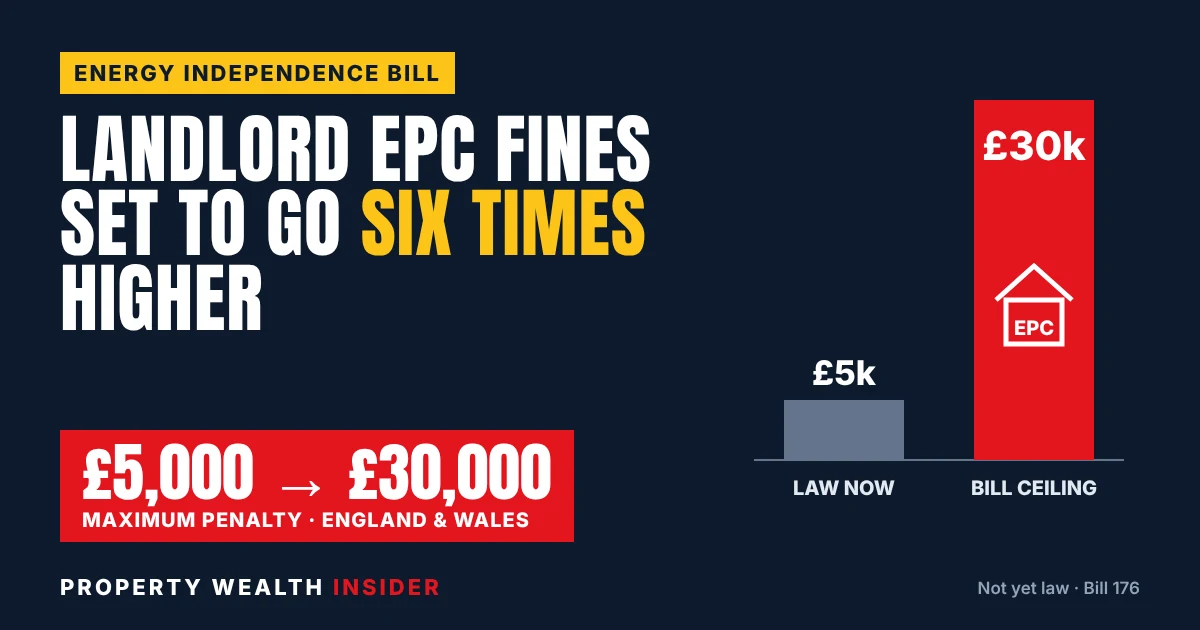
The maximum fine for letting a home that fails the energy efficiency rules is set to rise six-fold, from £5,000 to £30,000. The change is buried in Schedule 9 of the Energy Independence Bill, which the government introduced in the House of Commons on 4 November 2026.
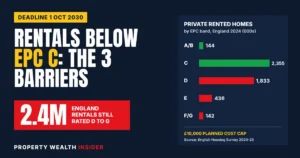
The Bill also gives ministers new powers. They could apply the rules to HMOs and to parts of a property, cover licences to occupy, and stop a home being marketed to let until it complies. It matters because private rented homes must reach EPC C by 1 October 2030, and the bigger fine is meant to stop landlords simply paying a penalty instead of doing the work.
It affects every private landlord in England and Wales. Before you panic, though: none of this is law yet. The £5,000 cap still applies today, and the Bill has only had its first reading.
Key facts
- The Energy Independence Bill (Bill 176) would raise the legal ceiling on MEES civil penalties from £5,000 to £30,000 (Schedule 9, paragraph 5).
- The government says this means a maximum of £30,000 per property, per breach. The exact penalty bands will be set later in regulations.
- Law today: up to £2,000 for letting a sub-standard home for less than 3 months, £4,000 for 3 months or more, capped at £5,000 per property.
- The plan for 2030 is EPC C for all private tenancies by 1 October 2030, with spending capped at £10,000 per property (today it is EPC E and £3,500).
- The Bill also adds new powers covering HMOs, parts of properties, licences to occupy and a ban on marketing non-compliant homes. It applies to England and Wales only.
What is law now vs what is only proposed
The Minimum Energy Efficiency Standards (MEES) rest on two layers of law. The first is section 45 of the Energy Act 2011, which says any civil penalty in the regulations “must not exceed £5,000”. The second is the Energy Efficiency (Private Rented Property) (England and Wales) Regulations 2015, which set the actual fines.
The Bill changes only the first layer. It lifts the ceiling to £30,000. Fines will not go up until ministers also make new regulations under that higher ceiling. The government’s January 2026 response says it aims to bring those updated regulations into force in 2027, subject to Parliament.
| Rule | Law now (25 November 2026) | Proposed | Status |
|---|---|---|---|
| Minimum rating to let | EPC E (F and G cannot be let without an exemption) | EPC C or equivalent on the new EPC metrics | Policy confirmed; regulations still to be made. Deadline 1 October 2030 |
| Spending cap before exemption | £3,500 per property | £10,000 per property (inc. VAT), counting spend from 1 October 2025 | Policy confirmed; regulations still to be made |
| Statutory penalty ceiling | £5,000 (Energy Act 2011 s45(3)) | £30,000 | In Bill 176, first reading 4 November 2026 |
| Actual fines | £2,000 / £4,000 for letting, £1,000 false information, £2,000 ignoring a compliance notice, total capped at £5,000 per property | Up to £30,000 per property per breach (government’s stated intention) | Needs new regulations after the Bill passes |
| HMOs, part-property lets, licences to occupy, marketing ban | No specific powers | Powers for ministers to bring these in | In Bill 176; would also need regulations |
Under the Bill’s commencement clause, clause 173 and Schedule 9 take effect two months after Royal Assent. Parliament’s records show the Bill has had its first reading only. Second reading has not yet taken place. It can still be amended.
What is in Schedule 9, power by power
We have read the Bill text as introduced. Clause 173 brings in Schedule 9, which amends Chapter 2 of Part 1 of the Energy Act 2011. Here is what each paragraph does in plain English.
| Sch. 9 para | What it does | What it could mean for you |
|---|---|---|
| 2 | Adds lets “as a dwelling under a licence to occupy” to the types of letting the rules can cover | Licence arrangements could be pulled into MEES. The government factsheet says it has no current plans to use this power |
| 3 | Lets regulations say how the rules apply to houses in multiple occupation (Housing Act 2004 definition), and makes “property” include part of a property | Room-by-room lets and HMOs could be brought clearly into scope |
| 4 | Lets the cost of an assessment done to show compliance count as an energy efficiency improvement | EPC and assessment fees could count towards your spending cap |
| 5 | Raises the s45(3) cap from £5,000 to £30,000 | The headline: much bigger fines, once regulations are made |
| 7 | Lets regulations stop anyone from marketing a property “as available to let” until it complies, and removes the words “on landlords” from s45(1) | Adverts for non-compliant homes could be banned, and enforcement could reach people other than the landlord |
| 8 | Allows rules on supplying and keeping compliance information, including on a database | More data shared with councils, making non-compliance easier to spot |
| 9 | Replaces “a local authority” with an “enforcement authority”, which can be a council or another body named in regulations | Enforcement may not be left to councils alone |
Paragraph 6 deals with inspections of non-domestic property. Paragraph 10 is a technical update to definitions. The marketing ban power appears in the Bill text but not in the gov.uk enforcement factsheet. The January response said a duty on agents and online platforms to advertise only compliant homes “will not be implemented at this time” and would stay under review. The Bill keeps that option open.
How the £30,000 fine would actually work
Is £30,000 charged per property, per breach, or as a cap? The Bill sets a cap: the amount of “any civil penalty” in the regulations cannot exceed £30,000. Read alone, it does not say the cap applies per property.
The government’s intention is clearer. Its response says councils will be able to issue “a maximum penalty of £30,000 per breach for each property” found non-compliant. The enforcement factsheet says the figure was deliberately set above the £10,000 spending cap, so paying a fine should never be cheaper than doing the work.
How fines are graded under that ceiling, and whether there is still an overall total for each property, will be decided in regulations that have not yet been drafted. For now the only reliable figures are the ceiling and today’s bands, shown below.
One point people miss: paying a fine does not make the letting lawful. Under regulation 23 you must not let a sub-standard home unless an exemption applies, so the duty to upgrade or register an exemption is still there after any penalty. The fine is a cost on top of the upgrade, not instead of it.
Worked examples in pounds
Example 1: law today. A landlord lets an F-rated flat with no registered exemption for five months, then ignores a council compliance notice. Five months is three months or more, so the letting fine can be up to £4,000. Ignoring the notice can add up to £2,000. That makes £6,000, but regulation 40(6) caps the total for that property at £5,000. The council can also publish the breach on the PRS Exemptions Register for at least 12 months.
Example 2: three homes under the Bill ceiling. Say the Bill passes and the 2030 rules arrive as planned. A landlord has three C-failing homes needing £7,000 of work each. The required spend is £21,000, because each job is under the £10,000 cap. The maximum exposure for the letting breach alone would be 3 × £30,000 = £90,000, and more if the government’s “per breach” approach adds penalties for other breaches.
Example 3: an expensive house. A solid-wall terrace needs £14,000 of work. Under the 2030 plan the landlord spends £10,000, including VAT, then registers a cost cap exemption, which lasts 10 years. Work done since 1 October 2025 counts. If the house were worth £80,000, the property value adjustment would cut the cap to 10% of the value: £8,000.
Calculator: penalty exposure vs upgrade cost
Enter your numbers to compare the most you could be fined under today’s rules, the proposed £30,000 ceiling, and what you would actually have to spend.
EPC penalty exposure vs upgrade cost
Guide only, not legal or financial advice. “Law now” uses the bands in regulation 40 of the 2015 Regulations. The Bill figure assumes each breach could be fined up to the £30,000 ceiling, in line with the government’s stated “per property per breach” intention. Actual bands have not been set and the Bill may change. A fine does not remove the duty to upgrade or register an exemption.
What to do now: step by step
- Check every EPC today. Any home rated F or G that is let without a registered exemption breaks the law now, with fines of up to £5,000.
- Check your exemptions. Many last five years from registration. Make sure none has lapsed and that the information you registered is accurate, because false information carries its own fine.
- Get quotes for EPC C. Ask an assessor which measures would get each home to C. The government’s average estimate is £5,400 per property.
- Keep receipts from 1 October 2025. Qualifying spend since that date is planned to count towards the £10,000 cap.
- Map your HMOs and room lets. If you let by the room or on licences, expect possible new rules for these types of let.
- Brief your letting agent. A marketing ban power is in the Bill. Agree now that no non-compliant home will be advertised.
- Follow Bill 176. Watch for second reading and amendments, then for the draft regulations that will set the actual fines.
- EPC rating and expiry date logged for every let property
- No F or G home let without a registered exemption
- Exemption expiry dates in the diary
- EPC C upgrade quotes obtained
- Invoices from 1 October 2025 filed by property
- HMO and room-let properties flagged
- Letting agent told not to advertise non-compliant homes
FAQ
Is the £30,000 EPC fine law yet?
No. It is in the Energy Independence Bill, which had its first reading on 4 November 2026. If passed, the change takes effect two months after Royal Assent. New regulations are then needed before any council can actually fine more than £5,000.
Is the £30,000 per property or per landlord?
The Bill caps “any civil penalty” at £30,000. The government says it intends a maximum of £30,000 per property, per breach. The exact structure will be in future regulations.
What is the fine for an F or G rated rental today?
Up to £2,000 if it was let in breach for less than three months, or £4,000 for three months or more. Up to £1,000 can be added for false exemption information and £2,000 for ignoring a compliance notice. The combined total is capped at £5,000 per property, and the council can also publish the breach.
Does this apply in Scotland or Northern Ireland?
No. The MEES powers and regulations cover the domestic private rented sector in England and Wales only.
Will short-term lets have to meet EPC C?
Not for now. The government says short-term lets will not be required to comply at this time. The Bill gives a power to cover licences to occupy, but the factsheet says there are no current plans to use it.
- Energy Independence Bill (Bill 176) as introduced, clause 173, Schedule 9 and commencement clause
- Energy Independence Bill: stages, UK Parliament
- DESNZ factsheet: domestic PRS MEES enforcement (4 November 2026)
- Improving the energy performance of privately rented homes: government response (January 2026)
- Energy Act 2011, section 45
- Energy Efficiency (Private Rented Property) (England and Wales) Regulations 2015, regulation 40
- 2015 Regulations, regulation 24 (£3,500 cost cap)
- 2015 Regulations, regulation 23 (prohibition on letting sub-standard property)
This is news and general guidance, not financial, legal or tax advice.