Wales Renters Bill confirmed as average rent hits £846
Wales is getting a new Renters Bill. The housing minister, Siân Gwenllian, told the Senedd on 7 October 2026 that the first bill in a phased programme of renters’ rights reform will “better protect tenants, tackle poor landlords and make renting more secure”.
The bill’s main job is to gather data on what tenants are actually paying across Wales. That data will feed a second and a third bill, with the stated end goal of putting a right to an adequate home into Welsh law. For landlords, rent data usually comes first and rent policy follows.
Nothing has changed in law yet. Below we set out exactly what was said, the rules that already apply to every Welsh landlord, the latest rent figures, and a calculator that checks whether a no-fault (section 173) notice would be valid today. This story covers Wales only.
Key facts
- The Welsh Government plans a three-bill renters’ rights programme. The first Renters Bill will gather rent data, which will shape bills two and three.
- The minister would not commit to ending no-fault evictions or freezing rents. She said a minority government may not be able to deliver its full ambition.
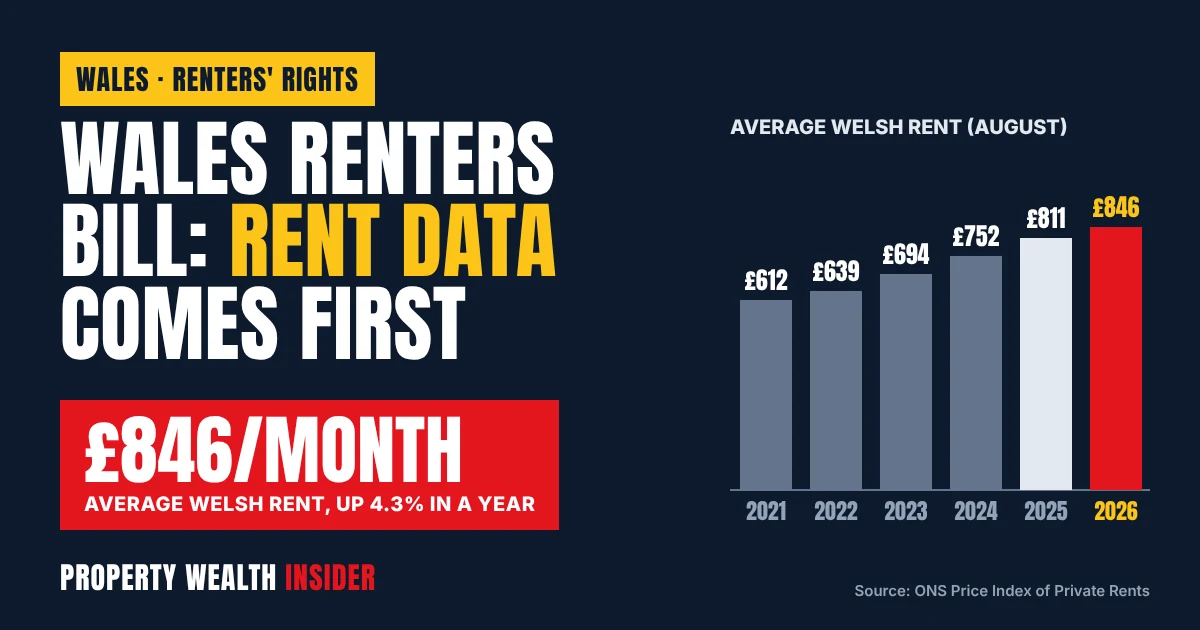
- The average private rent in Wales was £846 a month in August 2026, up 4.3% (£35) in a year (ONS).
- No-fault notices in Wales already need at least 6 months’ notice and cannot be given in the first 6 months of occupation.
- Privately rented homes made up an estimated 12% (184,900) of Welsh dwellings at 31 March 2025.
What the minister actually said
The statement came in housing questions in the Senedd on Wednesday 7 October 2026. Siân Gwenllian is the Cabinet Minister for Local Government, Housing and Planning in the Plaid Cymru government that took office in May 2026. She was answering a Member who asked about progress on renters’ rights.
According to the official Record of Proceedings, she made five points:
- Strengthening tenants’ rights is a priority for the government.
- Reform will be phased. The first renters bill is phase one.
- That bill will gather the data needed to see what renting looks like in different parts of Wales.
- The data will be the foundation for a second and third bill.
- The long-term aim is to put the right to an adequate home into Welsh law.
The Member who asked the question pressed her to end no-fault evictions “at the earliest possible opportunity” and to freeze private rents straight away. She committed to neither. She pointed out that hers is a minority government and the shared ambition “won’t be able to be delivered in full”. The minister also said that around one in six households in Wales rent privately.
No bill text, timetable or consultation has been published yet. The direction follows the previous government’s White Paper on Adequate Housing, Fair Rents and Affordability (October 2024). That paper proposed requiring landlords and/or agents to give rent data to Rent Smart Wales, and building a local rent map.
What is law now vs what is proposed
Welsh tenancies have run under the Renting Homes (Wales) Act 2016 since 1 December 2022. Tenants are “contract-holders” and most private lets are “standard occupation contracts”. The table separates those rules from the new talk in the Senedd.
| Issue | In force now (Wales) | Proposed / signalled |
|---|---|---|
| No-fault notice (s.173) | Minimum 6 months’ notice; cannot be given in first 6 months of occupation | No commitment to abolish. The minister declined to give a date |
| Landlord’s break clause | Only in fixed terms of 2 years or more; no notice in first 18 months; 6 months’ notice | Nothing announced |
| Rent increases (periodic) | At least 2 months’ notice; no more than once every 12 months (s.123) | No rent freeze promised. Rent data first, which could inform later bills |
| Rent data | No duty to report rents | First Renters Bill to gather rent data across Wales (White Paper floated reporting to Rent Smart Wales) |
| Registration and licensing | Rent Smart Wales registration (£60 online) and licence (£254 online), each valid 5 years | Nothing announced |
| Right to adequate housing | Not in law | Long-term aim, after bills two and three |
Welsh rents: the numbers behind the bill
The government wants better local data, but official national figures already show how fast rents have risen. The ONS Price Index of Private Rents puts the average Welsh rent at £846 a month in August 2026, up 4.3% on a year earlier. Annual growth is slowing: it was 4.5% in July, and growth peaked at 9.9% in November 2023.
Worked example: In August 2021 the average Welsh rent was £612. In August 2026 it was £846, an extra £234 a month or £2,808 a year for a tenant on the average rent. That 38% rise over five years is the reason affordability is a political issue in Cardiff Bay.
Local rents vary a lot, and that is why the government wants area-level data. ONS figures for August 2026:
| Local authority | Average monthly rent | Annual change |
|---|---|---|
| Cardiff | £1,177 | +3.5% |
| Monmouthshire | £994 | +2.3% |
| Vale of Glamorgan | £982 | +2.7% |
| Newport | £959 | +2.7% |
| Swansea | £852 | +6.2% |
| Caerphilly | £747 | +8.1% |
| Blaenau Gwent | £681 | +6.8% |
| Powys | £621 | +9.1% |
| Wales | £846 | +4.3% |
Rents are rising fastest in some of the cheapest areas, including Powys, Caerphilly and Blaenau Gwent. A single national rent policy would hit those areas very differently from Cardiff.
There are two different measures of the size of the sector. The minister said about one in six households rent privately. The Welsh Government’s own dwelling stock estimates count 184,900 privately rented dwellings, about 12% of the 1,487,200 homes in Wales at 31 March 2025. One figure counts households and the other counts dwellings.
Section 173 notice date calculator
No-fault possession is still available in Wales, but many notices fail on dates or paperwork. Enter your dates and tick the compliance items you can prove. The tool shows the earliest date you can give notice, the earliest end date the notice can name, and the window for making a court claim.
Wales no-fault notice date checker
Guide only, based on sections 173-179 and 194-200 of, and Schedule 9A to, the Renting Homes (Wales) Act 2016, and section 44 of the Housing (Wales) Act 2014. It does not cover converted contracts that were fixed terms before 1 December 2022, supported or other Schedule 8A contracts (2 months’ notice), withdrawn earlier notices, or retaliatory-eviction refusals. Where a date has no match in the later month (for example 31 August plus six months), it uses the 1st of the following month to be safe. Leave a few extra days for service. This is not legal advice.
Worked example (the default figures): A periodic contract has an occupation date of 1 February 2026. The landlord could give a section 173 notice from 1 August 2026. A notice given on 9 October 2026 must name an end date no earlier than 9 April 2027. The landlord then has two months from that date, up to 8 June 2027, to issue a possession claim. Miss that window and section 177 stops you serving another section 173 notice for six months.
What a mistake costs: Say you are selling a Cardiff flat let at the city average of £1,177 a month, and your buy-to-let mortgage interest is £650 a month. If the notice fails because the EPC was never handed over, you fix that and serve again. You need at least another six months’ notice. During that time you pay at least £3,900 in extra interest before you can sell with vacant possession, plus the cost of the failed court claim.
Seven things that make a no-fault notice invalid
Schedule 9A to the 2016 Act, together with section 44 of the Housing (Wales) Act 2014, lists the problems that stop a section 173 or break-clause notice being given. These rules apply now.
- No written statement. No notice can be given at all. If you gave the statement late (after the 14 days allowed by section 31), you must wait six months from the day you gave it.
- Deposit not protected or the required information not given. You must return the deposit, or have a court application resolved, before you can serve notice.
- No valid EPC given to the contract-holder.
- Gas safety record not given or displayed.
- Smoke or carbon monoxide alarms, or an electrical condition report, missing, so that the dwelling is treated as unfit for human habitation under the 2022 Fitness for Human Habitation Regulations.
- Prohibited payment or holding deposit not repaid, under the Renting Homes (Fees etc.) (Wales) Act 2019, or the landlord’s address notice under section 39 not given.
- Not registered or licensed with Rent Smart Wales. There is a 28-day grace period after you acquire a let property.
Two timing traps also apply. If you withdraw a notice, you generally cannot serve another for six months, although you may give one more within 28 days of the first. If a court refuses possession because the claim was retaliatory, you are barred for six months.
What Welsh landlords should do now
There is no bill text yet, so nothing new to comply with today. But a rent-data bill makes your records visible, so get your paperwork in order now.
- Check your Rent Smart Wales status. Registration lasts five years and costs £60 online for a new registration (£48 to renew). A landlord licence costs £254 online. Failing to register can mean a fixed penalty of up to £150 and blocks no-fault notices.
- Collect your rent records. Note the current rent, the start rent and the date of each increase for every property. If rent reporting comes in, you will need this.
- Check where your rents sit against the ONS local averages in the table above. A rent far above the local average is the kind that new data will highlight.
- Run every tenancy through the calculator before you plan a sale or refurbishment. Six months’ notice plus court time means you should plan vacant possession about nine to twelve months ahead.
- Use the correct rent increase process. For periodic contracts, give at least two months’ notice and no more than one increase every 12 months.
- Watch for the bill’s publication and any consultation, and respond with your own figures. The government says rent data will shape the next two bills.
- Rent Smart Wales registration in date (5-year cycle)
- Landlord licence held, or a licensed agent appointed
- Written statement given within 14 days of occupation (keep proof of service)
- Deposit protected and prescribed information served
- Valid EPC given to the contract-holder
- Current gas safety record given or displayed
- Smoke alarms working on each storey, CO alarm where required, EICR supplied
- Landlord’s address notice (s.39) given
- No unrepaid prohibited payments or holding deposits
- Rent history logged for each property (start rent, increases, dates)
FAQ
Is Wales banning no-fault evictions?
Not at the moment. The section 173 notice is still available with six months’ notice. On 7 October 2026 the minister was asked to end no-fault evictions and did not commit to doing so or give a date.
Will there be a rent freeze or rent controls in Wales?
Nothing has been announced. The minister declined to commit to an immediate rent freeze. The first Renters Bill will gather rent data, and the second and third bills will build on it.
How much notice does a landlord in Wales have to give?
For a section 173 notice on a periodic standard contract, at least six months, and it cannot be given in the first six months of occupation. A break-clause notice also needs six months, and it cannot be given in the first 18 months. Some contracts listed in Schedule 8A, such as supported accommodation, need only two months.
What is the average rent in Wales?
£846 a month in August 2026, up 4.3% in a year, according to the ONS. Cardiff is the highest at £1,177 and Powys the lowest at £621.
Can I serve a section 173 notice if I’m not registered with Rent Smart Wales?
No. Section 44 of the Housing (Wales) Act 2014 bars section 173 and break-clause notices while the landlord is unregistered, or unlicensed without a licensed agent. The only exception is the first 28 days after you acquire the property.
Sources
- Senedd Record of Proceedings, Plenary 7 October 2026 (OQ64622, Renters’ Rights)
- Welsh Government: Written Statement, White Paper on Adequate Housing and Fair Rents
- ONS: Private rent and house prices, UK: September 2026
- ONS: Price Index of Private Rents, UK: monthly price statistics
- Welsh Government: Dwelling stock estimates, 31 March 2025
- Renting Homes (Wales) Act 2016 (ss.31, 123, 173-179, 194-200, Schedules 8A, 9A, 12)
- Housing (Wales) Act 2014, section 44
- Welsh Government: Form RHW16, landlord’s notice under section 173
- Rent Smart Wales: landlord registration
- Rent Smart Wales: licensing
This article is news and general guidance only, not financial, legal or tax advice.