Budget 2026: landlord tax hits 24% – see what you’ll pay
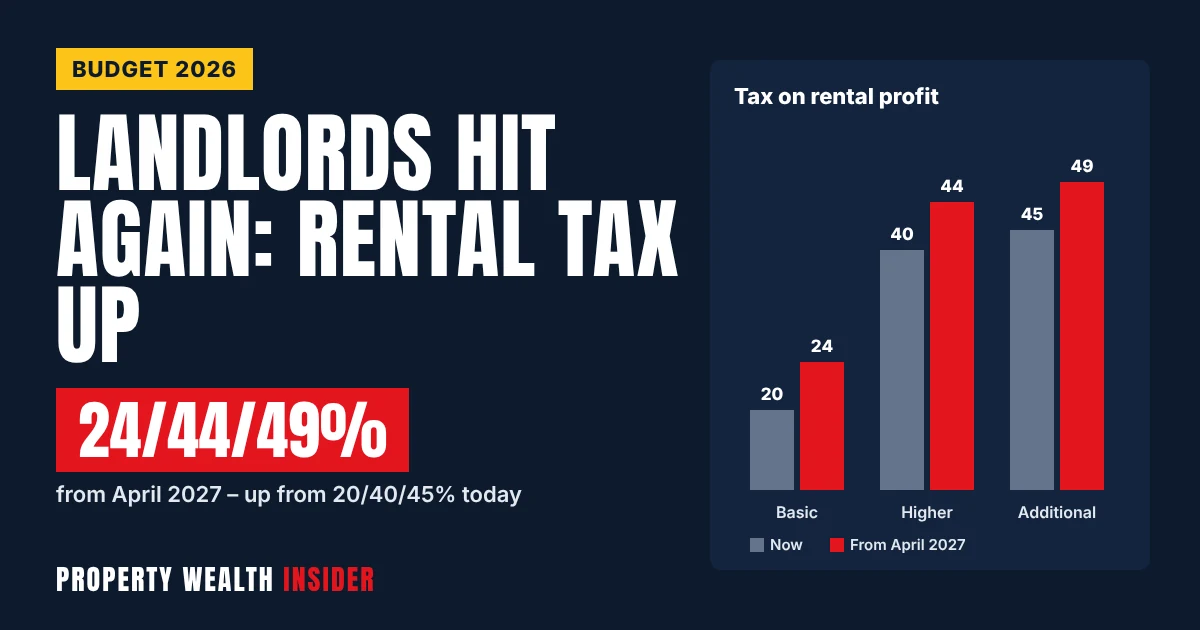
Landlords have been hit with a second rental income tax rise in 12 months. In today’s Budget (28 October 2026), Chancellor John Healey added another two percentage points to the tax on property income, so from 6 April 2027 individual landlords will pay 24%, 44% or 49% on their rental profits instead of 20%, 40% or 45% today.
That is on top of the 2-point rise announced in last year’s Budget, not a re-announcement of it. HMRC’s own rates table, published this afternoon, confirms the new figures. If you own buy-to-lets in your own name, your tax on every £1,000 of rental profit goes up by £40 from April 2027 compared with now.
The rental tax rise is not the only thing that affects property. The Budget also includes energy help for tenants, a 3.9% minimum wage rise, a new first-time buyer equity loan for new builds, a new First Time Buyer ISA, business rates cuts for small shops, more money for social housing and powers for mayors to bring in tourist taxes. This guide covers each one, with four free calculators so you can see how it affects you.
Key facts
- Property income tax rates rise to 24%, 44% and 49% from 6 April 2027 in England, Wales and Northern Ireland. That is +4 points on today’s rates.
- The Section 24 mortgage interest credit is set at the property basic rate, so it should rise to 24%. That softens the blow for landlords with a mortgage.
- Savings income rises to the same 24%, 44% and 49%. Tax on dividends and salaries is unchanged, and so is CGT at 18% and 24%.
- Your First Home: a 20% equity loan with a 2.5% deposit for first-time buyers, new builds only, backed by £4.7bn.
- The cash ISA stays at £20,000. A new First Time Buyer ISA from April 2029 can be used on any home up to £450,000.
- National Living Wage rises to £13.21 from 1 April 2027. Households in council tax bands A to D get a £100 energy payment in 2027.
Is it really another 2%? Yes – the proof
Many landlords will assume today’s headline is last year’s rise being repeated. It is not. Last year’s Budget set separate property income rates of 22%, 42% and 47% from April 2027, and these became law in section 7 of the Finance Act 2026. Today the Chancellor raised them by a further two points.
The Treasury’s Budget press release says savings and property income rates will “rise by a further two percentage points across all bands” from April 2027. HMRC’s rates and allowances annex lists the property rates for 2027–28 as 24%, 44% and 49%.
| Tax band (your total income) | Now (2026/27) | Budget 2025 plan | Budget 2026 (confirmed) | Rise vs now |
|---|---|---|---|---|
| Basic rate (£12,571 to £50,270) | 20% | 22% | 24% | +4 points |
| Higher rate (£50,271 to £125,140) | 40% | 42% | 44% | +4 points |
| Additional rate (over £125,140) | 45% | 47% | 49% | +4 points |
| Section 24 mortgage interest credit | 20% | 22% | 24%* | +4 points |
*The credit is legislated at the “property basic rate”, so it moves with that rate. Check the final wording when the Finance Bill is published. Band thresholds assume the standard £12,570 Personal Allowance.
Where it applies: the separate property rates apply in England, Wales and Northern Ireland, according to HMRC’s technical note. Scotland sets its own rates, and the Welsh Government is expected to get powers to set its own property rates in future.
Who it hits: only landlords who own property in their own name, including joint owners. Limited companies pay corporation tax, so this rise does not apply to rent received by a company.
Calculator: your landlord tax bill from April 2027
Enter your salary or other non-rental income and your yearly rental figures. The calculator works out the extra tax caused by your rental profit under today’s rates, under last year’s plan and under today’s Budget. It applies the Personal Allowance taper above £100,000, taxes rent on top of your other income as HMRC does, and gives the Section 24 credit on mortgage interest.
How much more tax will I pay on my rental income?
Guide only, not tax advice. Assumes England, Wales or Northern Ireland, no other savings or dividend income, the standard Personal Allowance and the same income in both years. The Section 24 credit is limited to the lower of your interest and your rental profit. Your accountant has the final word.
Worked examples
- Basic-rate landlord, no mortgage: £10,000 of rental profit costs £2,000 in tax today and £2,400 from April 2027, an extra £400 a year. Last year’s plan would have charged £2,200.
- Higher-rate landlord with a mortgage: salary of £60,000, rent of £20,000, running costs of £3,000 and mortgage interest of £8,000. Taxable rental profit is £17,000 because interest is not deductible. Tax is £6,800 at 40%, less a £1,600 credit, so £5,200 today. From April 2027 it is £7,480 at 44%, less a £1,920 credit, so £5,560. The cash profit is only £9,000, so 62% of it goes in tax.
- Married couple sharing 50/50: one partner earns £70,000 and the other £20,000, and they jointly own a let making £16,000 profit. The lower earner’s £8,000 share is taxed at 24% (£1,920) and the higher earner’s at 44% (£3,520). If the lower earner held more of the property, for example through a declaration of trust and HMRC Form 17, the family’s tax bill would be lower. Take advice first.
Section 24: why mortgaged landlords feel it most
Under Section 24, individual landlords cannot deduct mortgage interest from rent. Instead they get a tax credit worth a fixed percentage of the interest. HMRC’s technical note says that from 2027–28 the credit is given “at the property basic rate”, so it should rise to 24% alongside the new rates.
That helps basic-rate landlords, because the credit rises in step with their tax rate. Higher-rate landlords still pay 44% on rent but get only 24% back on interest, a 20-point gap on every pound of interest. As mortgage rates rise, more of the rent goes on interest, so more of the bill is driven by that gap. For more on finance costs, see our report on landlord profits falling as finance costs soar.
Limited companies: the gap just got wider
The Budget did not touch tax on dividends. HMRC’s annex keeps dividend rates at 10.75%, 35.75% and 39.35% for 2027–28. The Treasury also says it will keep the lowest headline corporation tax rate in the G7. So property held in a company is now taxed relatively less than property held personally.
Companies also get full relief for mortgage interest, which is the bigger difference for geared landlords. Moving existing properties into a company is a different matter. It usually counts as a sale at market value, which can trigger capital gains tax and stamp duty with the 5% surcharge. That can wipe out years of savings, so it is only worth it in specific cases (for example some partnerships) and only with specialist advice.
For new purchases, the case for buying through a company has got stronger. One related change: the Budget says it will tighten the rules on company distributions to stop complex arrangements that extract profits at lower tax rates. Expect more scrutiny of creative extraction schemes.
Stealth taxes: the freeze that makes it worse
The Chancellor said he had not raised taxes on working people. But income tax thresholds stay frozen. The Personal Allowance is £12,570 in both 2026–27 and 2027–28 in HMRC’s annex, and last year’s Budget froze thresholds until April 2031.
This matters more to landlords than to most people, because rent is taxed on top of your salary. Every time rents rise but the £50,270 higher-rate threshold does not, more of your rent is taxed at 44% instead of 24%. A landlord earning £45,000 with £8,000 of rental profit already has £2,730 of it in the higher band. A 5% rent rise each year pushes more over the line without any rate change at all.
| Measure | What changed today | Who feels it |
|---|---|---|
| Property income tax | +2 points on top of last year’s +2: 24%, 44%, 49% from April 2027 | Individual landlords |
| Savings income tax | Same rise: 24%, 44%, 49% from April 2027 (Personal Savings Allowance and £5,000 starting rate unaffected) | Savers with cash outside ISAs, including landlords’ repair funds |
| Threshold freeze | Not lifted. Allowances stay frozen to April 2031 | Everyone with rising income |
| Machine Games Duty | Higher-stakes machines up from 20% to 25% | Betting shop and casino tenants |
| Bank surcharge | 3% to 6% for 15 months | Banks, possibly passed on to borrowers |
| Online marketplaces | Must collect VAT on qualifying UK business sales from October 2027 | Online sellers |
There were two small giveaways. The trading allowance rises from £1,000 to £3,000, which helps people with small side incomes but not rental income (the separate £1,000 property allowance was not mentioned). And from April 2027 a new Pension Tax Allowance means pensioners whose total income is no more than the new State Pension pay no income tax. Most landlords will have too much rental income to qualify.
Tenants: wages, energy bills and jobs
Several measures put money in tenants’ pockets, which matters to landlords because it supports rent payments and reduces arrears risk.
- Minimum wage: the National Living Wage rises 3.9% to £13.21 an hour from 1 April 2027. The Treasury says that is £910 a year more for a full-time worker.
- £100 energy payment: in 2027 for up to 20 million households in council tax bands A to D in England, with similar support in the rest of the UK.
- No VAT on electricity: the temporary cut is extended to 1 July 2027. The Treasury says this takes about £50 off the Ofgem price cap from April 2027.
- Gas standing charges: the government will ask Ofgem to abolish them and recover the cost through unit rates. That helps low users and empty properties most, while high users may pay a similar total.
Bills-included lets (HMOs, rent-to-rent, serviced accommodation): if you pay the energy bills, the VAT extension cuts your costs on domestic supplies. Moving gas standing charges into unit rates means you stop paying a fixed daily charge on empty properties between tenancies. Business tariffs may not get the same treatment, so check with your supplier. The £100 payment goes to the household liable for council tax, which in most HMOs is the landlord.
Will the wage rise cost jobs? It is a fair worry. Employers in hospitality and retail, where many HMO and lower-value tenants work, face higher wage bills, and some cut hours rather than jobs. In March the OBR expected unemployment to peak at around 5.3% in 2026 before falling. The same sectors got business rates cuts today, which takes some pressure off. For landlords, the practical step is to reference on hours and job stability, not just the hourly rate, and to consider rent guarantee cover for 2027 tenancies.
How much does the Budget give a tenant household?
Guide only. The wage rise is £0.50 an hour (£12.71 to £13.21) for workers aged 21 and over from 1 April 2027. The VAT saving assumes 5% VAT would otherwise apply for the nine months from October 2026 to June 2027. The £100 payment is for England; similar support is planned elsewhere.
First-time buyers: Your First Home and the new ISA
Do first-time buyers have to buy a new build? Only to use Your First Home, which is for new-build homes from developers who sign up to the scheme. The new First Time Buyer ISA can be used on any home, new or second-hand, up to £450,000.
Your First Home was announced on 26 September 2026 and confirmed today. The Treasury says it aims to help 70,000 people buy, backed by £4.7bn of government-backed lending.
| Your First Home | First Time Buyer ISA | Lifetime ISA (existing) | |
|---|---|---|---|
| What it is | 20% government equity loan | Savings account with a 25% bonus when you buy | Savings account with a 25% bonus as you save |
| Which homes | New builds only, from participating developers in England | Any UK home, new or existing | Any UK home |
| Price limit | Local caps based on median prices; £650,000 inner London, £500,000 outer London | £450,000 | £450,000 |
| Deposit | 2.5% minimum (up to 15%) | Up to £4,000 a year saved | Up to £4,000 a year saved |
| Income limit | £110,000 a household; £140,000 in London | None | None |
| Bonus or loan terms | Interest-free for 5 years | 25%, up to £20,000 lifetime bonus, paid at exchange | 25%, up to £1,000 a year |
| Age | First-time buyers of any age | 18 and over, no upper limit | Open at 18 to 39 |
| Starts | Spring 2027 | April 2029 (replaces the LISA for new savers) | Open now; 20% charge above £450,000 (see below) |
The Lifetime ISA fix that applies now: the Treasury says the LISA withdrawal charge for buyers whose home costs more than £450,000 falls from 25% to 20% from Budget day. That means you get back what you paid in, but you lose the bonus. The £450,000 cap itself has not changed, which still rules out many first homes in London and the South East.
The FTB ISA needs a mortgage: the bonus is only paid on purchases with a mortgage, so cash buyers miss out. You must hold the account for at least 12 months before claiming.
First-time buyer: which scheme fits, and what deposit do I need?
Guide only. Your First Home price caps outside London are set locally and not yet published, so check the cap for your area. Stamp duty uses current England and Northern Ireland rates. Scheme rules may change before launch.
What it means for landlords and investors: Help to Buy showed that equity loans can push up new-build prices compared with similar second-hand homes. A new-build premium often reverses when owners sell. Investors should be careful about buying new-build flats in areas where Your First Home buyers will set prices. Expect demand from young professional renters with savings to soften in new-build-heavy towns from spring 2027, as some of your best tenants become buyers.
ISAs, banks and mortgage rates
The cash ISA cut is scrapped. Last year’s plan to cut the cash ISA limit for under-65s to £12,000 from April 2027 has been dropped, and the £20,000 limit stays for everyone. This matters for mortgages, because building societies use cash ISA deposits to fund lending, and the cut risked making mortgages dearer. The government will also work on an incentive for first-time stocks and shares ISA investors.
Savings tax rise: interest outside an ISA will be taxed at 24%, 44% or 49% from April 2027. If you keep a repair fund or a deposit for your next purchase in a normal savings account, moving it into a cash ISA now makes more sense than before.
Bank surcharge: the surcharge on bank profits doubles from 3% to 6% for 15 months from January 2027, raising about £1.5bn. It ends on 31 March 2028 and the Treasury says it will not be extended. Lenders may try to recover some of it through mortgage pricing, but gilt yields will matter far more for fixed rates. The fiscal headroom fell to £15bn, which markets will watch closely. See our guide to stress-testing your remortgage.
Serviced accommodation, holiday lets and the visitor levy
The Budget confirms legislation to give all Strategic Authorities in England the power to bring in an Overnight Visitor Levy. No rate has been set nationally. Under the government’s consultation, the levy would cover all commercially let short-term accommodation, including serviced apartments, Airbnb-style lets and self-catering cottages. It would be a percentage of the room price, collected by the operator.
Edinburgh already charges 5% on the first five nights of a stay, so 5% is a sensible planning figure. The Budget also gives mayors a share of business rates from 2027 and income tax from 2028. With more revenue powers, mayors are more likely to use the levy.
What would a visitor levy cost my serviced accommodation?
Guide only. No English mayor has set a levy yet, and the rate, exemptions and any night cap will be decided locally under the national framework.
Holiday lets and council tax: before the Budget there were strong reports that holiday lets could be treated as second homes for council tax and lose small business rates relief. The Treasury’s Budget summary does not mention it. Until the detailed documents are checked, treat it as not announced but still possible. Our guides on the 100% second homes premium threat and the business rates vs council tax tests explain where you stand now.
Commercial property: business rates, vape shops and gambling
For owners of shops and small commercial units in England, this Budget is good news. Lower business rates mean tenants have more room to pay rent, and fewer of them fail.
| Change (England) | Detail | What it means for landlords |
|---|---|---|
| Small business rate relief | Threshold rises from £12,000 to £18,000 rateable value for retail, hospitality and leisure. About 70,000 more businesses pay nothing | Half of these properties will pay no rates, so small units are easier to let |
| Real-terms freeze | All other retail, hospitality and leisure rates frozen in real terms for two years | More predictable costs for tenants |
| Pubs and live music | Extra 20% cut, announced in July | Helps pub freeholders |
| Vape shops and adult gaming centres | Lose the lower retail rates and, for vape shops, small business relief | Higher costs for these tenants, so check their finances at renewal |
| Machine Games Duty | Higher-stakes machines up from 20% to 25%; pubs and seaside arcades protected | More pressure on betting shop tenants |
| Mayors | Share of business rates from 2027, aiming for 100% local retention by the end of the decade | Local rates policy may start to differ between areas |
Business rates are devolved in Scotland, Wales and Northern Ireland. Those governments get extra funding and can choose whether to copy these measures.
Homelessness, social housing and rents
The Budget adds £1.5bn to social and affordable housing, taking 10-year capital investment above £40bn, and a further £432m over two years to tackle rough sleeping. That is good for the country. For private landlords the effects come at different speeds.
- Short term (2027–2028): new social homes take years to build. Meanwhile councils still have a legal duty to house homeless families and keep leasing private homes for temporary accommodation. That keeps demand and rents firm at the lower end of the market.
- Opportunity now: councils and housing associations are actively looking for homes and bedspaces. Leasing to a council or a supported housing provider can give long, guaranteed rent with fewer voids. Check the terms, repair obligations and break clauses carefully.
- Longer term (2029 onwards): as social homes are completed, people come off waiting lists and out of temporary accommodation. That eases demand for the cheapest private lets and could slow rent growth at the bottom of the market.
Put that next to the tax rise and the likely result is fewer small landlords, a tighter supply of private rented homes and rents that keep rising in most areas for now. Our sell-or-stay calculator can help you decide which side of that trade you want to be on.
What did not change
- Capital gains tax: still 18% and 24%, per HMRC’s annex. Landlords planning to sell do not need to rush to exchange.
- Stamp duty: rates unchanged, including the 5% surcharge on additional homes and first-time buyer relief up to £500,000.
- Dividends and wages: no change to income tax rates on salary or dividends.
- Already coming: Making Tax Digital for landlords with over £30,000 of rent from April 2027, the High Value Council Tax Surcharge on £2m+ homes in England from April 2028, and pensions entering estates for inheritance tax from April 2027.
Key dates
What landlords should do now
You have just over 17 months before the new rates start. Use it.
- Run your numbers in the calculator above for each property, and note which ones make little or no cash profit after tax.
- Check how your rental income is split between owners. Moving more to a lower-earning spouse or partner can save up to 20 points on every pound.
- Ask an accountant whether new purchases should go in a limited company. Do not move existing properties without a full CGT and stamp duty costing.
- Review your mortgage. Paying down expensive debt on the weakest properties reduces the Section 24 gap.
- Move cash savings into ISAs before April 2027, when savings tax rises too.
- Set aside more for your January 2029 tax bill, the first full balancing payment at the new rates.
- Get ready for Making Tax Digital if your gross rent is over £30,000.
- SA operators in mayoral areas: watch for local visitor levy consultations and build 5% into your 2028 pricing.
- Commercial landlords: check the covenant of vape shop and adult gaming centre tenants before renewals in 2027.
- Re-check rent affordability for tenants on the minimum wage, and consider rent guarantee cover.
FAQs
Is the landlord tax rise in Budget 2026 new or the same as last year?
It is new. Last year’s Budget set rates of 22%, 42% and 47% from April 2027. Today’s Budget adds another two points, so the rates will be 24%, 44% and 49%.
When does the 24% landlord tax rate start?
From 6 April 2027, the start of the 2027–28 tax year. Your 2026–27 rental profits are still taxed at 20%, 40% or 45%.
Does the property income tax rise apply to limited companies?
No. It applies to individuals who receive rental income, including joint owners. Companies pay corporation tax on their profits, which this Budget did not raise.
Does the Section 24 tax credit go up to 24%?
It is set at the property basic rate, which becomes 24% from April 2027, so it should rise too. Higher-rate landlords still pay 44% on rent but get only 24% back on mortgage interest.
Do you have to buy a new build with the First Time Buyer ISA?
No. The First Time Buyer ISA can be used on any UK home up to £450,000 bought with a mortgage. Only the separate Your First Home equity loan scheme is limited to new builds.
Will the visitor levy apply to Airbnb and serviced accommodation?
Yes, if your local Strategic Authority introduces one. The government’s framework covers all commercially let short-term accommodation. No English area has set a rate yet.
Sources
- HM Treasury: Budget 2026 – Breathing space for today, hope for the future (28 October 2026)
- HM Treasury: Budget 2026 document
- HMRC: Budget 2026 Annex A – rates and allowances
- HMRC: Budget 2026 overview of tax legislation and rates
- HMRC: Change to tax rates for property, savings and dividend income – technical note
- Finance Act 2026, section 7
- HM Treasury: Supporting documents for Budget 2026
- MHCLG: New first-time buyer scheme to be confirmed at Budget (26 September 2026)
- Financial Reporter: Your First Home scheme details (28 October 2026)
- HM Treasury: First Time Buyer ISA consultation
- MHCLG: Overnight visitor levy in England – consultation
- OBR: Economic and fiscal outlook, March 2026
This article is news and general guidance based on Budget announcements on 28 October 2026, not financial, legal or tax advice. Some details will be confirmed in the Finance Bill. Check your own position with a qualified adviser.