Buy a ready-made HMO or convert? The 5% stamp duty maths
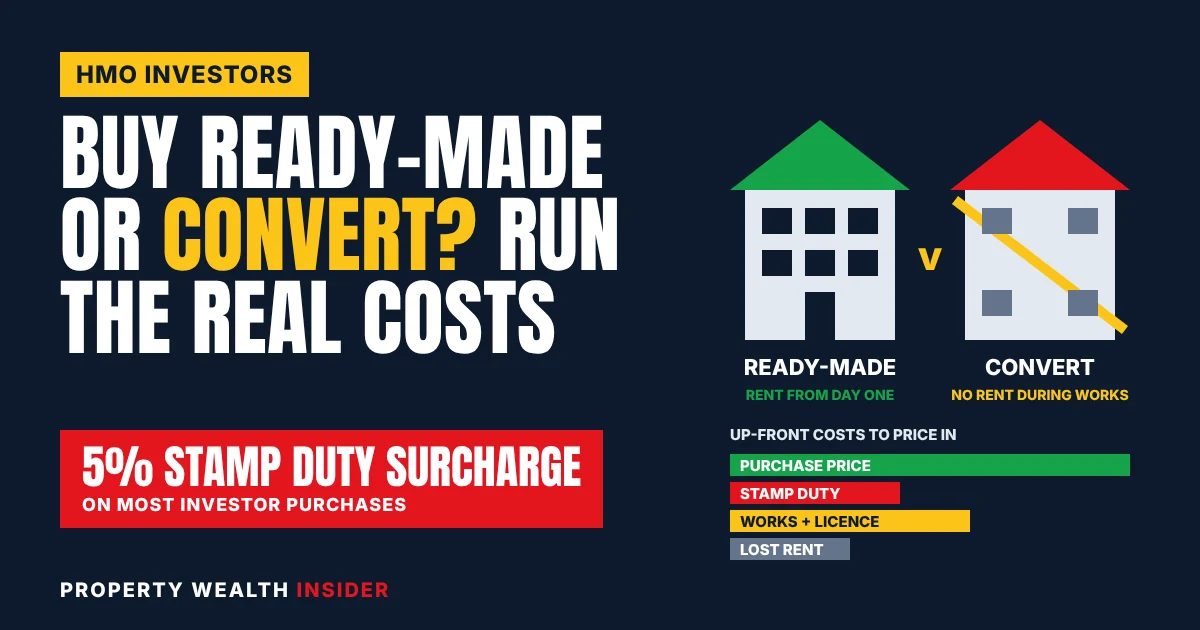
Should you buy an HMO that is already licensed and full of tenants, or buy an ordinary family house and convert it yourself? New research from property management firm Rushbrook has put that old question back on the table this week.
The research, which has been widely reported in the trade press, argues that ready-made licensed HMOs can cost less than the typical price of buying a three- or four-bed house and converting it. It compares two different groups of property, though, not the same houses. We could not find the full report on Rushbrook’s own website, so we have not printed its figures. Instead, here are the costs you can check for yourself: the 5% stamp duty surcharge, licence fees, planning, and the rent you lose while builders are on site.
This guide covers England only. HMO licensing and planning rules are different in Wales, Scotland and Northern Ireland.
Key facts
- A large HMO (5 or more people from 2 or more households) has needed a mandatory licence in England since 1 October 2018.
- Investors pay a 5% stamp duty surcharge on top of standard rates, up from 3% for completions on or after 31 October 2024. On a £300,000 purchase that means a £20,000 bill.
- A licence cannot be transferred to a buyer. When you buy an existing HMO, you have to apply for a new one yourself.
- Minimum bedroom sizes are 6.51 m² for one adult and 10.22 m² for two adults. Floor space where the ceiling is lower than 1.5 m does not count.
- Councils can fine you up to £40,000 instead of prosecuting for licensing offences. The cap went up from £30,000 on 1 May 2026.
Ready-made v conversion: the real trade-off
A ready-made HMO starts earning on the day you complete. A conversion can work out cheaper per room, but you pay for it in time, risk and hassle. The headline price of either one tells you very little.
Comparing asking prices across different groups of property also tells you little. An existing HMO might be a tired six-bed terrace in a student area. A house worth converting might be a bigger semi in a better location. The only fair test is to price two real properties in the same town, room for room, with every cost included.
| Factor | Buy existing licensed HMO | Buy house and convert |
|---|---|---|
| Income starts | From completion, if tenants stay | Only after works, sign-off and a licence (if needed) |
| Stamp duty | On the full HMO price, at higher rates | On the cheaper house price, at higher rates |
| Planning | Check the use is lawful, not just assumed | May need permission, especially in an Article 4 area |
| Licence | Seller’s licence does not transfer, so you must apply | New application once works finish |
| Build risk | Hidden defects and tired fire safety systems | Cost overruns, delays and finance interest |
| Control over layout | Inherited, and rooms may fail size rules | Designed to meet the standards from day one |
Stamp duty: the 5% surcharge hits both routes
For completions on or after 31 October 2024, the stamp duty surcharge on additional homes went up from 3% to 5% above standard rates. Companies buying residential property for £40,000 or more also pay the higher rates. Since 1 April 2025, the bands on an additional property have been as follows.
| Portion of price | Standard rate | Additional property rate |
|---|---|---|
| Up to £125,000 | 0% | 5% |
| £125,001 to £250,000 | 2% | 7% |
| £250,001 to £925,000 | 5% | 10% |
| £925,001 to £1.5 million | 10% | 15% |
| Above £1.5 million | 12% | 17% |
This is where converting has a built-in edge. You pay stamp duty on what you pay for the property, not on what it is worth after the works. Buy a £240,000 house as an additional property and the bill is £14,300. Buy a £300,000 ready-made HMO and it is £20,000. That £5,700 difference comes out of your capital before you have spent anything on building work.
Licensing, room sizes and fines
An HMO is a property rented to at least three people who are not from one household and who share a kitchen, bathroom or toilet. Since 1 October 2018, the Licensing of HMOs (Prescribed Description) (England) Order 2018 has required a mandatory licence for any HMO with five or more people from two or more households. Some councils also run additional licensing schemes that cover smaller HMOs, so check yours.
A licence lasts for up to five years, and each council sets its own fee. As a guide, Norwich currently lists £1,111 for a five-year licence, paid in two parts. South Cambridgeshire charges £895 for a five-bed HMO in 2026/27, plus £36 for each extra bedroom.
Room sizes are where many conversions go wrong. Licence conditions under the 2018 mandatory conditions regulations set these minimums for sleeping rooms:
- 6.51 m² for one person aged over 10
- 10.22 m² for two people aged over 10
- 4.64 m² for one child under 10. A room smaller than 4.64 m² cannot be used for sleeping at all.
- Floor space where the ceiling is lower than 1.5 m does not count towards these sizes. This matters in loft rooms.
Penalties are heavy. Under section 249A of the Housing Act 2004, a council can fine you up to £40,000 instead of prosecuting for offences including running an unlicensed HMO and breaching HMO management regulations. The cap was raised from £30,000 on 1 May 2026. If the council prosecutes instead, gov.uk warns that the fine for renting out an unlicensed HMO is unlimited.
Planning: C4, Article 4 and the seven-bed trap
Licensing and planning are separate systems, and having a licence does not mean you have planning permission. Under the Use Classes Order, a small HMO with no more than six residents falls into Class C4. Class L permitted development normally lets you change a family house (C3) into a C4 HMO, or back again, without applying for planning permission.
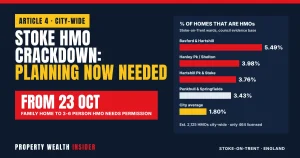
There are two catches. First, a council can use an Article 4 direction to remove that right in all or part of its area, so you then need a full planning application, which may be refused. Many towns and cities with lots of HMOs have done this. Second, an HMO with seven or more residents falls outside Class C4. That generally means applying for planning permission wherever the property is.
For a conversion, find out whether an Article 4 direction applies before you make an offer, not after. Planning risk can make a cheap house worthless as an HMO.
Buying an existing HMO: what does not come with the keys
Going the ready-made route does not get you out of the paperwork. Section 68(6) of the Housing Act 2004 says plainly that a licence may not be transferred to another person. As the buyer, you need your own licence. If you are charged with running an unlicensed HMO, having made a valid licence application is a defence under section 72(4), so get your application in to coincide with completion.
Check the planning position too. If the seller cannot show planning permission, or that the use falls under permitted development, ask whether there is a Lawful Development Certificate. The Planning Portal says this confirms that an existing use is lawful for planning purposes. It is not compulsory, but if there isn’t one, your solicitor needs to find out why.
Then look at the condition of the building. A licence the council issued years ago does not mean the property meets today’s standards. Budget for a fire safety survey and electrical checks, and measure every bedroom. If a room is too small, the council can stop it being used for sleeping, and you lose that rent.
Worked example and buy v convert calculator
Here are two illustrative six-bed deals in the same town. Prices and rents are examples, not market data. Stamp duty is worked out using HMRC’s rates for an additional property.
| Cost | A: ready-made 6-bed HMO | B: 4-bed house converted to 6 rooms |
|---|---|---|
| Purchase price | £300,000 | £240,000 |
| Stamp duty (additional rates) | £20,000 | £14,300 |
| Legal, survey, planning and design fees | £3,000 | £6,000 |
| Conversion or upgrade works | £10,000 | £60,000 |
| Licence fee (estimate) | £1,000 | £1,000 |
| Finance interest during 5 months of works (6%) | £0 | £6,000 |
| Total cost in | £334,000 | £327,300 |
| Rent lost during works (6 x £600 x 5 months) | £0 | £18,000 |
| Cost including lost rent | £334,000 | £345,300 |
On paper, the conversion is £6,700 cheaper. Once you count the five months without any rent, the ready-made HMO comes out £11,300 ahead. If the works overrun by a couple of months, that gap grows quickly. Put your own numbers into the calculator below.
HMO buy v convert calculator
This is a guide only, not financial or tax advice. Stamp duty uses England and Northern Ireland residential rates from 1 April 2025, with the 5% additional property surcharge. It ignores the non-resident surcharge, any reliefs and the corporate 17% flat rate on dwellings over £500,000. The finance cost is simple interest on the purchase price during the works. Get quotes and take professional advice before you commit.
What to do now: step by step
- Pick one town and compare like with like. Find a real ready-made HMO and a real house you could convert, on similar streets.
- Check planning first. Search the council’s website for an HMO Article 4 direction. If the house would have seven or more residents, plan for a full application.
- Measure the rooms. Draw up the layout against the 6.51 m² and 10.22 m² minimums, leaving out floor space under 1.5 m ceilings.
- Get real quotes. Ask for fire safety, electrics, en-suites and kitchens to be priced separately. Ask the council’s building control team what sign-off the works need.
- Price the stamp duty properly. Use the higher rates and the calculator above. Make sure the time cost of the works is included.
- If you are buying ready-made, prepare your own licence application so you can submit it on completion. Ask the council about the property’s licensing history.
Printable due diligence checklist
- Copy of the current HMO licence and its conditions
- Council public register entry checked
- Planning permission, Class L use or Lawful Development Certificate
- Article 4 direction status checked with the council
- Every bedroom measured against the minimum sizes
- Fire risk assessment, alarm and fire door condition
- Gas safety record and electrical installation report
- Tenancy agreements, rent schedule and deposit protection records
- Stamp duty worked out at additional property rates
- New licence application ready for completion day
FAQ
Is it cheaper to buy an HMO or convert a house?
It depends on the property. Converting often costs less up front, because you pay stamp duty on a cheaper purchase price. However, you earn no rent while the works go on, and there is a risk with planning and the build. Compare two real properties in the same area.
Does an HMO licence transfer to a new owner?
No. Section 68(6) of the Housing Act 2004 says a licence may not be transferred to another person. As the buyer, you must apply for your own licence.
Do I need planning permission to turn a house into an HMO?
For a small HMO with up to six residents (Class C4), you usually do not, unless the council has an Article 4 direction for the area. With seven or more residents you are outside Class C4 and will generally need permission.
How much stamp duty do you pay on an HMO?
Most investors pay the higher rates, which are 5% above the standard rates. On a £300,000 HMO bought as an additional property, the bill is £20,000.
What is the minimum room size in an HMO?
In a licensed HMO in England, it is 6.51 m² for one adult and 10.22 m² for two adults. A room under 4.64 m² cannot be used for sleeping at all.
What is the fine for an unlicensed HMO?
In England, a council can impose a civil penalty of up to £40,000 (raised from £30,000 on 1 May 2026). If it prosecutes instead, gov.uk says the fine can be unlimited.
- GOV.UK: House in multiple occupation licence
- Licensing of Houses in Multiple Occupation (Prescribed Description) (England) Order 2018
- Licensing of HMOs (Mandatory Conditions of Licences) (England) Regulations 2018
- Housing Act 2004, section 68
- Housing Act 2004, section 72
- Housing Act 2004, section 249A
- GOV.UK: SDLT residential property rates
- GOV.UK: Higher rates of Stamp Duty Land Tax
- GOV.UK: SDLT increase to the higher rates (31 October 2024)
- Town and Country Planning (Use Classes) Order 1987, Schedule
- GPDO 2015, Schedule 2 Part 3 Class L
- GPDO 2015, article 4 directions
- Planning Portal: Lawful Development Certificates
- Norwich City Council: HMO licence cost
- South Cambridgeshire District Council: HMO licence fees
This article is news and general guidance, not financial, legal or tax advice.