LHA gap hits record 23.3%: renters £170 a month short
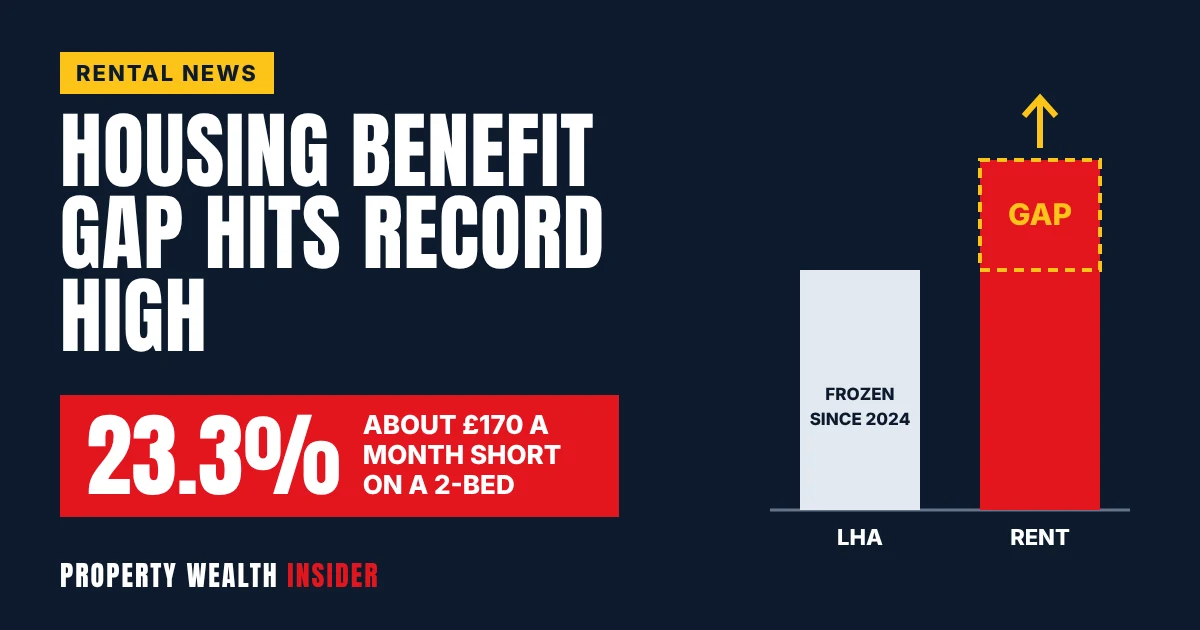
The gap between what housing support pays and what low-income tenants are actually charged has hit an all-time high. New analysis from the Resolution Foundation puts the average shortfall between Local Housing Allowance (LHA) and the cheapest third of local rents at 23.3 per cent, or about £170 a month for a typical family in a two-bedroom home.
LHA caps the housing element of Universal Credit and Housing Benefit for private tenants. Rates have been frozen since April 2024 while rents have kept climbing, so every month the freeze lasts, more of the rent has to come from the tenant’s own pocket. Over 900,000 families on Universal Credit were already paying more than their LHA in May 2026.
For landlords who let to tenants on benefits, that gap is where arrears start. The Budget on 28 October 2026 decides whether it keeps widening. Here is what the numbers mean for your rent roll, how to check any tenancy in seconds, and what help exists if a tenant falls behind.
Key facts
- The average gap between LHA and the 30th percentile of local rents is a record 23.3%, about £170 a month for a typical two-bedroom family (Resolution Foundation, 21 October 2026).
- LHA rates for April 2026 to March 2027 are the same rates that came into force on 1 April 2024: frozen for a second year running in England, Wales and Scotland.
- Over 900,000 families on Universal Credit were paying rents above their LHA in May 2026.
- ONS puts the average UK private rent at £1,406 a month in September 2026, up 3.8% in a year (England £1,466, up 4.0%).
- Without a change, the Resolution Foundation projects the shortfall will reach 32%, or £235 a month for a two-bed family, by 2029-30.
- A landlord can ask DWP to pay rent direct once arrears reach 2 months’ rent.
What the research found
The Resolution Foundation, the living-standards think tank, published its figures on 21 October 2026. It measures the gap between LHA and the 30th percentile rent, which is the level LHA is supposed to track. That gap now averages 23.3 per cent, the highest on record.
In cash terms that is roughly £170 a month for a typical family in a two-bedroom home. In every English region there is at least one local authority where the two-bed shortfall tops £100 a month. The think tank gives Manchester at £250 a month and Newcastle at £180.
It also warns the problem compounds. With no action, it projects the gap at 32 per cent by 2029-30, or £235 a month for a two-bed family. A month earlier, on 21 September, it had flagged that the gap was on course to hit a record this October and put the typical two-bed shortfall in Inner East London at £324 a month.
How LHA works and why it is frozen
For a private tenant, the housing element of Universal Credit is whichever is lower: the rent, or the LHA rate for the tenant’s area and household size. Housing Benefit works the same way. Anything above the LHA rate is the tenant’s to find.
- Area: rates are set for Broad Rental Market Areas (BRMAs), not council boundaries. England has 152 of them.
- Household size: the rate depends on how many bedrooms the household is entitled to, not how many the property has. Nobody gets more than the 4-bedroom rate.
- Under-35s: a single person under 35 with no children and no non-dependants living with them gets only the shared accommodation rate, even in a self-contained flat. There are exceptions, including care leavers aged 18 to 24, people who have spent at least 3 months in a homeless hostel and some disabled claimants.
- Basis: rates are meant to follow the 30th percentile of local rents, meaning 3 in 10 local lets should be at or below LHA. They were last reset to that level in April 2024.
For 2026-27 the government used a legal order (SI 2026/5) to carry the April 2024 rates forward again. The Valuation Office Agency still calculated fresh 30th percentile figures from lettings up to September 2025, but under that order they are “excluded from calculation” of the April 2026 rates. Those unused figures are what we use below to show the official gap.
Which nations? LHA covers Great Britain. England’s rates come from the VOA, Wales and Scotland publish their own (both frozen at April 2024 levels for 2026-27). Northern Ireland has its own system: the Housing Executive publishes rates for 8 BRMAs, frozen for 2026/27 at their 2025/26 levels. The emergency help in England has also changed (see below).
The gap by area: official figures
The government’s own spreadsheet sets the frozen two-bedroom rates beside the 30th percentile rents it chose not to use. We have converted the weekly figures to monthly the way Universal Credit does (weekly × 52 ÷ 12). Bear in mind the 30th percentile figures run only to September 2025. Rents have risen since, which is why the think tank’s current estimates are higher.
| BRMA (England) | 2-bed LHA (weekly) | 2-bed LHA (monthly) | 30th percentile rent (monthly, to Sept 2025) | Monthly gap | % of rent covered |
|---|---|---|---|---|---|
| Inner East London | £402.74 | £1,745.21 | £2,069.30 | £324.09 | 84% |
| Outer North London | £322.19 | £1,396.16 | £1,595.62 | £199.46 | 88% |
| Bristol | £252.00 | £1,092.00 | £1,246.57 | £154.57 | 88% |
| Central Greater Manchester | £201.37 | £872.60 | £1,047.11 | £174.50 | 83% |
| Birmingham | £172.60 | £747.93 | £892.54 | £144.60 | 84% |
| Leeds | £178.36 | £772.89 | £822.73 | £49.83 | 94% |
| Greater Liverpool | £136.93 | £593.36 | £723.02 | £129.65 | 82% |
| Tyneside | £126.58 | £548.51 | £648.22 | £99.71 | 85% |
Even on the year-old figures, the frozen rate is below the 30th percentile in all 152 English BRMAs for a two-bed home. There is also a national ceiling: no two-bed LHA rate can exceed £412.86 a week, and Inner North London’s rate sits exactly on it. The think tank’s higher Manchester figure (£250) is its current estimate for the city council area, while our table uses the wider BRMA and year-old rents.
LHA shortfall calculator
Look up the rate for your property’s BRMA and the tenant’s bedroom entitlement on the VOA LHA rate search (England). For Wales, Scotland or Northern Ireland use the official tables linked in the sources. Enter it weekly or monthly; the tool converts it for you.
LHA shortfall calculator
Guide only, not advice. Assumes the tenant gets the full LHA rate for the category you pick. The actual award can be lower because of the benefit cap, deductions for adults living in the home, earnings or other deductions. Weekly rates are converted as × 52 ÷ 12.
What it means for landlords: worked examples
A shortfall is not your loss on day one. It becomes your loss when the tenant cannot keep finding it. These examples use the official 2026-27 rates.
Example 1: family in a Manchester two-bed
Rent is £1,050 a month in the Central Greater Manchester BRMA. The two-bed LHA is £201.37 a week, which is £872.60 a month. The tenant must find £177.40 a month, or £2,128.80 a year. LHA covers 83% of the rent.
Example 2: single 28-year-old in a Birmingham one-bed flat
Rent is £800 a month. Being single and under 35, the tenant gets the shared accommodation rate of £78.61 a week, or £340.64 a month. That leaves £459.36 a month uncovered: LHA pays under 43% of the rent.
If the same tenant qualified for an exception, such as being a care leaver under 25, the one-bed rate of £159.95 a week (£693.12 a month) would apply instead. The gap falls to £106.88 a month. Checking that one fact can be worth more than £4,200 a year to the tenancy.
Example 3: three-bed on Tyneside
Rent is £700 a month. The three-bed LHA is £149.59 a week, or £648.22 a month. The shortfall is £51.78 a month, or £621.36 a year. Manageable for many households, but it grows every time the rent rises and LHA does not.
That last point is the real risk. ONS figures show private rents up 4.0% in England in the year to September 2026, and 5.7% in the North West. With LHA frozen, any rent increase goes straight onto the shortfall. A £40 rise on example 3 takes the gap from £52 to £92 a month.
Direct payments and emergency help
Universal Credit is normally paid monthly in arrears to the tenant, rent included. Under DWP’s Alternative Payment Arrangements, the housing costs can be paid straight to you instead. This is called a managed payment to landlord.
- Who can ask: either the tenant or the landlord.
- The arrears trigger: arrears equal to or more than 2 months’ rent. If the tenant has underpaid continually for more than 2 months, one month’s arrears is enough.
- How: landlords use DWP’s Apply for a Direct Rent Payment service. It replaced the old UC47 form.
- Tenant objections: the tenant has 7 days to object and must show they are not in arrears at that level or are in a disrepair dispute. Universal Credit payments pause while DWP decides.
- Clearing old arrears: DWP can also deduct towards arrears, capped at 15% of the standard allowance since April 2025.
A managed payment only redirects the LHA-capped housing element. It does not close the shortfall. That is where discretionary help comes in, and the system in England changed this year.
England: Discretionary Housing Payments ended on 31 March 2026. They have been replaced by the Housing Payments strand of the new Crisis and Resilience Fund, which councils run from April 2026 to March 2029. It can cover shortfalls caused by LHA, as well as deposits and rent in advance, and can be paid to the landlord. The tenant must be getting Housing Benefit or the Universal Credit housing element.
Wales: Discretionary Housing Payments continue on the same basis. Scotland: DHPs have been run by the Scottish Government since 2017. A DHP refusal carries no right of appeal to a tribunal, but councils have an internal review process.
The Budget: what could change
The Budget is on 28 October 2026. The Resolution Foundation wants LHA re-linked every year to the 30th percentile of local rents. It estimates that would help over 900,000 households at a cost of £2.3 billion by the end of the Parliament.
It also argues the money goes to tenants, not landlords: when LHA was last raised, it found only about 10p in every pound of extra support showed up as higher rents at the bottom of the market. After the April 2024 reset, just over 150,000 fewer Universal Credit households in England faced a shortfall.
In force vs proposed: the freeze is law for April 2026 to March 2027. Re-linking LHA is only a proposal. Until new rates are actually published, plan every tenancy on today’s frozen rates.
What to do now
- Find each tenant’s real rate. Look up the BRMA and use the tenant’s bedroom entitlement, not the property’s bedroom count.
- Run the calculator. Note the monthly gap and the % covered for every benefit-supported tenancy.
- Check the under-35 exceptions. A tenant on the shared rate who is a care leaver, hostel leaver, disabled or a domestic abuse survivor may qualify for the self-contained rate.
- Price rent reviews with the gap in mind. On a frozen LHA, every pound of increase is a pound the tenant pays. Ask whether the extra rent is worth the arrears risk.
- Point tenants to the council early. A Crisis and Resilience Fund housing payment in England, or a DHP in Wales or Scotland, is easier to win before arrears build.
- Keep a clean rent record. DWP accepts rent statements, not bank statements, as evidence. If arrears hit 2 months, apply for a managed payment straight away.
- Watch 28 October. If LHA is unfrozen, re-run the numbers when new rates are published.
- BRMA and LHA rate recorded for each benefit-supported tenant
- Bedroom entitlement checked (shared rate, 1 to 4 beds)
- Monthly and annual shortfall calculated
- Under-35 exception checked where relevant
- Tenant told about council housing payments / DHPs
- Rent statement kept up to date for DWP evidence
- Managed payment applied for if arrears reach 2 months’ rent
- Rent review decision made with the LHA gap in view
FAQ
Are Local Housing Allowance rates frozen in 2026?
Yes. The rates for April 2026 to March 2027 are the same as those that came into force on 1 April 2024, in England, Wales and Scotland. Northern Ireland’s rates are frozen at their 2025/26 levels.
How do I find the LHA rate for my property?
In England, use the VOA LHA rate search by postcode. It shows the BRMA and the weekly rate for each category, from shared accommodation up to 4 bedrooms.
Can Universal Credit rent be paid directly to the landlord?
Yes, through a managed payment to landlord. Either side can ask. It can be considered where arrears equal 2 months’ rent or more, or where the tenant has a listed vulnerability such as addiction, severe debt or a mental health condition. DWP decides.
What is the shared accommodation rate?
It is the lowest LHA rate, for a room in a shared house. It applies to single people under 35 with no children, even if they rent a self-contained flat, unless an exception applies.
Can a tenant get help paying the LHA shortfall?
Possibly. In England, councils can pay from the Crisis and Resilience Fund housing payments strand; in Wales and Scotland through Discretionary Housing Payments. Awards are discretionary and the tenant must be getting housing support already.
Will LHA go up in the Budget?
Nothing has been announced. The Budget is on 28 October 2026, and re-linking LHA to local rents is being urged but is not government policy until announced.
Sources
- Resolution Foundation: Low-income private renters face record gap between the rents they pay and Local Housing Allowance (21 October 2026)
- Resolution Foundation: Chancellor must act to address record gap between local rents and support (21 September 2026)
- GOV.UK: LHA rates applicable from April 2026 to March 2027 (with Tables 1-4)
- The Rent Officers (Housing Benefit and Universal Credit Functions) (Modification) Order 2026 (SI 2026/5)
- Universal Credit Regulations 2013, Schedule 4 (4-bedroom limit, shared accommodation rate)
- GOV.WALES: LHA rates from April 2026 to March 2027
- Scottish Government: LHA rates 2026 to 2027
- Northern Ireland Housing Executive: LHA rent levels
- ONS: Private rent and house prices, UK (21 October 2026)
- DWP: Alternative payment arrangements
- DWP: Universal Credit and rented housing, guide for landlords
- DWP: Crisis and Resilience Fund guidance for local authorities in England
- DWP: Discretionary Housing Payments guidance manual (Wales)
- HM Treasury: Budget 2026 date
- VOA: LHA rate search
This article is news and general guidance only, not financial, legal or tax advice.