Rent tribunals: landlords get full rise in just 28% of cases
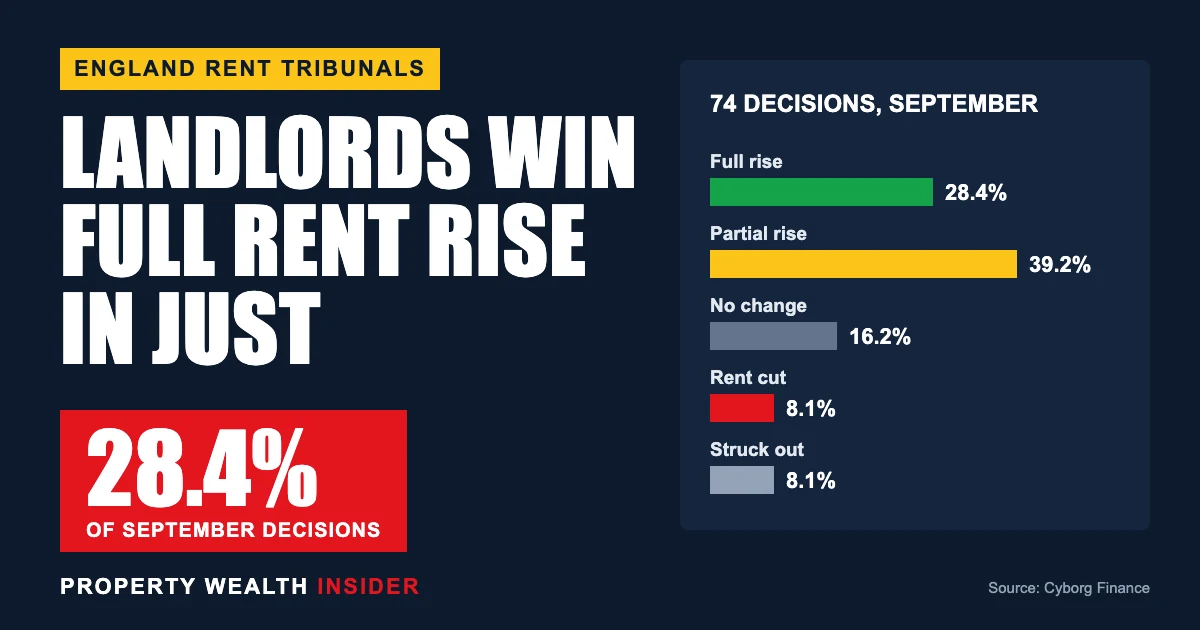
Landlords in England who saw a rent increase challenged at the First-tier Tribunal in September got the full amount they asked for in only 28.4% of cases, according to an analysis of 74 published decisions by mortgage broker Cyborg Finance.
That does not mean tenants who challenge usually win outright. Two in three cases still ended with a higher rent, and across the decisions with comparable figures, rents rose 6.7% overall. But the landlords who got the most were the ones whose proposal already sat at or below what the tribunal judged the open market would pay.
Under the Renters’ Rights Act rules that took effect on 1 May 2026, the tribunal cannot award more than you proposed, and the higher rent is no longer backdated to the date on your notice if the decision comes later. Overpricing a section 13 increase can now cost real money. These rules apply to assured periodic tenancies in England only.
Key facts
- Only 21 of 74 September tribunal decisions (28.4%) gave landlords their full proposed rent, per Cyborg Finance.
- 50 cases (67.6%) still ended with a higher rent, in full or in part.
- Across 68 comparable cases, average rent went from £1,372 to £1,464 a month, up 6.7% (6.3% in August).
- The tribunal can set a rent lower than you proposed, even below the current rent, but never higher.
- If the decision comes after your notice date, the new rent starts from the next rent period after the decision. It is not backdated.
- A tenant pays a £47 fee to apply. Cyborg Finance’s tracker puts the average time from notice to decision at around 91 days.
What the September decisions show
Cyborg Finance looked at 74 published First-tier Tribunal (Property Chamber) decisions on challenged private assured-tenancy rent increases in England dated 1 to 30 September 2026. It says the set may not include every decision made that month.
| Outcome | Cases | Share | What it means for the landlord |
|---|---|---|---|
| Full proposed increase | 21 | 28.4% | Tribunal’s market rent was at or above the proposal, so the proposal stood |
| Partial increase | 29 | 39.2% | Rent rose, but to the tribunal’s lower market figure |
| No change | 12 | 16.2% | Market rent judged to be the existing rent |
| Rent reduced | 6 | 8.1% | Market rent judged below the existing rent |
| Struck out | 6 | 8.1% | No rent determined |
| Total | 74 | 100% |
On the 68 cases with both an original and a determined rent, combined monthly rent rose from £93,285 to £99,509. That works out at an average of £1,372 rising to £1,464, about £92 a month or £1,104 a year more per tenancy. The figure includes the cases where rent was unchanged or cut.
The aggregate rise was 6.7%, up from 6.3% in August. Cyborg Finance stresses these figures describe the tribunal cases it analysed, not rents across the whole private rented sector.
How the tribunal sets the rent now
When a tenant challenges a section 13 notice, the tribunal works out the rent the property “might reasonably be expected to be let in the open market by a willing landlord” on the same terms. This is set out in section 14 of the Housing Act 1988. It ignores improvements the tenant has made and any damage caused by the tenant breaking the tenancy terms.
Since 1 May 2026, a new section 14ZB decides what you actually get. Four rules matter.
- Your proposal is the ceiling. The new rent is the tribunal’s open-market rent if that is lower than your proposal. Otherwise it is your proposed rent. You cannot be awarded more than you asked for.
- It can go below the current rent. Nothing stops the open-market figure from being below what the tenant pays today. Six September cases ended in a cut.
- No backdating. If the decision comes before the start date on your notice, the rent changes on that date. If it comes after, the new rent starts from the first rent period beginning on or after the decision date.
- Hardship can push it later. If paying from that date would cause the tenant undue hardship, the tribunal can choose a later date. It must fall within two months of the decision.
Before May, a successful increase was normally backdated to the date on the notice. The tenant now keeps paying the old rent for as long as the case runs. The tenant’s only cost is a £47 application fee, and they can ask the tribunal to order you to repay it. No fee applies if your notice was served before 1 May 2026.
Cases are decided on paper unless either side asks for a hearing. According to tribunal guidance, the decision usually follows within six weeks of a hearing. Cyborg Finance’s wider tracker puts the average gap from notice to decision at around 91 days, based on cases since May 2026.
What an over-market proposal costs you
Take a flat let at £1,372 a month, the average starting rent in the September cases. Local comparables suggest £1,464. These examples assume the higher rent starts four months late if challenged, in line with Cyborg Finance’s estimate of the delay.
| Scenario | New rent | Extra rent, first 12 months |
|---|---|---|
| A. Propose £1,500, tenant accepts | £1,500 | £128 x 12 = £1,536 |
| B. Propose £1,500, tenant challenges, tribunal sets £1,464 | £1,464 | £92 x 8 = £736 |
| C. Propose £1,464, tenant accepts | £1,464 | £92 x 12 = £1,104 |
| D. Propose £1,500, comparables only support £1,330 | £1,330 | -£42 x 8 = -£336 |
In scenario B, the extra £36 a month you asked for is removed by the tribunal. You also lose four months of the £92 rise you would have got anyway, which is £368. Compared with a tenant who accepts, that is £800 less in year one.
Scenario C shows why a well-evidenced figure often wins. The proposal sits at market, so a challenge has little chance of reducing it. That makes a challenge less attractive to the tenant in the first place.
Scenario D is the worst case. If your evidence is weak and the tribunal decides the flat is worth less than it currently earns, your rent goes down. Over a full year after the decision, that is £504 less.
Timing example: you serve Form 4A on 1 December 2026 for an increase from 1 February 2027, with rent due on the 1st. The tenant applies in January. If the decision is dated 15 April 2027, the new rent starts on 1 May 2027. You collect the old rent for February, March and April.
Calculator: rent increase vs tribunal risk
Enter your current rent, the rent you want to propose and what your comparables honestly support. The calculator shows what you gain if the tenant accepts, what a challenge could cost, and whether you are asking above market.
Rent increase vs tribunal risk
Guide only, not legal or financial advice. Assumes the tribunal sets the rent at your market estimate and the new rent starts after the delay you enter. The real outcome depends on the evidence and the tribunal’s own knowledge of the local market. England only.
How to serve a section 13 increase properly
A notice with a mistake in it can be struck out or fail, and you then have to start again. These are the steps for an assured periodic tenancy in England under the rules in force since 1 May 2026.
- Check you are allowed to increase the rent. You can raise the rent once a year and not in the first year of the tenancy. The new rent cannot start until 52 weeks after the last increase took effect, even if that increase was before 1 May 2026 under Form 4 or a rent review clause.
- Pull your evidence together first. Decide the figure from comparables, not from your costs. Mortgage rates and service charges do not set market rent.
- Talk to the tenant. Government guidance says you should discuss the increase first. Showing your comparables at this stage costs nothing and can head off a challenge.
- Use the current Form 4A. Get it from the gov.uk assured tenancy forms page. You need to follow this section 13 process every time, even if the tenant has already agreed the rise.
- Give at least two months’ notice. Set the start date so it begins a new rental period and falls at least two months after the tenant receives the form. Allow extra days for postal service.
- Serve it in a way you can prove. You can serve in person, by post, or by email if the tenancy agreement allows it. Keep proof of service.
- If the tenant applies to the tribunal, you will be sent the landlord’s reply form (MR2). Respond within the deadline the tribunal gives you and attach your comparables. Ask for a hearing or inspection if the property’s condition or features will help your case.
- Budget for the delay. The old rent continues until the decision, so check your mortgage payments are covered on the current rent.
How to evidence market rent
The tribunal compares your property with similar homes let nearby and often uses its own knowledge of the local market. Your job is to make your figure the easy answer. Achieved rents on comparable lets carry more weight than one optimistic asking price.
Be honest about condition. The tribunal assumes the home is let on the open market as it actually is, so a dated kitchen or damp patch will count against a headline figure taken from a refurbished flat down the road.
- At least three to five comparables with the same bedrooms, type and broadly similar condition, ideally within a mile
- Agreed or achieved rents where possible (agent letters, recent lets in your own portfolio), not just asking prices
- Dated screenshots of current listings, with links, saved on the day you set the figure
- A note of differences: parking, garden, furnishing, EPC rating, bills included or not
- A letting agent’s written market appraisal for the property
- Recent photos showing the property’s current condition
- A copy of Form 4A, proof of service and the date of the last increase
- The tenancy agreement, especially who pays which bills and whether the rent includes furniture or council tax
FAQs
Can a rent tribunal set a higher rent than the landlord asked for?
Not for section 13 challenges in England made under the post-May 2026 rules. Section 14ZB says the new rent is the tribunal’s open-market rent if that is lower than your proposal, and otherwise your proposed rent. It can be lower than the current rent.
Is a rent increase backdated after a tribunal decision?
No. If the decision is made after the start date on your notice, the new rent applies from the first rent period beginning on or after the decision. The tribunal can delay it by up to two months if paying would cause the tenant undue hardship.
How often can a landlord increase rent in England?
Once a year, and not in the first year of the tenancy. You must use Form 4A and give at least two months’ notice every time, even if the tenant agrees.
How much does it cost a tenant to challenge a rent increase?
The tribunal application fee is £47. Tenants can ask the tribunal to order the landlord to repay it. There is no fee where the landlord served notice before 1 May 2026. The tenant must apply before the date the new rent is due to start.
How long does a rent tribunal take?
Cyborg Finance’s tracker puts the average at around 91 days from service of the notice to a decision for cases since May 2026. Tribunal guidance says a decision usually follows within six weeks of a hearing.
Do these rules apply in Wales or Scotland?
No. This guidance covers assured periodic tenancies in England. Wales, Scotland and Northern Ireland each have their own rent increase rules.
Sources
- Cyborg Finance press release, 1 November 2026
- Cyborg Finance: Rent tribunal decisions research
- GOV.UK: Assured tenancy agreements, a guide for landlords (rent increases)
- GOV.UK: Assured tenancy forms (Form 4A)
- HM Courts and Tribunals Service: Form MR1, application to the tribunal
- GOV.UK: Taking part in a residential property tribunal rent case (T540)
- Housing Act 1988, section 13
- Housing Act 1988, section 14
- Housing Act 1988, section 14ZB
This article is news and general guidance only, not financial, legal or tax advice.