Build to Rent Starts Crash 63%: What It Means for Your Rents
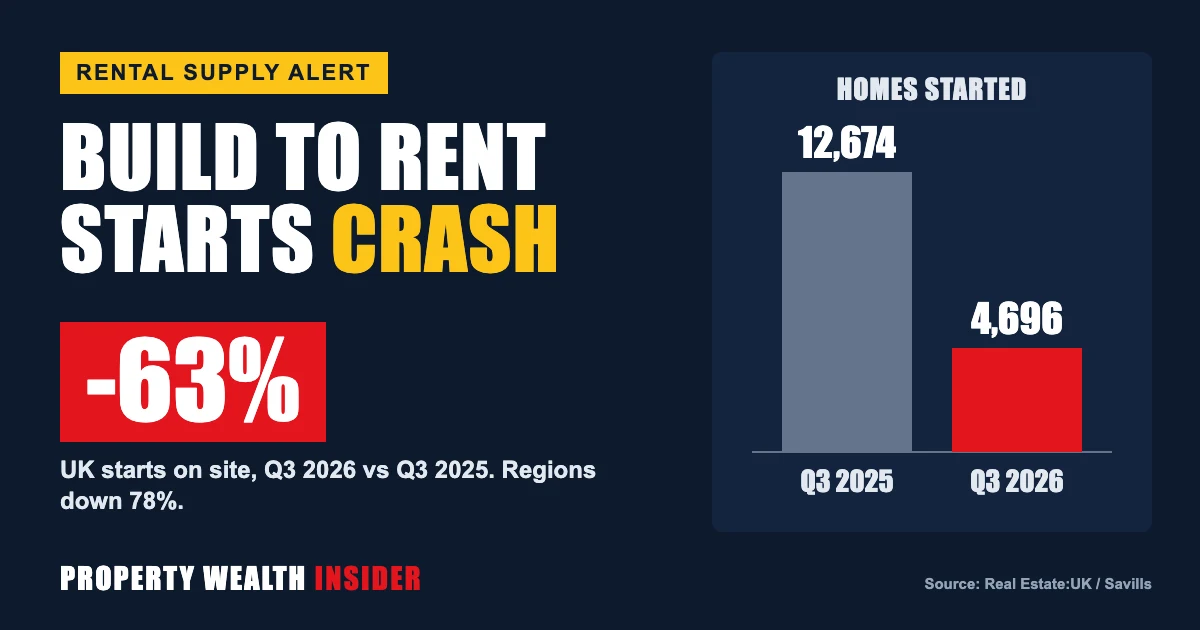
Construction of new purpose-built rental homes has fallen sharply. Figures published by Real Estate:UK, the industry body formerly called the British Property Federation, show 4,696 Build to Rent homes started on site at Q3 2026, against 12,674 at Q3 2025. That is a 63% drop.
Outside London the fall was even steeper: 78%. Homes under construction are down 30% across the UK. The data, compiled by Savills, shows completions have been higher than starts for eleven quarters running, so the pipeline of new rental homes is running down.
For small and mid-sized landlords, that means fewer new rental blocks competing for your tenants over the next few years, especially in regional cities. Below we explain what the figures show and what they could mean for rents and voids. A calculator then shows whether keeping a good tenant on a smaller increase beats re-letting at full market rent.
Key facts
- UK Build to Rent starts on site fell 63%, to 4,696 at Q3 2026 from 12,674 at Q3 2025 (Real Estate:UK / Savills).
- Starts outside London fell 78%, from 10,232 to 2,275.
- Homes under construction fell 30% in the 12 months to September (London -28%, regions -30%).
- Completions reached 21,979 in the 12 months to Q3 2026, up 21% on 18,204. This is the 11th quarter in a row that completions have exceeded starts.
- UK private rents rose 3.8% to an average of £1,406 a month in the 12 months to September 2026 (ONS).
What the new Build to Rent figures show
Build to Rent (BTR) means blocks and estates built specifically for renting and owned by large investors such as pension funds and insurers. Real Estate:UK says it now accounts for about 8% of new homes, or nearly one in ten.
The Q3 2026 figures from Real Estate:UK show a sector still finishing homes it started years ago, but starting far fewer new ones.
| Measure | Q3 2025 | Q3 2026 | Change |
|---|---|---|---|
| UK starts on site | 12,674 | 4,696 | -63% |
| Starts outside London (regions) | 10,232 | 2,275 | -78% |
| London starts (our calculation: UK minus regions) | 2,442 | 2,421 | -1% |
| Completions, 12 months to Q3 | 18,204 | 21,979 | +21% |
| Homes under construction, UK | n/a | n/a | -30% |
| Homes under construction, London / regions | n/a | n/a | -28% / -30% |
| Schemes at detailed application stage (vs Q2 2026) | n/a | n/a | -9% |
Real Estate:UK did not publish a London starts figure. We worked it out by subtracting regional starts from the UK total, and it suggests London starts held roughly level at about 2,400. Almost all of the collapse happened in the regional cities, where BTR had been growing fastest.
There is a little good news further back in the pipeline. The number of consented homes has risen slightly year on year. But schemes at detailed application stage fell 9% between Q2 and Q3 2026, which points to weaker supply in the longer term.
Why developers have stopped starting schemes
Real Estate:UK calls it a viability crisis: on current numbers, many schemes no longer pay. It points to four pressures:
- higher construction and financing costs
- planning and regulatory delays, including at the Building Safety Regulator
- the combined effect of taxes and levies
- political uncertainty over possible rent controls
The industry body wants the government to use the Budget to bring back Stamp Duty Land Tax multiple dwellings relief for high-density housing and to zero-rate VAT on rents. These are lobbying requests, not policy. Nothing has been announced.
Investment money has not disappeared. Savills reports more than £900 million was invested in UK BTR in Q3 2026. Almost £300 million of that went to funding suburban single-family rental homes across five English regions. Some of the money bought homes that are already finished, such as an 866-home portfolio in the South East, and that does not add new supply.
The wider housing picture is also tight. Official figures show 208,600 net additional homes in England in 2024-25, 6% fewer than the year before.
What it means for rents
Rents are already rising. In the latest ONS release (21 October 2026), the average UK private rent was £1,406 a month in September 2026, 3.8% higher than a year earlier. The annual rate was unchanged from August.
| Area | Average monthly rent | Annual change |
|---|---|---|
| UK | £1,406 | +3.8% |
| England | £1,466 | +4.0% |
| Wales | £848 | +4.1% |
| Scotland | £1,011 | +0.7% |
| Northern Ireland (to July 2026) | £879 | +1.7% |
| North West (fastest in England) | n/a | +5.7% |
| London and South East (slowest in England) | n/a | +3.5% |
Source: ONS Price Index of Private Rents, 12 months to September 2026 unless stated. The next release is due on 18 November 2026.
Savills also found that 72% of English local authorities recorded stronger-than-average rental growth in the three months to August 2026. It said Birmingham was the exception among the big cities, because a large amount of new rental supply there held increases back. That shows how much new supply can matter in a local market.
Savills expects the summer jump to be a one-off adjustment after the Renters’ Rights Act, not a lasting change. So do not assume rents will keep rising at this pace. What has changed is the supply picture in regional cities. Fewer BTR starts today mean fewer new rental homes being finished in the years ahead. Without those new homes, local rental markets are likely to stay tight for longer, though local conditions will vary.
Voids, tenant demand and your competition
About one in five households in England (19%) now rent privately, according to the English Housing Survey 2024-25. That is a large and stable pool of demand. The main difference for you is the competition those renters can choose from.
- Regional city flats: big BTR blocks offering gyms and concierge services have been the main rival for young professional tenants. With 78% fewer regional starts, fewer new blocks will open over the next few years.
- Family houses: the investment that is still happening is going into suburban single-family rental homes. In some suburbs, family houses may face more competition from these schemes, not less.
- London: starts were broadly flat on our calculation, and homes under construction fell 28%. London rent growth is already the slowest in England, at 3.5%.
Tighter supply should mean shorter voids for well-priced, well-kept homes. But the biggest cost to a small landlord is still losing a good tenant. A void of 4 weeks on a £1,200-a-month let costs £1,108 in lost rent, and each extra week adds £277. Add agent fees, referencing, cleaning and redecoration, and one change of tenant can easily cost a month’s rent or more.
Keep the tenant or re-let? Run the numbers
When rents are rising, it is tempting to push the rent up to full market level. This calculator compares two options over the next 12 months. Option one is a modest increase for your current tenant. Option two is re-letting at market rent, after allowing for the void and the cost of finding a new tenant.
Void and re-let cost calculator
Guide only, not financial advice. Covers 12 months of rent only. It ignores mortgage costs, tax, arrears risk and any repairs needed between tenancies. In England a rent increase for a sitting tenant must follow the section 13 (Form 4A) process.
Worked example: £1,200 a month flat
A tenant pays £1,200 a month, and similar flats nearby are advertised at £1,250. If you offer a 3% increase to £1,236, you collect £14,832 over 12 months.
If the tenant leaves instead and you re-let at £1,250, a 4-week void costs £1,154 at the new rent. With £800 of re-let costs on top, you collect £13,046. Keeping the tenant leaves you £1,786 better off.
Re-letting would only come out ahead in the first year if market rent were above about £1,411 a month, almost 18% more than the current rent. At £1,250, the extra £14 a month would take around 140 months to cover the cost of changing tenants.
Worked example: a bigger gap to market
Now suppose the same flat would re-let at £1,450. The new rent brings in £17,400 a year, minus a £1,338 void and £800 of costs, which leaves £15,262. That beats keeping the tenant at £1,236 (£14,832) by £430.
Even so, a better first step is usually a bigger increase for the sitting tenant, still at or below market rent and served properly on Form 4A. The tenant can challenge any increase they think is above open market rent at the First-tier Tribunal.
The rent rules you must follow now (England)
The Renters’ Rights Act’s main changes took effect in England on 1 May 2026. From that date, all assured shorthold tenancies automatically became assured periodic tenancies. Wales, Scotland and Northern Ireland have their own rules. The gov.uk guidance for landlords sets out how rents can change in England:
- Once a year only. You cannot increase rent in the first year of a tenancy. Each increase must come at least a year after the last one, and that includes increases under a rent review clause.
- Form 4A, every time. Use the section 13 process even if your tenant has already agreed to the increase.
- At least 2 months’ notice before the new rent starts.
- Tenants can challenge an increase they think is above open market rent at the First-tier Tribunal.
- Old review clauses: an increase agreed before 1 May 2026 that would take effect after that date does not apply.
- No rental bidding. Adverts must show a single rent, and you cannot ask for, encourage or accept higher offers. A first offence can bring a fine of up to £7,000 (gov.uk).
- Rent in advance: usually no more than one month (or 28 days) of rent, taken only between signing the agreement and the start of the tenancy (gov.uk).
The bidding ban means demand alone will not push your rent up during a re-let. You need to set the right asking rent from the start.
What to do now: step by step
- Check your local market. Look up your region’s figure in the ONS release, then compare five or six similar homes listed nearby. Regional rent growth ranges from 3.5% in London to 5.7% in the North West.
- Check for new BTR nearby. Look at your council’s planning portal for large rental schemes near you. A block opening down the road matters more than any national figure.
- Run the calculator for each property using realistic voids and your actual agent fees.
- Talk to the tenant first. The gov.uk guidance recommends discussing an increase before you serve notice. Then serve Form 4A with at least 2 months’ notice.
- Price at or below open market rent. An increase you can justify with evidence is much less likely to end up at tribunal.
- Put money into keeping tenants. Fix repairs quickly and plan upgrades. Spending £300 on a repair is cheaper than a £1,100 void.
- If you do re-let, advertise one fixed rent and take no more than one month in advance.
- Local comparable rents saved as evidence (date and listing)
- Date of last rent increase checked (at least 12 months ago, not in the first year)
- Old rent review clauses checked against the 1 May 2026 cut-off
- Form 4A completed, with at least 2 months’ notice
- Outstanding repairs logged and booked
- Re-let adverts show a single fixed rent, with no bidding
- Rent in advance limited to one month (or 28 days)
FAQ
Will fewer Build to Rent homes push rents up?
It removes one source of new supply, especially in regional cities, where starts fell 78%. Rents are also driven by wages, demand and the wider housing market. UK rents rose 3.8% in the year to September 2026, and Savills expects this summer’s surge to be a one-off.
How much did Build to Rent starts fall?
By 63%, to 4,696 at Q3 2026 from 12,674 at Q3 2025, according to Real Estate:UK and Savills. Outside London they fell 78%, to 2,275.
How often can I put the rent up under the Renters’ Rights Act?
In England, once a year, never in the first year of a tenancy, using Form 4A with at least 2 months’ notice. The tenant can challenge it at the First-tier Tribunal.
Is it better to keep a tenant or re-let at market rent?
Usually it is better to keep the tenant, unless the gap to market rent is large. On a £1,200 let with a 4-week void and £800 of costs, market rent would need to be above about £1,411 before re-letting wins in year one.
Can tenants bid above the asking rent?
Not in England. Landlords and agents must advertise a single rent and cannot accept higher offers. A first offence can bring a fine of up to £7,000.
- Real Estate:UK: Q3 2026 Build to Rent figures (Savills data)
- Savills: Q3 UK BTR investment surpasses £900 million
- Savills: UK Build to Rent Market Update, Q3 2026
- ONS: Private rent and house prices, UK: October 2026
- MHCLG: English Housing Survey 2024 to 2025 headline findings
- MHCLG: Housing supply, net additional dwellings, England 2024 to 2025
- gov.uk: Assured periodic tenancies, rent increases
- gov.uk: Rental bidding
- gov.uk: Rent in advance and deposits
- gov.uk: Renters’ Rights Act, an overview for landlords
This article is news and general guidance only. It is not financial, legal or tax advice.