Sell before the Budget? HMRC says a CGT hike would lose £3.6bn
Landlords thinking about selling a buy-to-let have eight days to decide whether to move before Chancellor John Healey delivers his first Budget on Wednesday 28 October 2026. A leading think tank has told him not to touch Capital Gains Tax, and HMRC’s own costings back up its warning that a big rate rise could raise less money, not more.
Nothing has been announced. The rates you pay today are 18% and 24%, and that is the only thing that is certain. But speculation is building, and if you are weighing up a sale, you need your real numbers now, not on Budget day.
Below we explain exactly how CGT on a rental sale is worked out, run three worked examples, and give you a calculator to test your own sale at today’s rates and at any hypothetical rate.
Key facts
- CGT on residential property is 18% within your unused basic rate band and 24% above it. These are the rates in force now.
- The tax-free allowance (Annual Exempt Amount) is £3,000 per person. Joint owners get one each.
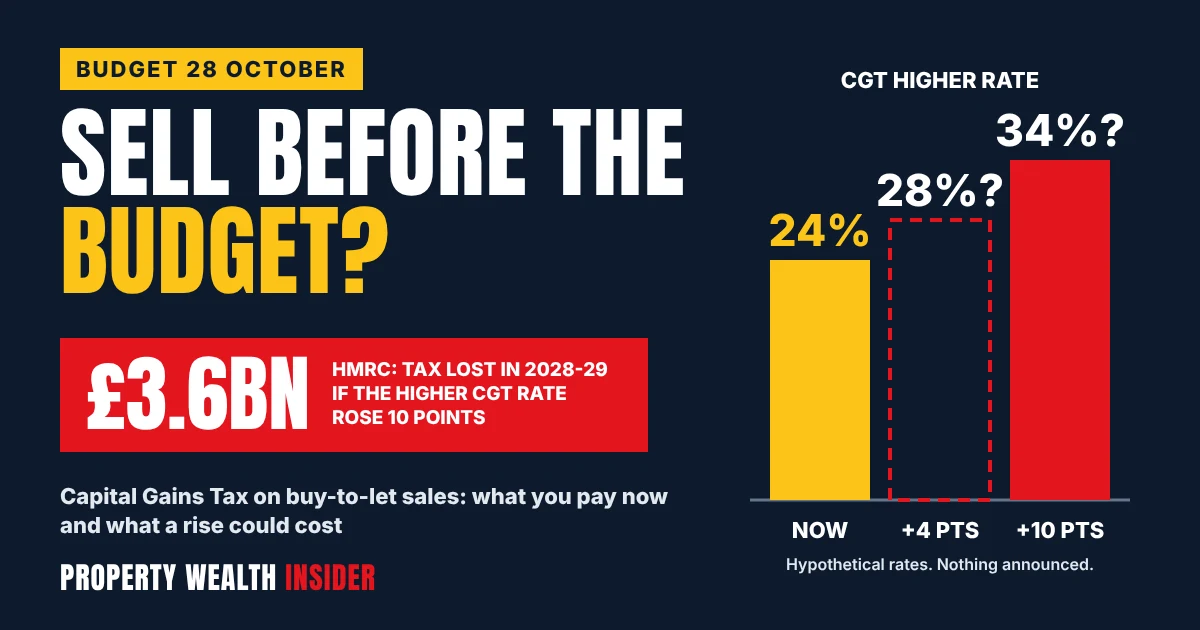
- HMRC estimates a 10-point rise in the higher CGT rate would cut receipts by about £3.6bn (£3,565m) in 2028-29.
- Any CGT on a UK residential sale must be reported and paid within 60 days of completion.
- For CGT, the disposal date is the date of exchange of an unconditional contract, not completion.
- The Budget is on 28 October 2026. Any CGT change is speculation until the Chancellor stands up.
What the think tank said, and what is really on the table
The Centre for Policy Studies, a right-leaning think tank, has urged the Chancellor not to raise CGT. Its case rests on two published sources, and we have checked both.
First, HMRC’s ready reckoner of illustrative tax changes. It estimates that raising the higher CGT rate by 10 percentage points would reduce receipts by £540m in 2026-27, £2,060m in 2027-28 and £3,565m in 2028-29. The reason is behaviour: people with big gains simply stop selling.
Second, the US-based Tax Foundation’s International Tax Competitiveness Index 2026, published on 19 October 2026. It ranks the UK 30th of 38 OECD countries overall (up from 31st) and 33rd for property taxes.
What about the Budget itself? Reports say the Chancellor has rejected calls to align CGT with income tax rates. The Treasury has not confirmed this and says tax decisions are set out at fiscal events. A smaller rate change has not been ruled out. Treat all of it as speculation.
The CGT rules in force today
CGT is a UK-wide tax. It applies the same way to landlords in England, Wales, Scotland and Northern Ireland.
One point catches Scottish landlords out: your CGT rate is worked out using the UK basic rate band, not the Scottish income tax bands. The law says to assume you are not a Scottish or Welsh taxpayer for this purpose (section 1J, Taxation of Chargeable Gains Act 1992).
| Rule (2026-27 tax year) | Figure | Status |
|---|---|---|
| CGT rate on gains within your unused basic rate band | 18% | In force |
| CGT rate on gains above the band (or if you pay higher/additional rate tax) | 24% | In force |
| Annual Exempt Amount (per individual) | £3,000 | In force |
| Personal Allowance | £12,570 (tapers above £100,000) | In force |
| Basic rate band (taxable income) | £37,700 | In force |
| Report and pay CGT on UK residential property | Within 60 days of completion | In force |
| Any change to CGT rates at the 28 October Budget | Unknown | Speculation only |
Your own home is usually exempt under Private Residence Relief. If you once lived in a property you now let, you get relief for the years you lived there plus the last 9 months of ownership. Lettings Relief now only applies if you lived in the property at the same time as your tenant, capped at £40,000.
How CGT on a rental sale is worked out
It is the gain that is taxed, not the sale price. Work through it in five steps.
- Start with the sale price, then take off the purchase price.
- Deduct allowable costs: Stamp Duty and legal fees when you bought, estate agent and solicitor fees when you sell, and capital improvements such as an extension or loft conversion. Routine maintenance and redecorating do not count, and nor does mortgage interest.
- Take off the £3,000 allowance (each owner uses their own on their share).
- Find your unused basic rate band: £37,700 minus your taxable income (income after the Personal Allowance). Rental profit counts as income.
- Apply the rates: 18% on the part of the gain that fits in the unused band, 24% on the rest.
Worked example 1: higher-rate landlord, sole owner
Sarah bought a flat for £180,000, paying £4,500 in Stamp Duty and legal fees. She later spent £20,000 on a loft conversion. She sells for £320,000, with £5,500 of agent and legal costs. Her other income is £60,000.
Gain: £320,000 − £180,000 − £4,500 − £5,500 − £20,000 = £110,000. After the £3,000 allowance, £107,000 is taxable. Her taxable income (£47,430) already fills the basic rate band, so it is all at 24%: £25,680.
Worked example 2: basic-rate landlord
Dev earns £30,000 in total, so his taxable income is £17,430 and he has £20,270 of basic rate band left. He makes a £60,000 gain, leaving £57,000 taxable.
£20,270 at 18% = £3,648.60. The remaining £36,730 at 24% = £8,815.20. Total: £12,464. A large gain pushes even a basic-rate taxpayer mostly into the 24% rate.
Worked example 3: the same flat, owned jointly
If Sarah owned the flat 50/50 with a partner earning £25,000, each would have a £55,000 gain and their own £3,000 allowance. Sarah pays £12,480. Her partner has £25,270 of basic rate band left and pays £10,963.80. Together: £23,444, which is about £2,236 less than as a sole owner.
Calculator: your CGT now and under a Budget scenario
Enter your figures. Set a hypothetical higher rate (for example 28%, or 34% for HMRC’s 10-point illustration) to see the effect of a rise. These are illustrations, not predictions.
Landlord CGT calculator with Budget scenarios
Guide only, not tax advice. Uses 2026-27 figures (Personal Allowance £12,570 tapering above £100,000, basic rate band £37,700, £3,000 allowance) and assumes no other gains, losses or reliefs. Pension contributions and Gift Aid can extend your basic rate band. Scenario rates are hypothetical; no change has been announced.
What a rate rise would mean: three landlords
Here are our three worked examples at today’s rates, at a hypothetical 28% higher rate, and at 34% (HMRC’s 10-point illustration). The 18% lower rate is held unchanged in every column.
| Landlord | Taxable gain | Now (24%) | If 28% | If 34% |
|---|---|---|---|---|
| Sarah, sole owner, £60,000 income | £107,000 | £25,680 | £29,960 | £36,380 |
| Sarah and partner, 50/50 (£60,000 and £25,000 incomes) | £104,000 | £23,444 | £26,593 | £31,317 |
| Dev, £30,000 income, £60,000 gain | £57,000 | £12,464 | £13,933 | £16,137 |
For Sarah, a 10-point rise would add £10,700 to the bill. That is the scale of the decision landlords are weighing up. But it only matters if a rise happens, and only if it applies to your sale date.
HMRC’s own CGT statistics show why. In 2024-25, 45% of all CGT came from people with gains of £5 million or more, who make up less than 1% of CGT taxpayers. Landlords are a smaller slice. In 2025-26, 156,000 taxpayers filed a CGT on UK property return, reporting £8.9bn of residential gains and £1.9bn of tax.
Should you sell before 28 October? The timing traps
Exchange, not completion, sets the date. Under section 28 of the Taxation of Chargeable Gains Act 1992, the disposal happens when an unconditional contract is made. Exchanging before a change usually fixes the tax year and the rules for your sale. Getting from offer to exchange in eight days is unrealistic for most sales.
Changes can start on Budget day. In 2024, the main CGT rates rose to 18% and 24% for disposals made on or after Budget day, 30 October 2024. A change can also be set for a later date, such as 6 April. We will not know until the speech.
Watch for anti-forestalling rules. In 2024, HMRC brought in a rule so that, for contracts exchanged before Budget day but completed afterwards, the new rate could apply. It targeted contrived deals, such as contracts with family trusts. Genuine arm’s-length sales could be excluded, with a claim needed for gains over £100,000 (HMRC manual CG10250). There is no guarantee any new rule would work the same way.
Rushing has costs too. HMRC’s figures show residential property sales and gains rose in the months before both the October 2024 and November 2025 Budgets, as sellers moved early. But a quick sale at a discount can cost more than the tax you save. Every £1,000 off the price costs a higher-rate seller £760 after tax, so a £14,000 discount would cost Sarah about as much as the £10,700 extra she would pay if the rate jumped to 34%.
The 60-day clock runs from completion. You must report and pay through a CGT on UK property account within 60 days of completing. Complete on 30 November 2026 and the deadline is 29 January 2027. Miss it and you may face interest and penalties.
What to do now: step by step
- Get your real numbers. Dig out the completion statement from when you bought, your Stamp Duty receipt, and invoices for every improvement.
- Run the calculator at 24% and at a couple of hypothetical rates to see how much is genuinely at stake.
- Check your ownership. Joint owners each get a £3,000 allowance and their own basic rate band. Gifts between spouses and civil partners are usually free of CGT, but take advice before moving shares.
- Do not make a panic sale. Compare the possible tax saving with any discount you would accept for speed.
- Watch the Budget on 28 October. Check the effective date of any change and whether anti-forestalling rules apply to contracts already exchanged.
- Set aside the tax and diary your 60-day deadline the moment completion is booked.
- Purchase completion statement and price paid
- Stamp Duty and legal fees on purchase
- Invoices for capital improvements (extensions, conversions), not repairs
- Estate agent and solicitor fees on sale
- Exchange date and completion date
- Your total income for 2026-27, including rental profit
- Any periods you lived in the property (Private Residence Relief)
- Government Gateway login for a CGT on UK property account
- 60-day payment deadline in your diary
FAQ
Will capital gains tax go up in the October 2026 Budget?
Nobody outside the Treasury knows. Reports say aligning CGT with income tax has been ruled out, but a smaller rate change has not. The current rates are 18% and 24% until the Chancellor announces otherwise.
What is the CGT rate on a buy-to-let sale?
18% on the part of your taxable gain that fits within your unused basic rate band, and 24% on the rest. Higher and additional rate taxpayers pay 24% on the whole taxable gain.
Is the CGT date the exchange or completion date?
For working out the tax year and rules, it is the date you exchange an unconditional contract. The 60-day reporting and payment deadline runs from completion.
Can I deduct Stamp Duty and improvement costs from my gain?
Yes. Stamp Duty, legal and agent fees on buying and selling, and capital improvements can all be deducted. Repairs, redecorating and mortgage interest cannot.
Do Scottish landlords pay a different CGT rate?
No. CGT rates are the same across the UK, and the 18% band is worked out using the UK basic rate band, even if you pay Scottish income tax.
What happens if I miss the 60-day CGT deadline?
HMRC can charge interest and penalties. Do not wait for your Self Assessment return; if you are registered for Self Assessment you must also include the sale there.
Sources
- GOV.UK: Capital Gains Tax rates and allowances
- GOV.UK: Tax when you sell property
- GOV.UK: Private Residence Relief and Letting Relief
- GOV.UK: Report and pay your Capital Gains Tax (60-day rule)
- GOV.UK: Income Tax rates and Personal Allowances
- HMRC: Direct effects of illustrative tax changes (June 2025)
- HMRC: Capital Gains Tax statistics (August 2026)
- HMRC Capital Gains Manual CG10250: anti-forestalling rules
- Taxation of Chargeable Gains Act 1992, section 28
- Taxation of Chargeable Gains Act 1992, section 1J
- HM Treasury: Budget 2026 date
- GOV.UK: Chancellor of the Exchequer
- Tax Foundation: International Tax Competitiveness Index 2026
This article is news and general guidance only. It is not financial, legal or tax advice.