Scottish landlords: will Holyrood copy the UK’s 24% tax raid?
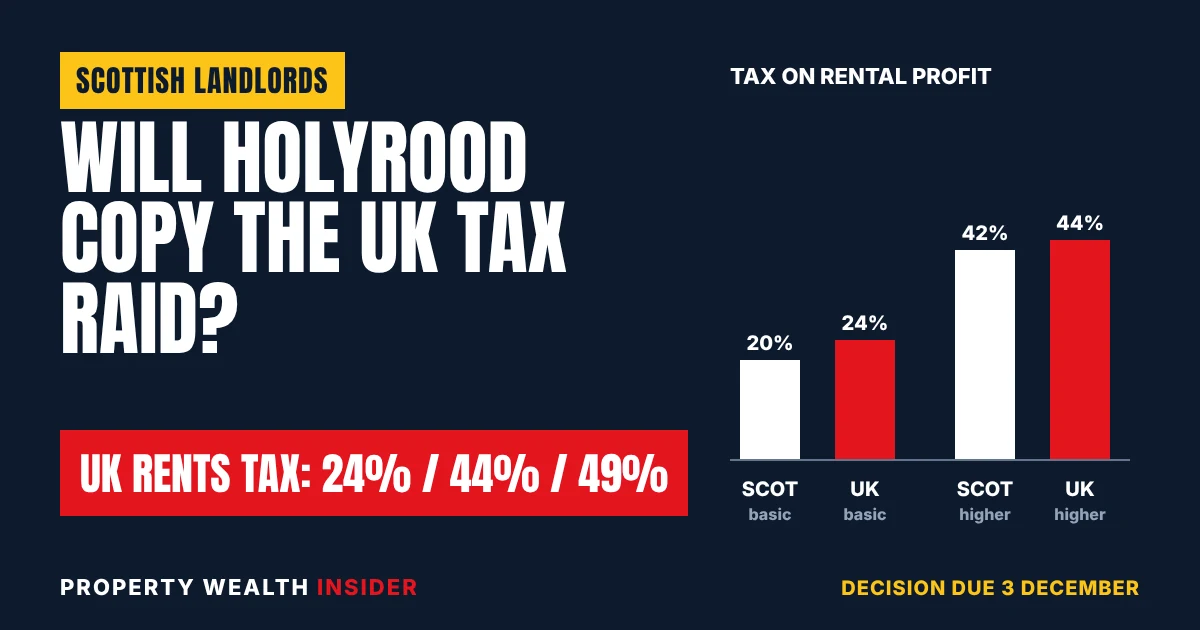
Scottish landlords have four weeks to find out whether Holyrood will copy the UK Government’s latest raid on rental income. The UK Budget on 28 October 2026 pushed property income tax in England, Wales and Northern Ireland up to 24%, 44% and 49% from April 2027. For the first time, the Scottish Parliament has the legal power to do something similar, or to do nothing at all.
Landlord groups are lobbying hard for the second option. The Scottish Association of Landlords (SAL) has warned ministers off “punitive tax hikes”. Propertymark has spent years calling for the 8% Additional Dwelling Supplement (ADS) on buy-to-let purchases to be cut.
Finance Secretary Jenny Gilruth will present the draft Scottish Budget on Thursday 3 December 2026. This guide covers what is already decided, what Holyrood still has to choose, and what each choice would cost you in pounds.
Key facts
- From 6 April 2027, property income in England, Wales and Northern Ireland will be taxed at 24% / 44% / 49%. That is 2 points on top of the 22/42/47 rise announced in Budget 2025.
- Scottish taxpayers are not covered by those UK rates. Their rental profits are still taxed at Scottish rates, currently 19% to 48%.
- Finance Act 2026 lets Holyrood set separate Scottish property income rates. That power came into force on 16 September 2026 and applies from the 2027-28 tax year.
- The draft Scottish Budget is due on 3 December 2026. That is when ministers will say whether, and by how much, Scottish property rates go up.
- ADS on additional homes in Scotland is 8% of the price, on purchases of £40,000 or more. It has been 8% since 5 December 2024.
What the UK Budget decided
Budget 2025 created separate income tax rates for property income: 22% basic, 42% higher and 47% additional, starting from the 2027-28 tax year. That made rental profit 2 points dearer than salary at every band. HMRC’s policy paper says these rates apply to England, Wales and Northern Ireland.
Chancellor John Healey’s Budget 2026 then said the government “will increase these rates by a further two percentage points” from the same date. From April 2027, landlords outside Scotland therefore face 24%, 44% and 49% on rental profits, against 20%, 40% and 45% on earnings.
Property income will also be taxed after earnings and before savings and dividends. Mortgage interest relief, the Section 24 tax credit, moves to the property basic rate (22% under the Budget 2025 plans). Both points are set out in HMRC’s technical note.
Scotland: what is decided and what is up to Holyrood
Scottish income tax depends on where you live, not where your rental property is. A landlord whose main home is in Scotland pays Scottish rates, even on a flat in Manchester. A landlord living in England pays the new UK property rates, even on a flat in Glasgow.
Until now, Holyrood could not tax rental profit differently from wages. Schedule 2 of the Finance Act 2026 changes the Scotland Act 1998 so that a Scottish rate resolution “may provide for the rates applicable in relation to property income to be different”. There is a catch: Scottish property rates must use the same bands as other income. Ministers can change the percentages, but not the thresholds where each band starts and ends.
| Issue | Status |
|---|---|
| UK property rates of 24% / 44% / 49% from 6 April 2027 | Decided for England, Wales and NI (announced; to be legislated) |
| Holyrood’s power to set separate property rates | Decided. In force since 16 September 2026, for 2027-28 onwards |
| Property rates must share the bands used for other income | Decided (Finance Act 2026) |
| Whether Scottish property rates rise, and by how much | Up to Holyrood. Due in the draft Budget on 3 December 2026, then a Scottish rate resolution |
| Scottish band thresholds for 2027-28 | Up to Holyrood. Higher, advanced and top thresholds are frozen until 2028-29 |
| Any change to ADS or LBTT rates | Up to Holyrood. ADS is 8% today |
If Holyrood does nothing: Scottish landlords keep paying the same six rates on rents as on wages. The UK rise still cuts Scotland’s block grant, though. ICAS warns that Scotland “will see a negative impact to its funding” if it does not raise its own rates. That is why landlords cannot assume the answer will be no.
SAL is pushing for no change. “Introducing a property income tax in Scotland could be the final straw for many private landlords,” said chief executive John Blackwood in the association’s Budget response. He added that around 90% of Scottish landlords own just one or two properties. SAL says the government should work with landlords “rather than frightening them off with punitive tax hikes.”
The rates side by side
Scotland has six bands, and the UK has three. The table shows today’s Scottish rates (from the Scottish Budget 2026-27) and what they would become with a uniform 2-point or 4-point rise. A 2-point rise matches the extra gap the UK opened up in each of its two Budgets. A 4-point rise matches the UK’s total move from 20% to 24%. Neither has been proposed. They are illustrations.
| Scottish band (2026-27) | Rate now | +2 points | +4 points |
|---|---|---|---|
| Starter: £12,571 to £16,537 | 19% | 21% | 23% |
| Basic: £16,538 to £29,526 | 20% | 22% | 24% |
| Intermediate: £29,527 to £43,662 | 21% | 23% | 25% |
| Higher: £43,663 to £75,000 | 42% | 44% | 46% |
| Advanced: £75,001 to £125,140 | 45% | 47% | 49% |
| Top: over £125,140 | 48% | 50% | 52% |
Worked examples: what each choice costs
Here is the quick rule. Every 1 point added to Scottish property rates costs you 1% of your taxable rental profit. If your profit is £10,000, a 2-point rise costs £200 a year and a 4-point rise costs £400. Mortgage interest relief cushions the bill, but it does not change that rule.
Example 1: intermediate-rate landlord. Morag earns a £35,000 salary and rents out one flat for £1,000 a month. She pays £2,400 a year in letting costs and £5,000 in mortgage interest. Her taxable profit is £9,600, and most of it falls in the 21% intermediate band, with the rest at 42%. Her tax on the flat is about £1,213 after the 20% mortgage interest credit of £1,000. A 2-point rise takes it to £1,405 (+£192). A 4-point rise takes it to £1,597 (+£384), or £32 a month.
Example 2: higher-rate landlord. Callum earns £55,000 and gets £18,000 a year from two flats. His costs are £3,500 and his mortgage interest is £9,000. All £14,500 of profit is taxed at 42%, less an £1,800 interest credit, which leaves about £4,290. With a 2-point rise he pays £4,580 (+£290). With a 4-point rise he pays £4,870 (+£580).
These figures use 2026-27 Scottish bands and assume mortgage interest relief stays at 20%. That is the rate HMRC uses today. Nobody has yet said how relief would work for Scottish taxpayers if Holyrood sets separate property rates.
Calculator: your bill under each Holyrood choice
Scottish landlord tax: what each Holyrood choice costs you
Guide only, not tax advice. It assumes you are a Scottish taxpayer and uses the 2026-27 Scottish bands and rates as a stand-in for 2027-28, with the same rise applied to every band. Rental profit is taxed on top of other income, and the personal allowance tapers above £100,000. Mortgage interest gets a 20% credit, capped at your rental profit. It ignores savings, dividends, losses brought forward and the Scottish Budget itself, which is not yet published.
ADS and LBTT: the other landlord battleground
Income tax is not the only lever Holyrood controls. Land and Buildings Transaction Tax (LBTT) replaces stamp duty in Scotland. Buy-to-let and second-home buyers also pay the Additional Dwelling Supplement. Revenue Scotland confirms ADS rose from 6% to 8% for contracts entered into on or after 5 December 2024. The 2026-27 Budget kept it at 8%.
Propertymark has long said ADS should be reduced to encourage investment in Scottish rented homes. It called the rise to 8% “out of touch with the housing needs of Scotland”. On a typical £185,000 flat, ADS adds £14,800 on top of £800 of LBTT, so the total tax is £15,600.
| LBTT residential band (2026-27) | Rate |
|---|---|
| Up to £145,000 | 0% |
| £145,001 to £250,000 | 2% |
| £250,001 to £325,000 | 5% |
| £325,001 to £750,000 | 10% |
| Over £750,000 | 12% |
| ADS on additional dwellings (£40,000+) | 8% of the price |
ADS + LBTT on a Scottish buy-to-let
Guide only, not tax advice. It assumes a single residential dwelling bought by an individual who already owns a home, and uses 2026-27 LBTT bands. It ignores first-time buyer relief, multiple-dwellings purchases, company buyers and ADS repayment claims. Any rate other than 8% is hypothetical.
What Scottish landlords should do now
- Check which regime you are in. Your main home decides it. If you have moved recently, or split time between homes, confirm your Scottish taxpayer status before April 2027.
- Run the calculator for each property. Use your 2025-26 return figures. A 2-point and a 4-point rise give you a best and worst case to budget for.
- Watch 3 December. The draft Budget will set out the proposed rates. They only take effect once the Scottish Parliament passes a rate resolution.
- Time your purchases. ADS is fixed by the date you enter the contract. If you are weighing a purchase, know that the rate could move either way in the Budget. The last rise applied to contracts entered into from the day after the Budget.
- Talk to an accountant about structure. Company-owned property pays corporation tax, not these rates. Incorporating has its own LBTT, ADS and capital gains costs, so get the numbers modelled first.
- Have your say. Write to your MSP before the Budget. MSPs’ votes decide whether any rise passes.
- Scottish taxpayer status confirmed for 2027-28
- Rental profit and mortgage interest figures for each property to hand
- Calculator run for a 2-point and a 4-point rise
- Extra tax set aside in your 2027-28 cash-flow plan
- Any planned purchase checked for ADS timing and rate risk
- Diary note for the draft Scottish Budget, 3 December 2026
- Accountant appointment booked if your profit tips you into a higher band
FAQ
Does the 24% property income tax apply in Scotland?
No. The 24%, 44% and 49% rates apply to taxpayers in England, Wales and Northern Ireland. Scottish taxpayers’ rental profits are taxed at Scottish rates, which are currently 19% to 48%, unless Holyrood votes for separate property rates.
When will Scotland decide on property income tax rates?
The draft Scottish Budget for 2027-28 is due on Thursday 3 December 2026. Any rates it proposes then need a Scottish rate resolution passed by the Parliament. They would apply from 6 April 2027 at the earliest.
I live in England but my rental flat is in Edinburgh. Which rates do I pay?
You pay the UK property rates, so 24%, 44% or 49% from April 2027. Scottish income tax follows where your main home is, not where the property is.
Can Scotland set different bands for property income?
No. The Finance Act 2026 says Scottish property rates must use the same limits as the rates on other income. Holyrood can only change the percentage charged in each band.
How much is ADS on a buy-to-let in Scotland?
ADS is 8% of the price on additional dwellings costing £40,000 or more, on top of standard LBTT. A £200,000 buy-to-let costs £16,000 in ADS plus £1,100 in LBTT, so £17,100 in total.
- HM Treasury: Budget 2026 document
- HMRC: Income Tax changes to tax rates for property, savings and dividend income
- HMRC: technical note on property, savings and dividend rates
- Finance Act 2026, Schedule 2, paragraph 1
- Scottish Government: draft Budget 2027-28 timetable letter
- Scottish Government: Scottish Budget 2026-27, Chapter 2 Tax Policy
- GOV.UK: Scottish Income Tax
- GOV.UK: tax relief for residential landlords
- Revenue Scotland: ADS change to 8%
- Scottish Association of Landlords: UK Autumn Budget 2026
- Propertymark: response to the ADS rise
- ICAS: What does the Autumn Budget 2026 mean for Scotland?
This article is news and general guidance, not financial, legal or tax advice.