NRLA Budget plea: stop taxing landlords on inflation gains
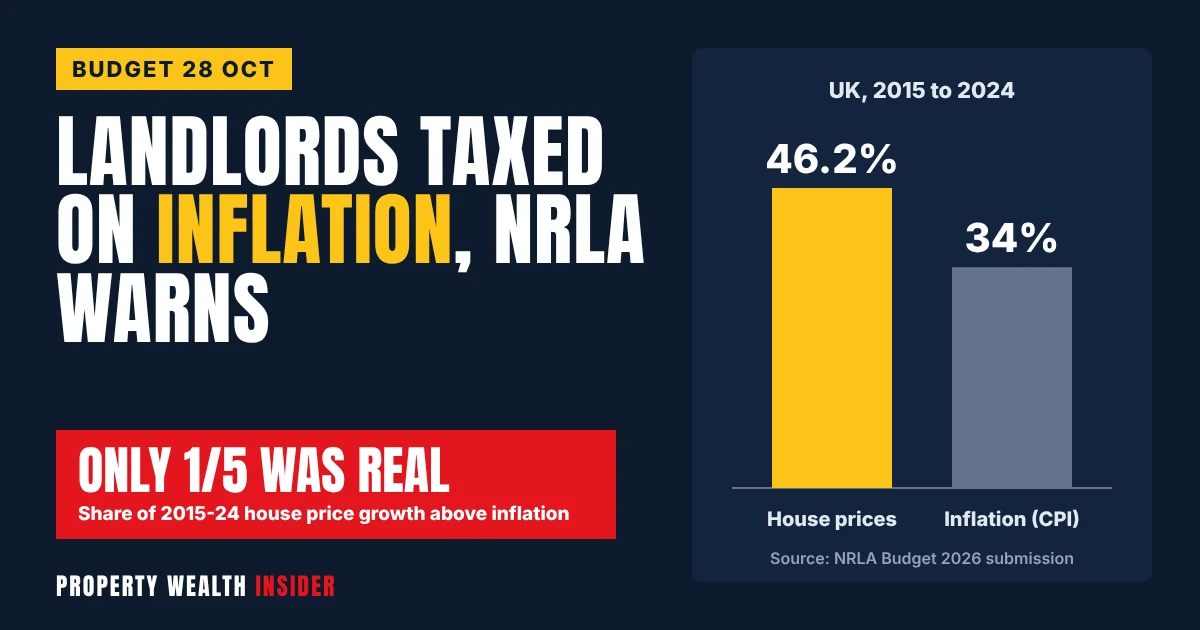
With two days to go until the Budget, the UK’s biggest landlord body is pressing the Chancellor on its wishlist, and its headline demand is simple: stop charging Capital Gains Tax on inflation. The National Residential Landlords Association (NRLA) says that between 2015 and 2024 only around one-fifth of the rise in house prices was a real gain. The rest was general inflation, yet landlords who sell are taxed on all of it.
John Healey delivers his first Budget as Chancellor on Wednesday 28 October 2026. The NRLA’s Budget submission also asks for Local Housing Allowance to be unfrozen and for energy-efficiency upgrades to become tax-deductible in the year you pay for them.
What the submission does not ask for is the return of full mortgage interest relief. Section 24 stays in place, and from April 2027 landlords also face new, higher property income tax rates. Below we set out what is law now and what is only proposed, then work out what each change would mean for you in pounds.
Key facts
- The Budget is on Wednesday 28 October 2026. Nothing the NRLA has asked for is law yet.
- The NRLA’s main ask is to index the CGT base cost for inflation (CPI), with relief graded by how long you have owned the property and no relief for sales within three years.
- NRLA analysis: UK house prices rose 46.2% between 2015 and 2024 while consumer prices rose 34%, leaving real growth of just 9.1%.
- CGT on residential property is 18% / 24% today, with a £3,000 annual exempt amount for 2026-27.
- Section 24 still limits mortgage interest relief to a 20% tax credit. From 6 April 2027 that credit rises to 22%, but property income will be taxed at 22% / 42% / 47%.
What the NRLA has asked the Chancellor for
The NRLA’s submission to the Treasury sets out three main policy asks. It says it represents more than 114,000 landlords in England and Wales.
- Change how CGT works on rental property. The base cost would be indexed for inflation using CPI. That base cost includes the purchase price, Stamp Duty, other buying costs and qualifying improvements, each indexed from the date it was paid. The maximum relief would rise with how long you have owned the property, and a sale within three years would get none.
- Unfreeze Local Housing Allowance and link it again to the cheapest 30% of local rents, with that level kept for the rest of this Parliament.
- Make energy-efficiency upgrades deductible against rental profits in the year you pay for them. The NRLA also floats a modernised Landlord Energy Saving Allowance (“LESA 2.0”) covering a set list of upgrades.
The NRLA says it opposes aligning CGT rates with income tax rates. It would accept higher rates only as part of a package that also stops inflation being taxed. It puts the static cost of its CGT reform at around £1.21bn a year in current conditions, and argues that more sales and more Stamp Duty would win back part of that.
On demand, the submission quotes Rightmove: the average rental home gets 10 enquiries. That is down from a peak of 22 in 2022 but still double the pre-pandemic average of 5.
Proposed vs in force: where the rules stand
| Area | In force now (2026-27) | What changes or is proposed | Where |
|---|---|---|---|
| Mortgage interest (Section 24) | No deduction from rental profit. Instead you get a tax credit of 20% of the interest. | Legislated: the credit rises to 22% from 6 April 2027. Full relief restored: not proposed by the NRLA | UK-wide (individual landlords) |
| Tax on rental profit | Normal income tax rates: 20% / 40% / 45% | Legislated: 22% / 42% / 47% from 6 April 2027 | England, Wales, NI (Scotland sets its own) |
| CGT on residential property | 18% / 24%, with a £3,000 annual exempt amount | NRLA proposal: CPI-indexed base cost, with relief graded by how long you have owned the property | UK-wide |
| Stamp Duty surcharge on additional homes | 5% on top of standard rates (since 31 October 2024) | No change requested in the submission | England and NI (SDLT) |
| Energy-efficiency upgrades | Upgrades and new insulation are usually capital costs, so you cannot deduct them from rental profit | NRLA proposal: treat them as revenue costs you can deduct in the year you pay | UK-wide (income tax) |
| Local Housing Allowance | Frozen | NRLA proposal: unfreeze it and link it to the 30th percentile of local rents | GB (Housing Benefit and UC) |
CGT on inflation: what indexation could be worth
Today CGT is charged on the gain in pounds, with no allowance for inflation. If your property has only kept pace with prices in general, you can still owe a five-figure tax bill on a gain that has bought you nothing extra.
Worked example. A higher-rate landlord bought a buy-to-let in 2015 for £200,000 and paid £5,000 in buying costs. The property has grown in line with the NRLA’s 46.2% average, so it is now worth £292,400.
- Today: the gain is £292,400 − £205,000 = £87,400. Take off the £3,000 exempt amount and £84,400 is taxed at 24%, giving a £20,256 CGT bill.
- With full CPI indexation (34%): the base cost becomes £274,700. That leaves a gain of £17,700, or £14,700 after the exempt amount. At 24% the bill is £3,528.
That is a difference of £16,728, and it is the most you could save. The NRLA would grade relief by how long you have owned the property, and it has not published the exact scale. A nine-year owner might therefore get less than full indexation. Our illustration also leaves out selling costs and improvements, which would reduce the gain further.
CGT today vs CGT with inflation indexation
Guide only, not tax advice. The calculator applies a single CPI percentage to your whole base cost and uses the 2026-27 £3,000 exempt amount at one flat CGT rate. Indexation is an NRLA proposal, not law. Any real scheme could index each cost from the date you paid it and cap relief by how long you have owned the property.
Section 24: the cost that is not on the list
Section 24 is the rule in section 272A of the Income Tax (Trading and Other Income) Act 2005. Since 2020-21, individual landlords cannot deduct any mortgage interest on residential lets from their rental profit. Instead they get a tax credit worth 20% of the lowest of three figures, HMRC says: the finance costs, the property profits, and adjusted total income above the personal allowance. Any interest the credit does not use is carried forward.
Basic-rate landlords who stay within the basic-rate band end up roughly where they would have been anyway. Higher and additional-rate landlords lose half or more of their relief. Section 24 can also push a landlord into a higher band, because the interest stays inside taxable profit. Limited companies are not affected.
Worked example (2026-27, England). A landlord earns a £45,000 salary. Rent is £18,000, other allowable costs are £3,000 and mortgage interest is £7,000, which leaves £8,000 of real profit. Under Section 24 the taxable rental profit is £15,000. About £5,270 of it falls in the basic-rate band and £9,730 in the higher-rate band, giving £4,946 of tax. The £1,400 credit (20% of £7,000) cuts this to £3,546. If the interest were fully deductible, the tax would be £2,146. Section 24 therefore costs this landlord £1,400 a year, and takes 44% of their real £8,000 profit in tax.
Section 24 cost calculator
Guide only, not tax advice. For individual landlords outside Scotland with only salary or pension as their other income. It uses 2026-27 allowances and bands for both years, so 2027-28 shows the effect of the new rates alone. The personal allowance tapers above £100,000. It ignores credits carried forward from earlier years, losses, savings and dividends, student loans and the High Income Child Benefit Charge. Full mortgage interest relief is shown only for comparison and is not on the table.
The chart shows what Section 24 does. With full relief, every extra £2,000 of interest cuts this higher-rate landlord’s tax by £800. Under Section 24 it cuts the tax by only £400. Lenders’ rates feed straight into that gap.
The April 2027 property tax rates already coming
Whatever happens on Wednesday, one rise is already law. Finance Act 2026 creates separate property income rates for 2027-28: 22% basic, 42% higher and 47% additional, from 6 April 2027. HMRC’s technical note says the finance cost credit will rise to the property basic rate of 22%.
Two details matter. First, the personal allowance must be set against employment income before property income. Second, property income is taxed after other earned income and before savings and dividends. HMRC says the rates apply to England, Wales and Northern Ireland, and that it will work with the Scottish and Welsh governments on setting their own property rates.
In our example the bill rises from £3,546 to £3,706, which is £160 more a year. The higher credit claws back £140 of the extra £300 of tax. The NRLA notes that if the Government aligns CGT with these new property rates, it would accept that only as part of its indexation package.
Energy upgrades and LHA: the other two asks
Energy efficiency. Under current rules, replacing a broken boiler with a similar one is a deductible repair. Upgrading to a more efficient system, or adding insulation where there was none, usually counts as capital spending. The NRLA wants specific upgrades treated as revenue costs you can deduct in the year you pay. The Government’s consultation on a new minimum energy standard for private rentals was published in January 2026.
Take our £45,000-salary landlord and £5,000 spent on insulation. If that were deductible, taxable rental profit would fall from £15,000 to £10,000 and the tax from £3,546 to £1,546, a £2,000 saving at the 40% rate. Today the same spend gives no income tax relief. It can only be added to the base cost when you sell, if it qualifies as an improvement. You can try your own figures in the calculator above.
Local Housing Allowance. The NRLA cites Joseph Rowntree Foundation research: for 54% of private renters on Universal Credit in England, LHA did not cover the rent in November 2025. If you let to tenants on benefits, unfreezing LHA would narrow the shortfall your tenants have to make up, which lowers your arrears risk.
What to do before and after the Budget
- Do not rush to sell on rumour. The NRLA quotes HMRC data showing disposals jumped in September and October 2024 on CGT speculation. Selling early to beat a change that may never come can cost more than it saves.
- Gather your base cost evidence now. That means completion statements, Stamp Duty returns, legal fees and invoices for capital works, with dates. Any indexation scheme would need those dates.
- Run the Section 24 calculator for both tax years. Then budget for the April 2027 rise, which is already law.
- Hold off on non-urgent energy upgrades until you have read the Budget documents. If deductibility arrives, the date it starts may decide which tax year your spending falls in. Do not delay safety work or anything you legally have to do.
- On Budget day, read the HMRC tax information notes rather than headlines. Check the start dates and which nations each measure covers.
- Talk to a property tax adviser before acting on any announcement, especially about incorporation or a sale.
- Purchase completion statement and SDLT return for each property
- Invoices for capital improvements, with dates
- Last two years’ mortgage interest statements
- Any finance costs carried forward from your last tax return
- Your 2026-27 Section 24 bill, and the same figure at 2027-28 rates
- A list of planned energy upgrades and their costs
- Budget documents saved on 28 October 2026
FAQ
Is the NRLA asking for Section 24 to be scrapped?
Not in its 2026 Budget submission. Its asks are CGT indexation graded by how long you have owned the property, unfreezing LHA, and tax relief for energy-efficiency upgrades. Section 24 stays in force.
When is the Autumn Budget 2026?
Wednesday 28 October 2026. The Chancellor confirmed the date in a letter to the Treasury Select Committee published on 31 July 2026.
What will landlords pay on rental income from April 2027?
In England, Wales and Northern Ireland, rental profit will be taxed at 22%, 42% or 47% from 6 April 2027. The mortgage interest credit rises from 20% to 22%.
What is the CGT rate on selling a buy-to-let now?
18% on any part of the gain that falls within your unused basic-rate band and 24% above it, after a £3,000 annual exempt amount for 2026-27. There is currently no inflation relief.
Does Section 24 apply to limited companies?
No. Section 272A does not apply to companies, which can still deduct finance costs. They pay corporation tax instead, and taking money out as dividends is taxed again.
How much Stamp Duty does a landlord pay on another property?
In England and Northern Ireland, buying an additional home usually means 5% on top of standard SDLT rates. HMRC’s example of a £300,000 purchase comes to £20,000.
Sources
- NRLA: Capital Gains Tax calls at core of Budget proposal
- NRLA: Budget 2026 submission (PDF)
- NRLA: CGT system restricts investment in homes (16 October 2026)
- HM Treasury: Budget 2026 date letter
- ITTOIA 2005 s272A
- HMRC: Tax relief for residential landlords, how it’s worked out
- HMRC: Property, savings and dividend rates technical note
- Finance Act 2026
- GOV.UK: Income Tax rates 2026-27
- GOV.UK: Capital Gains Tax rates
- HMRC: SDLT higher rates for additional properties
This article is news and general guidance, not financial, legal or tax advice.