Section 8 Notice: Copy the Exact Wording or Lose 4 Months
Landlords in England are getting stuck on one box of the new section 8 notice. Since the Renters’ Rights Act possession rules started on 1 May 2026, Form 3A asks you to write out the full legal wording of every possession ground you rely on, not just its name. Plenty of landlords don’t know where that wording lives.
It matters because section 21 is gone for private tenancies in England, so a section 8 notice on Form 3A is now the only way to start ending an assured tenancy. The government’s own landlord guidance warns that partial or inaccurate wording may make the notice invalid and your claim could be dismissed. Get it wrong and you are back to square one, with the notice period still to run again.
Here is where the official wording is, how to fill in the grounds section properly, the verified notice period for each main ground, and a free checker that works out the earliest date you can go to court.
Key facts
- Section 21 can no longer be used in England: the new possession system started on 1 May 2026.
- Question 4.2 of Form 3A needs the full legal wording of each ground. The note on the form says: “Do not rely on the name of the ground only.”
- The official wording is in a 29-page GOV.UK PDF, “Form 3A: Legal wording for possession grounds”, which also gives a plain-English explanation of each ground.
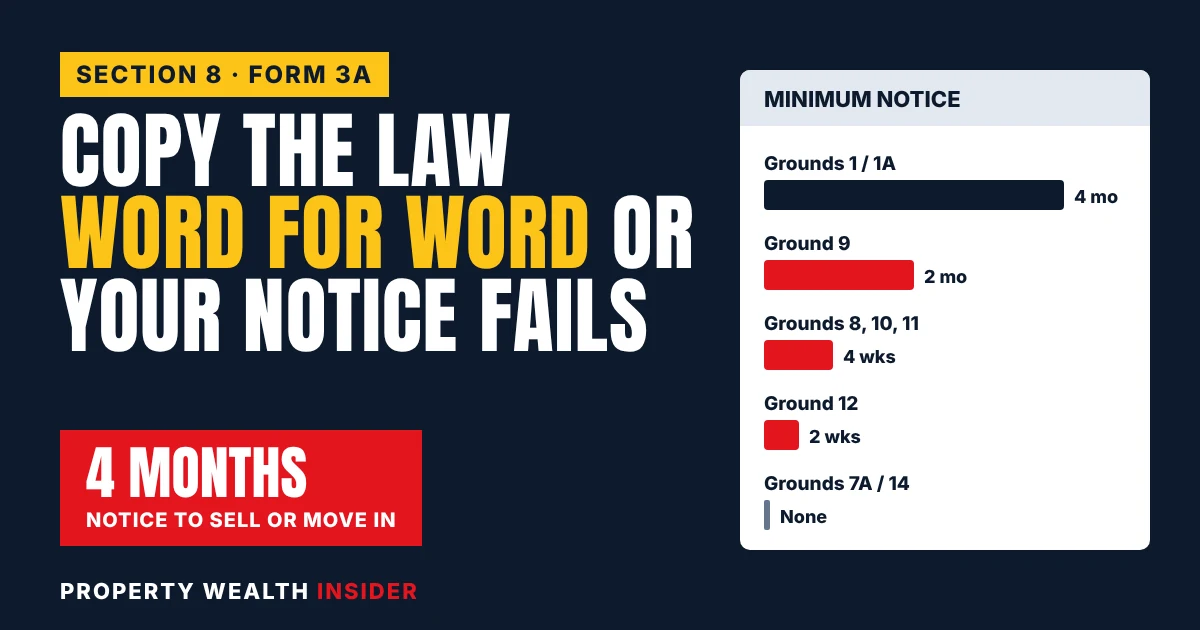
- Selling (ground 1A) or moving in (ground 1) needs 4 months’ notice, and the notice cannot expire in the first 12 months of the tenancy.
- Mandatory rent arrears (ground 8) needs 3 months’ rent owed (or 13 weeks’ for weekly or fortnightly rent), both when you serve notice and at the hearing, plus 4 weeks’ notice.
- A notice is normally valid for 12 months from the date you serve it. Court proceedings must start within that time.
Where to find the exact legal wording
The wording comes from Schedule 2 of the Housing Act 1988, as amended by the Renters’ Rights Act 2025. You don’t need to dig through the legislation yourself. The government has put it all in one document.
Go to the GOV.UK page Assured tenancy forms for privately rented properties from 1 May 2026. In the Form 3A section you will find four files:
- Form 3A itself, the notice seeking possession (10 pages).
- Form 3A: Legal wording for possession grounds (29 pages). This is the one you copy from for question 4.2.
- Completing the notice seeking possession: guidance for private landlords (7 pages).
- The matching guidance for tenants.
The legal wording document gives each ground’s statutory text plus a short plain-English explanation. If you want to check a ground against the law itself, the current text of Schedule 2 on legislation.gov.uk shows the amended version.
England only. Form 3A and these rules are for private assured tenancies in England. Social landlords use Form 3. Wales and Scotland have their own separate systems and notices, so none of this guide applies there.
How to fill in the grounds section (4.2 and 4.3)
Section 4 of Form 3A has three parts, and landlords mix them up.
- 4.1 Common reasons is an optional tick-box list (for example “Your landlord wants to use or sell the property”). The form says it is only an aid. Ticking a box here does not count as stating the ground.
- 4.2 Possession ground(s) as set out in Schedule 2 is where you copy the full legal wording of every ground you rely on, word for word. The form’s note also asks you to include the official explanation of each ground alongside it. Use a continuation sheet if it is long.
- 4.3 Landlord’s explanation is where you write, under a heading for each ground, why that ground applies, in your own words, with as much evidence as possible.
This mirrors the law. Section 8(2) of the Housing Act 1988 says the court cannot order possession on a ground unless “that ground and particulars of it” are in the notice. Question 4.2 covers the ground; question 4.3 covers the particulars.
Good particulars are specific: dates, amounts and facts. For rent arrears, list the rent due, what was paid and the running balance, and attach a rent statement. For a sale, say you intend to sell and give the estate agent details. For a tenancy breach, name the clause broken and what happened, with dates.
Any continuation sheet must say which section and question it continues, and be signed and dated.
Main grounds and notice periods
The minimum notice periods are set by section 8(4AA) of the Housing Act 1988. Each runs from the date of service. If you use more than one ground, you must wait for the longest notice period to end before going to court. The exceptions are the antisocial behaviour grounds 7A and 14, where you can apply straight away.
| Ground | What it covers | Type | Minimum notice | Key restrictions |
|---|---|---|---|---|
| 1 | Landlord or close family moving in | Mandatory | 4 months | Notice cannot expire in the first 12 months of the tenancy. Re-letting and marketing ban for a “restricted period” (s16E) |
| 1A | Landlord selling | Mandatory | 4 months | Same 12-month protection and re-let ban. Not available for assured (non-shorthold) “lifetime” tenancies created before 1 May 2026 |
| 7A | Severe antisocial or criminal behaviour | Mandatory | None: apply on service | Notice must be served within set time limits, e.g. 12 months from a conviction |
| 8 | Serious rent arrears | Mandatory | 4 weeks | At least 3 months’ rent (monthly) or 13 weeks’ rent (weekly/fortnightly) unpaid at service AND at the hearing. Arrears caused only by a delayed Universal Credit payment are ignored |
| 10 | Any rent arrears | Discretionary | 4 weeks | Some rent unpaid when you serve notice and when proceedings begin |
| 11 | Persistent late payment | Discretionary | 4 weeks | Applies even if the arrears are cleared by the time of court |
| 12 | Breach of tenancy (not rent) | Discretionary | 2 weeks | – |
| 14 | Antisocial behaviour, nuisance, certain convictions | Discretionary | None: apply on service | Court cannot make a possession order for 14 days from the date notice was given |
Mandatory means the court must make a possession order if you prove the ground. Discretionary means you must prove it and the court must also think it reasonable to evict. Rent arrears grounds 8, 10 and 11 cannot be used while a tenant is in a Debt Respite Scheme breathing space.
Using ground 1 or 1A also triggers a ban on re-letting or marketing the home to rent during a “restricted period” under section 16E of the Housing Act 1988. We covered that in our guide to the ground 1A re-let ban.
Section 8 notice date checker
Pick a ground, enter when you will serve the notice and when the tenancy started. The checker gives the date to put in question 2.1, the last day to start court proceedings, and (for ground 8) whether the arrears meet the threshold.
Section 8 notice date checker
Guide only, not legal advice. Assumes the notice is validly served on the date entered (follow your tenancy agreement or hand-deliver). Month periods run to the same date in the later month, as in the GOV.UK example (served 1 June, 2 months, apply from 1 August); where that date does not exist we use the 1st of the next month. For grounds 1 and 1A we use the first anniversary of the tenancy start as the cautious protected-period end. The 12-month validity can be extended by a breathing space. Check the ground’s conditions in full before serving.
Worked examples in £
Rent arrears, monthly rent. Rent is £1,150 a month, so the ground 8 threshold is 3 × £1,150 = £3,450. The tenant owes £3,600 when you serve on 12 November 2026. With 4 weeks’ notice, the earliest court date is 10 December 2026.
Now suppose the tenant pays £300 before the hearing. Arrears fall to £3,300, below £3,450, so ground 8 fails. If you also listed grounds 10 and 11 (same 4-week notice), the court can still consider possession, but it becomes discretionary.
Weekly rent. Rent is £280 a week. The threshold is 13 weeks, so 13 × £280 = £3,640 must be unpaid both at service and at the hearing.
Selling early in a tenancy. The tenancy started on 1 June 2026 and you serve a ground 1A notice on 12 November 2026. Four months takes you to 12 March 2027, but that falls inside the first 12 months. The notice cannot expire until that protected period is over, so the date in 2.1 must move out to around 1 June 2027. That is well over six months’ notice.
Mixing grounds. GOV.UK’s own example: serve grounds 8 (4 weeks) and 7 (2 months) on 1 June 2026 and you must wait until 1 August 2026 to apply. The longest period wins.
Serving the notice and what happens next
Follow the service method in your written tenancy agreement. If it doesn’t specify one, GOV.UK’s landlord guidance lists handing it to the tenant in person (the most reliable), delivering it to the property, or registered post. Email only counts if the agreement clearly names email as an agreed method. We covered this trap in detail in our guide to emailing section 8 notices.
Give a copy to every tenant named on the agreement, keep the original, and record service on form N215 or by noting on the notice who served it and when.
The tenant does not have to leave when the notice ends. If they stay, you apply to court: online via Possession Claim Online if the claim is rent only, or on paper (forms N5 and N119) for any ground. GOV.UK puts the fee at £415. You must prove each ground with evidence such as rent statements, witness statements, photos or estate agent instructions.
On a mandatory ground, the date to leave in the order is usually within 14 days, extendable up to 6 weeks for exceptional hardship. If the tenant still stays, you apply for a warrant (form N325, fee £148) and county court bailiffs carry out the eviction.
No self-help. Changing the locks, cutting off utilities or removing a tenant without a court warrant and a court-appointed bailiff is illegal eviction. GOV.UK warns landlords can be prosecuted or fined up to £40,000.
Mistakes that get notices thrown out
- Naming the ground instead of quoting it. “Ground 8 – rent arrears” in 4.2 is not enough.
- Editing or trimming the wording. Partial or inaccurate wording may make the notice invalid.
- Thin particulars. No amounts, dates or facts in 4.3.
- Wrong date in 2.1. Too early for the longest notice period, or inside the 12-month protected period for grounds 1 and 1A.
- Missing tenants or signatures. List every joint tenant; joint landlords must each sign or nominate one signatory.
- Using the wrong form. Form 3 is for social housing; private landlords use Form 3A.
- Serving arrears grounds during a breathing space, or emailing without an agreed email clause.
- Letting the notice lapse. Proceedings must start within 12 months of service.
Also check your deposit paperwork first. GOV.UK’s repossession guidance says deposit protection rules apply to most grounds (not 7A or 14), and any deposit taken in a form other than money must be returned before you can get possession.
What to do now: step by step
- Download the current Form 3A and the legal wording PDF from the GOV.UK assured tenancy forms page.
- Pick your grounds and check each condition is actually met (for ground 8, test the threshold today and plan for the hearing).
- Copy the full legal wording of each ground into 4.2, plus the official explanation.
- Write specific particulars for each ground in 4.3 and attach evidence.
- Work out the date for 2.1 from the longest notice period (use the checker above).
- List all tenants, sign (all joint landlords or a nominee) and date the form.
- Check deposit protection and that no breathing space applies.
- Serve by a valid method, give each tenant a copy and complete form N215.
- Diary the earliest court date and the 12-month expiry date.
FAQ
Where do I find the legal wording for section 8 grounds?
In the GOV.UK document “Form 3A: Legal wording for possession grounds”, on the assured tenancy forms page for privately rented properties from 1 May 2026. It reproduces each Schedule 2 ground with a plain-English explanation.
Can I just write the ground number and name on Form 3A?
No. The note to question 4.2 tells you to insert the full legal wording and not rely on the name of the ground only. Then explain why it applies in question 4.3.
How much notice do I need to give to sell my rental property?
Four months under ground 1A, and the notice cannot expire within the first 12 months of the tenancy. You can serve during that first year, but the date in 2.1 must fall after it.
How much rent must a tenant owe for ground 8?
At least 3 months’ rent if rent is monthly, or 13 weeks’ rent if it is weekly or fortnightly, both on the day you serve notice and on the hearing date. The notice period is 4 weeks.
How long is a section 8 notice valid for?
Normally 12 months from the date of service. You must start court proceedings within that time, though a breathing space can extend it.
Do these rules apply in Wales or Scotland?
No. Form 3A and the Renters’ Rights Act possession grounds covered here apply to England. Wales and Scotland have their own systems.
- GOV.UK: Assured tenancy forms for privately rented properties from 1 May 2026
- GOV.UK: Form 3A – Legal wording for possession grounds (PDF)
- GOV.UK: Form 3A – Completing the notice seeking possession, guidance for landlords (PDF)
- GOV.UK: Form 3A notice (PDF)
- GOV.UK: Grounds for possession – guidance for landlords and letting agents
- GOV.UK: Repossessing your privately rented property after 1 May 2026
- GOV.UK: Evicting tenants in England – giving notice
- GOV.UK: Harassment and illegal evictions
- legislation.gov.uk: Housing Act 1988, section 8
- legislation.gov.uk: Housing Act 1988, Schedule 2
- legislation.gov.uk: Housing Act 1988, section 16E
- legislation.gov.uk: Renters’ Rights Act 2025 (Commencement No. 2 and Transitional and Saving Provisions) Regulations 2026
This article is news and general guidance only. It is not legal, financial or tax advice.